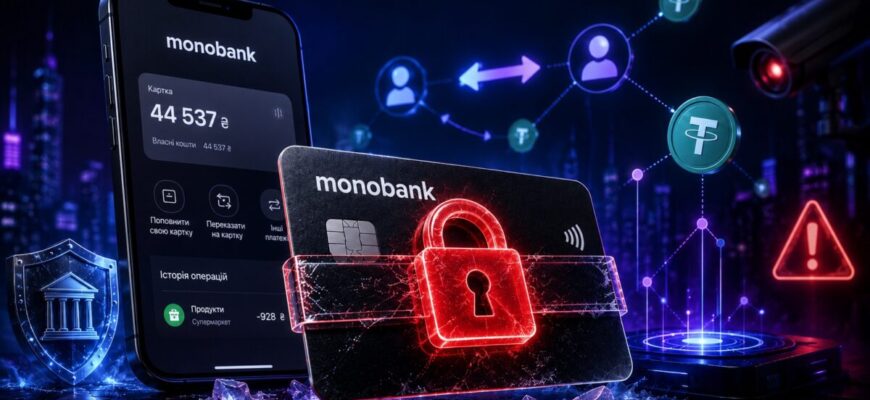
Sold or bought USDT via P2P, and Monobank blocked your card or asked for proof of the source of funds — this is not a dead end and is almost always solvable. The reason is financial monitoring: the bank noticed activity that is unusual for your profile (many P2P transfers from different people, a sharp increase in turnover, signs of crypto exchange activity). What to do: do not panic, do not withdraw the remaining balance in bursts, gather exchange statements and your P2P transaction history, and calmly and honestly explain the source of the money. The main mistakes are lying, using slang (“moved crypto around,” “arbitrage”), and ignoring the request. Below is a step-by-step guide: why cards get blocked, which documents to prepare, how to explain the transfers, what not to write to the bank, and how to reduce the risk in the future.
- Why a bank may block your card after P2P
- Which transactions look suspicious
- A special P2P risk: the “triangle”
- What documents to prepare
- How to explain P2P transfers
- What NOT to write in your reply to the bank
- Timeframes and What Actually Happens
- A Safe Alternative and Prevention
- Taxes and the Status of Crypto in Ukraine (2026)
- FAQ
Why a bank may block your card after P2P
The issue is not that “crypto is banned.” Cryptocurrency is legal in Ukraine as an asset. A block is related to financial monitoring: the bank is required to analyze transactions and make sure the money was obtained legally. This logic is based on several factors:
- Threshold of UAH 400,000. Under Law No. 361-IX (Articles 20–21), transactions totaling UAH 400,000 or more are subject to compulsory financial monitoring with verification of the source of funds. If you withdraw that amount from an exchange in a single transaction, the bank will almost certainly ask for details.
- Risk-based approach below the threshold. Most issues arise precisely with amounts below UAH 400,000. The bank looks not at the amount itself, but at whether it matches your “profile.” Transfers to individuals’ cards exceeding ~UAH 100,000 per month (for standard clients) or ~UAH 50,000 (for higher-risk clients) may already require an explanation.
- Suspicious transactions — no limit. The bank has the right to suspend any transaction that appears unusual, regardless of the amount.
- Unregulated status of crypto. As of mid-2026, there is still no full tax regime for crypto (more on this below), and the bank may classify large-scale P2P transactions as business activity.
Monobank’s official position: the bank has not introduced any new special rules, but it has the right to suspend or block a card after P2P transactions, request proof of the source of funds, and ask about the purpose of transfers. This rule applies to all Ukrainian banks, not just Monobank.
A separate nuance is quasi-cash. Under NBU Resolution No. 18, the purchase of quasi-cash (which also includes cryptocurrency) is allowed only with foreign currency cards and up to the equivalent of UAH 100,000 per month. Exceeding this amount or buying with a hryvnia card is an additional trigger.
Which transactions look suspicious
The bank does not assess your intentions, but the external pattern of transactions. The following most often come under suspicion:
| Indicator | Why it triggers scrutiny |
|---|---|
| Many P2P transfers from different individuals | Looks like transit activity or hidden exchange operations |
| A sharp increase in turnover over a short period | Falls outside the customer’s usual profile |
| Identical amounts, high speed of money movement | A sign of “cycling” funds |
| Incoming payments + quick withdrawal/cash-out | Looks like a money mule scheme |
| Connection with crypto exchanges, P2P, OTC, arbitrage | Higher risk under FATF methodology |
| Several banks used for the same type of transactions | An attempt to spread out the activity |
| No clear income source matching the turnover | The turnover does not align with official income |
⚠️ Splitting amounts does not help — it makes things worse. Trying to break withdrawals into parts to stay below the UAH 400,000 threshold is itself a sign of structuring and increases the risk. Banks deliberately do not disclose exact limits — financial company NovaPay was even fined UAH 90 million for revealing financial monitoring rules.
A special P2P risk: the “triangle”
This is the most unpleasant situation you can end up in, even without breaking any rules. The scheme looks like this: a scammer deceives a victim (for example, under the guise of “investments” or “payment for goods”), but asks them to transfer the money not to the scammer, but to you — the USDT seller on P2P. You receive the payment, release the crypto to the buyer (the scammer), and then the deceived victim goes to the police or the bank and states that the transfer was made under fraudulent influence.
The result: to the bank, you look like the recipient of disputed funds, and your account may be blocked or frozen, even if you were not the organizer of the scheme. How to reduce the risk: trade only on platforms with escrow and counterparty ratings, do not accept payments from third parties (the payer’s name must match the buyer’s name), and keep the correspondence and proof that the crypto was released specifically to that counterparty.
What documents to prepare
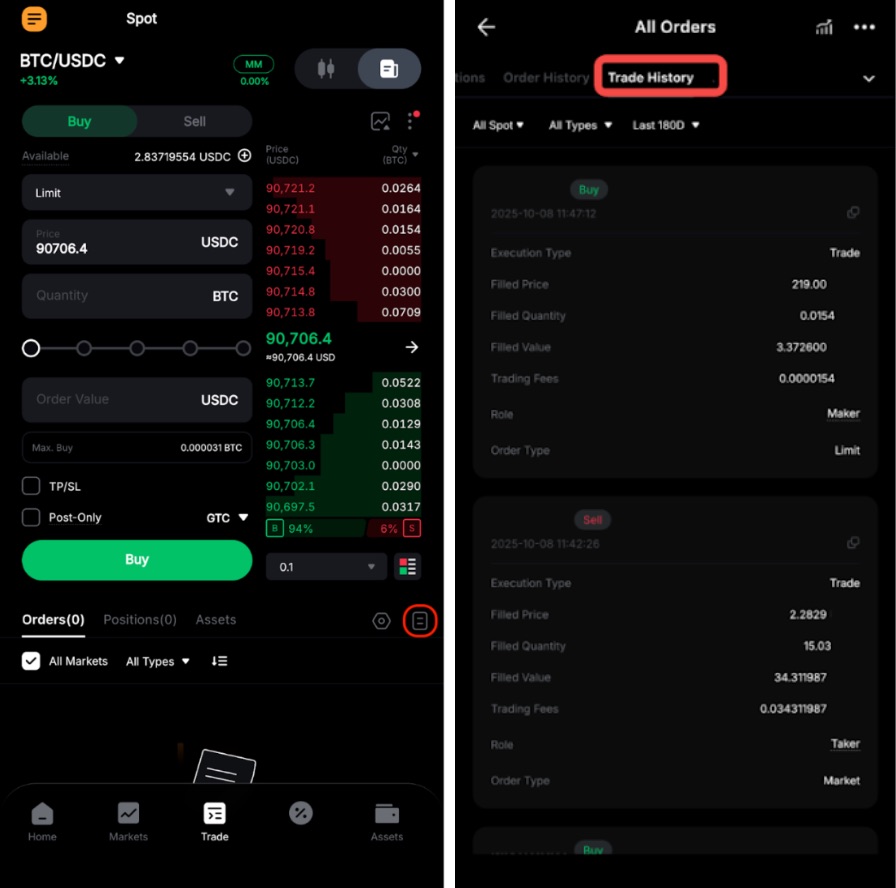
The goal is to show the entire chain: where your cryptocurrency came from and how it turned into hryvnias on your card. Prepare in advance:
- Exchange / P2P platform statement: account profile, verification level (KYC), order history, specific trade — date, amount, exchange rate, status “completed”.
- Counterparty details within the platform interface and correspondence related to the trade.
- Confirmation of crypto release to the buyer (release) and, if available, the transaction hash and wallet address.
- Source of the crypto itself: how you earned it or when you bought it — freelance contract, invoice, earlier purchase statement, deposit screenshot.
- Tax trail, if any: tax return, proof of tax payment.
If the transaction was carried out not through an exchange, but through an exchanger or a private arrangement, the risks are higher. In that case, the agreement, application, receipt/voucher, exchange rate confirmation, wallet address, and hash are especially important.
Useful: according to the Ministry of Finance, it is usually enough to verify the source of funds once — the data is retained, and similar transactions then go through without unnecessary questions, as long as you do not do anything atypical for your profile.
How to explain P2P transfers
A financial monitoring officer is a real person who needs to understand your situation in a couple of minutes. So explain it in simple, plain language and as one logical sequence:
“I am selling my own cryptocurrency (USDT), which I earned/purchased earlier, via P2P on the [name] exchange. The buyer transfers hryvnias to my card, and I transfer USDT to them. I am attaching an exchange statement, transaction history, and correspondence.”
What strengthens your position is consistency (the same information in the support chat, in the email, and in the documents), specificity (dates, amounts, exchange rate), and willingness to come to a branch and show the exchange app login with open orders — real unblocking cases are often built precisely on this.
What NOT to write in your reply to the bank
This is where people lose money more often than on the documents themselves. Don’t do this:
- Do not lie or invent a “convenient” source. False explanations are a separate and far more serious risk than P2P itself.
- Do not use slang: “moved crypto around,” “arbitrage,” “generated volume,” “drop,” “cash-out,” “spun funds.” For a bank, these are risk markers.
- Do not contradict yourself. Vague and changing versions are worse than one honest one.
- Do not admit to something that did not happen. If this is not a regular business, do not call it “entrepreneurship”; if it is regular, it is better to legalize it (sole proprietor/tax declaration) rather than disguise it.
- Do not threaten, pressure, or be rude. Emotions and threats of legal action in the very first message do not speed things up — they slow them down.
- Do not ignore the request or stay silent. Silence is interpreted against you.
Timeframes and What Actually Happens
Based on real cases, financial monitoring lasts from several business days to 180 days — it depends on the bank and the complexity of the case. Possible scenarios include a temporary suspension of transactions pending review, a request for documents, and in the worst case, refusal of service and account closure. If the account is closed, the bank must return the remaining balance, but by transfer to an account at another bank and with accompanying information about the reasons. Since banks exchange data, opening a new account after this may become more difficult — effectively a “blacklist effect.” That is why proper communication at the first suspension is more important than it may seem.
A Safe Alternative and Prevention
It is impossible and unnecessary to completely “bypass” monitoring — it is illegal and works against you. But the risk of suspension can genuinely be reduced:
- A separate card/account for crypto and transaction volumes within a clear profile, without sharp spikes.
- Platforms with KYC and escrow, verified counterparties with ratings; no payments from third parties.
- A “file” for every transaction: order screenshot, correspondence, hash — save everything immediately, not after you have already been blocked.
- Do not split amounts to stay under a threshold — that in itself is a trigger.
- Observe the quasi-cash limit (NBU No. 18) and do not buy crypto with a hryvnia card beyond the rules.
- Declare your income. This removes half of the bank’s questions and prepares you for the new tax regime.
- Preventive communication: if you are planning a large transaction, notify the bank in advance.
- Legal diversification: a European account/IBAN (for example, with services like Wise or Revolut) as an additional channel — but this is not a way to hide money, income still must be declared.
Taxes and the Status of Crypto in Ukraine (2026)
The basic Law “On Virtual Assets” No. 2074-IX was adopted back in 2022, but it has still not come into force — it depends on tax changes. Bill No. 10225-d was adopted as a basis in the first reading on September 3, 2025 (246 votes), but as of mid-2026 it is still being prepared for the second reading — meaning it has not yet become law, and its provisions may change.
What is expected once the law comes into force:
- Cryptocurrency = movable property; not a means of payment (you cannot pay with it in a store; the legal tender is the hryvnia).
- Tax is paid only when converting to fiat, on net profit: 18% personal income tax + 5% military levy = 23%.
- Preferential period: in the first year, for assets purchased before the law enters into force, upon sale you can choose a 5% rate — an incentive to declare assets.
- Sole proprietors under the simplified tax system: transactions with virtual assets are planned to be prohibited — you should not route crypto through a sole proprietor account as “services”.
Until the regime takes effect, the State Tax Service acknowledges that income from selling crypto may be taxable, but there is no full-fledged mechanism yet. Therefore, keep your documents and monitor the adoption of the law.
FAQ
Monobank blocked my card after P2P — is it forever? No. Most often, this is a temporary financial monitoring review. After providing documents on the source of funds, the account is usually unblocked. In the worst-case scenario, the bank closes the account and returns the remaining balance via transfer to another bank.
Why did Monobank block the card specifically because of crypto? Formally, not “because of crypto,” but because of an atypical transaction profile: mass P2P transfers, a sudden spike in turnover, and signs of crypto exchange activity. Crypto only increases the risk assessment under the FATF methodology.
Monobank requested proof of source of funds — what should I send? A statement from the exchange or P2P platform with transaction history, counterparty details, correspondence, proof of the source of the cryptocurrency itself, and a tax trail, if available. Explain the chain clearly in plain language.
What P2P amount is safe? Banks do not disclose exact limits. General benchmarks: up to UAH 400,000 — required source-of-funds verification; problems often arise with smaller amounts as well if the transaction profile is atypical. Splitting amounts is not allowed — that is a separate trigger.
Do you need to pay tax on P2P crypto sales? The special regime (23%, with a reduced 5% rate in the first year) will take effect only after the adoption of Law No. 10225-d. Until then, income may be taxed under the general rules — keep your documents and, if necessary, consult a tax lawyer.