
Monero (XMR) — the main private cryptocurrency in the market. Unlike Bitcoin, where every transaction is visible in the public blockchain forever, Monero by default hides the sender, receiver, and amount. It is the only major coin where privacy is mandatory for all transactions, not optional. In this material — how it works technically, what changed after the FCMP++ update, why exchanges are massively delisting XMR, and what the real picture of legality looks like in 2026.
- In Brief: What is Monero
- How Monero’s Privacy Works
- 1. Ring Signatures — Hides the Sender
- 2. Stealth Addresses — Hides the Receiver
- 3. RingCT — Hides the Amount
- FCMP++: The Main Privacy Update
- Monero Mining
- Tail Emission
- The Qubic Incident (August 2025)
- Price and Market Dynamics
- Delistings: The Main Risk for Monero
- Legal Status: Where It Is Banned
- Can Monero Be Traced?
- Wallets for XMR
- Pros and Cons
- Pros
- Cons
- Who is Monero For
- FAQ
In Brief: What is Monero
| Parameter | Value |
|---|---|
| Ticker | XMR |
| Launch | April 2014 |
| Type | private cryptocurrency (privacy coin) |
| Algorithm | RandomX (Proof-of-Work, ASIC-resistant) |
| Privacy | mandatory for all transactions |
| Emission | infinite (tail emission 0.6 XMR/block) |
| Block time | ~2 minutes |
| All ATH | $517.62 (January 2018) / according to some data up to ~$799 |
| Governance | decentralized, without an issuing company |
Monero originated from the CryptoNote protocol. Initially, 7 developers worked on the project, 5 of whom remained anonymous. The coin has no parent company, no ICO, no premine — it is a completely community-driven project, which distinguishes it from most altcoins.
How Monero’s Privacy Works
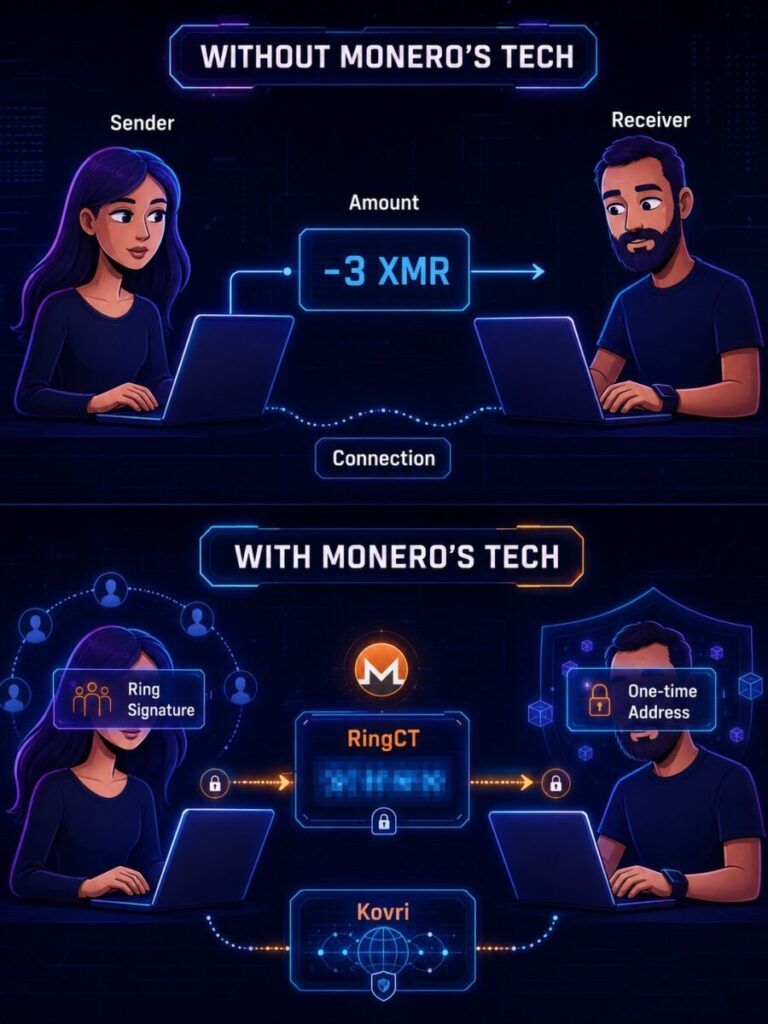
Monero’s privacy is built on three independent technologies that work simultaneously in each transaction. Each one covers its part: who sent, who received, how much.
1. Ring Signatures — Hides the Sender
When you spend coins, your signature is mixed with the signatures of other network participants — “false” outputs (decoys). From the outside, a “ring” of several possible senders is visible, but determining the real one is mathematically impossible.
Since the hard fork in 2022, the ring size is 16 (1 real input + 15 false). This creates “plausible deniability”: any of the 16 could be the sender.
It is important to understand: ring signatures do not make the transaction invisible — they create uncertainty by embedding the real input among the false ones.
2. Stealth Addresses — Hides the Receiver
For each incoming transaction, the sender generates a one-time address. Your public address (which you give to people) never appears in the blockchain. The receiver scans the chain with their view key and finds the funds.
The two-key system:
- View key — allows seeing incoming transactions but not spending. Can be given to an auditor or tax authority.
- Spend key — gives the right to manage the funds.
This solves the problem of address reuse and ensures fungibility: “dirty” coins cannot be marked because the history is not tied to the address.
3. RingCT — Hides the Amount
Ring Confidential Transactions (since 2017) hide the amount of the transfer using Pedersen commitments — a form of homomorphic encryption. The network can verify that the balance matches (input = output + fee) without seeing the actual numbers. The correctness of the range of amounts is confirmed through Bulletproofs — compact zero-knowledge proofs.
FCMP++: The Main Privacy Update
By 2025, ring signatures revealed limitations. A ring of 16 is a relatively small set of anonymity. Analytical firms (Chainalysis, Elliptic) demonstrated ways to statistically narrow down the circle of suspects through timing, correlation of amounts, and known spending patterns.
Full-Chain Membership Proofs (FCMP++) — a fundamental overhaul, not just cosmetic. Instead of a fixed ring of 16 elements, the transaction proves membership to the entire set of unspent outputs in the blockchain — that’s 1.8+ million outputs.
What FCMP++ changes:
- Explosion of the anonymity set — from 16 to the entire chain (1.8M+). Statistical attacks become computationally infeasible.
- Protection against chain analysis — timing, amount, and graph attacks lose effectiveness.
- Future-proofing — as the chain grows, the anonymity set increases. Privacy improves over time, rather than degrading.
- Efficiency — proofs are compact, verification is fast.
By mid-2026, FCMP++ is undergoing beta stressnet testing. Stealth addresses and RingCT are retained — the update specifically enhances the sender’s privacy. After the hard fork, wallets will automatically use the new system, and users will not need to do anything manually.
Monero Mining
Monero uses the RandomX algorithm (since 2019), optimized for regular processors (CPU) and resistant to ASIC miners. This is a conscious decision against centralization: anyone with a regular computer can mine, not just large farms with specialized hardware.
Features:
- Mining on CPU, graphics cards are inefficient
- Profitability mainly depends on electricity costs
- Mining through pools (e.g., P2Pool — decentralized pool)
- Block time ~2 minutes
Tail Emission
After the main emission was exhausted (which occurred in May 2022), Monero switched to “tail emission” — 0.6 XMR per block forever. The logic: a fixed small influx rewards miners and supports network security better than a model that relies entirely on fees. This means that XMR has no hard supply cap, unlike Bitcoin.
The Qubic Incident (August 2025)
In August 2025, the Qubic project attempted to centralize Monero mining, briefly concentrating a significant portion of the hash rate. The network survived this, and the incident sparked discussions about the resilience of PoW. Concurrently, the Fluorine Fermi release came out with critical security updates.
Price and Market Dynamics
This is not an investment recommendation. The figures are provided for context, not as advice to buy. Cryptocurrencies are extremely volatile.
XMR has taken an atypical path for an altcoin. After falling to ~$100 in 2023, the coin remained in the $120–320 range until mid-2025. The $260–300 zone had acted as a ceiling for years.
In the second half of 2025, XMR broke through this resistance on rising volumes and entered a parabolic rise: from $280 to about $500 by the end of the year. By early January 2026, the price was around $447–460 with a market cap of ~$8.2 billion, an annual growth of about 195%.
What drove the price:
- Increased demand for privacy amid heightened surveillance
- Political support for the privacy sector in the US (Congressman Davidson)
- Capital flow from Zcash (ZEC) to XMR after staffing issues in the ZEC team
- Occasional spikes due to laundering (e.g., converting ~$330 million of stolen BTC to XMR in April 2025 resulted in +50% in a day)
By mid-2026, the market was in correction — XMR traded below $400 amid the Fed’s tough rhetoric and overall “Extreme Fear” in crypto.
Delistings: The Main Risk for Monero
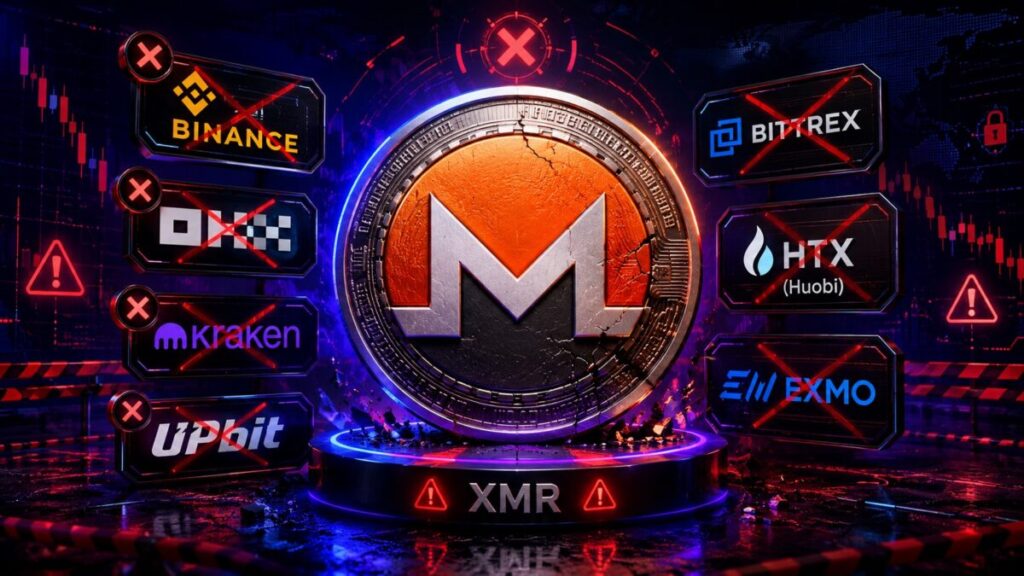
This is a key issue for XMR holders. In 2025, Monero experienced 73 delistings from exchanges (for comparison: 51 in 2023). The reason is pressure from AML regulators, not issues with the coin itself.
Who removed XMR:
- Binance — delisted in February 2024
- Kraken — in the European Economic Area (pressure from MiCA)
- Coinbase — never listed due to the nature of privacy coins
- Poloniex, OKX and dozens of others in various jurisdictions
Where XMR is still traded (as of 2026):
- Centralized: KuCoin, HTX, MEXC and several smaller platforms
- Decentralized: atomic swaps, DEX, cross-chain exchanges without KYC
- TradeOgre — but in 2025, the platform had $40 million in crypto seized by the police (without charges)
An important trend: decentralized and offshore platforms now handle about 40% of the volume of private tokens (up from 18% in 2021). Liquidity has shifted but not disappeared.
Legal Status: Where It Is Banned
The legal status of XMR is fragmented. The coin itself is not banned for ownership in most countries, but its exchange on exchanges is often restricted.
Where privacy coins are banned or heavily restricted:
- Japan — FSA prohibits trading private coins on exchanges
- South Korea — similar ban
- Australia — delistings at the regulator’s request
- UAE (Dubai) — direct ban on the use of Monero
- EU — MiCA and new AML rules effectively ban support for privacy coins by providers from December 2024
- Philippines — BSP banned privacy coins on licensed exchanges from June 2026
An important nuance regarding legal nature: in the US, the CFTC classifies XMR more as a commodity than a security. There are no claims under securities legislation against Monero — exchanges delist it due to AML requirements, not due to its status as a security.
Check the local legislation of your country. In Ukraine, there is no direct ban on owning XMR, but this does not negate the general requirements for declaring and taxing crypto.
Can Monero Be Traced?
At the protocol level — no. The basic privacy of Monero is considered extremely strong, and after FCMP++, it is further enhanced.
However, de-anonymization is possible through user errors (operational security):
- Address reuse
- Tying to a KYC exchange (when XMR arrives at a verified account, the exchange knows your identity — this breaks the chain)
- IP address correlation (solved through Tor)
- Vulnerabilities in third-party wallet software
Law enforcement operates precisely on these points, not by breaking the cryptography. For example, in August 2025, the indictment of British Kai West (IntelBroker) involved XMR transactions — tracked through exchange data and OpSec errors, not directly through the blockchain.
Best privacy practices for 2026:
- Monero GUI with a local node + hardware wallet (Ledger/Trezor)
- Or Feather Wallet through Tor + hardware wallet
- Do not send XMR directly to a KYC exchange tied to your identity
Wallets for XMR
| Wallet | Type | Features |
|---|---|---|
| Monero GUI/CLI | Desktop (official) | Full node or remote, maximum control |
| Feather Wallet | Desktop | Lightweight, built-in Tor, popular among privacy enthusiasts |
| Cake Wallet | Mobile | iOS/Android, user-friendly for beginners |
| Monerujo | Android | Open source, supports hardware wallets |
| Ledger / Trezor | Hardware | Cold storage, compatibility with Ledger fixed in 2026 |
For maximum privacy — a combination of a local node + hardware wallet.
Read also: Cake Wallet: A Detailed Review of the Private Crypto Wallet
Pros and Cons
Pros
- Best privacy among major cryptocurrencies — mandatory and automatic
- Fungibility — no “dirty” and “clean” coins
- Decentralized mining on CPU (RandomX), resistant to ASIC
- No issuing company, no premine, community-driven
- Active development — FCMP++, Seraphis in the roadmap
- Real use case (private payments, jurisdictions with surveillance)
Cons
- Mass delistings — reduce liquidity and availability
- Bans in several countries (Japan, Korea, UAE, EU)
- High volatility
- Reputational risk due to use in illegal operations
- No institutional acceptance
- Infinite emission (though minimal)
- Complexity for beginners (privacy requires understanding of OpSec)
Who is Monero For
Suitable for:
- Those who value financial privacy as a principle
- Users in jurisdictions with strict surveillance or capital control
- Those who understand the risks of delistings and hold XMR in their own wallet
Not suitable for:
- Those who want to easily enter/exit fiat through major regulated exchanges
- Investors who need institutional infrastructure (ETFs, custodians)
- Beginners without the willingness to understand OpSec
FAQ
How does Monero differ from Bitcoin? Bitcoin is a transparent blockchain: all transactions are visible and traceable. Monero by default hides the sender, receiver, and amount. BTC has a hard cap of 21 million, while XMR has infinite tail emission.
How does Monero differ from Zcash? In Zcash, privacy is optional (most transactions are transparent), while in Monero it is mandatory for all. Monero uses ring signatures + FCMP++, Zcash uses zk-SNARK (Halo 2). Supporters of XMR consider Zcash’s “selective transparency” a weakness.
Where to buy XMR in 2026? On the remaining CEX (KuCoin, HTX, MEXC) or through atomic swaps and cross-chain exchanges without KYC. On major regulated exchanges (Binance, Coinbase, Kraken in the EU), XMR is unavailable.
Can a Monero transaction be traced? At the protocol level — no. De-anonymization occurs through user errors: KYC exchanges, address reuse, IP leaks. The cryptography itself has not been broken.
Is it legal to own Monero? In most countries, ownership is legal, but exchange on exchanges is restricted or banned (Japan, Korea, UAE, EU). Check the laws in your jurisdiction.
What is FCMP++? An update replacing ring signatures with proofs of membership to the entire blockchain. It expands the anonymity set from 16 to 1.8M+ outputs. As of mid-2026, it is in the testing phase.
Can Monero be mined on a home PC? Yes. RandomX is optimized for CPU. Profitability depends on electricity costs. Mining is done through pools, including the decentralized P2Pool.