
Your money is not gone. That’s the first thing worth knowing, because most people land on this page with a frozen balance and a sinking feeling.
When Wise account blocked, restricts or deactivates an account, the balance is returned to an external bank account once their checks finish. The account itself usually doesn’t come back. The refund does.
What follows is the process: what to do in the first 24 hours, how to answer a source of funds request without making things worse, realistic timelines, and what to use instead while your money is in transit.
If you only read one thing: if your account still lets you withdraw — withdraw now, before you do anything else. If it’s already deactivated, submit a refund request with external bank details. Appeals can run in parallel.
- What to do in the first 24 hours
- Wise account blocked, restricted or deactivated — what’s the difference
- Why Wise blocks accounts
- What “source of funds” actually means
- Documents Wise asks for
- How to write to Wise (with templates)
- How long the refund really takes
- Alternatives to keep money moving
- How to avoid this next time
- FAQ
What to do in the first 24 hours
Order matters here. Work down this list.
1. Check whether you can still withdraw. Log in. If transfers are still possible, send the balance to your external bank account immediately. A restriction can escalate to full deactivation, and the window closes. Do this before writing to anyone.
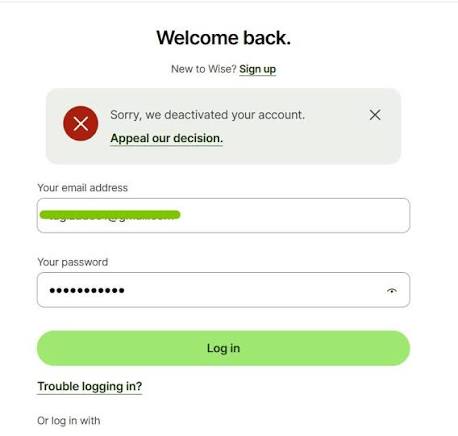
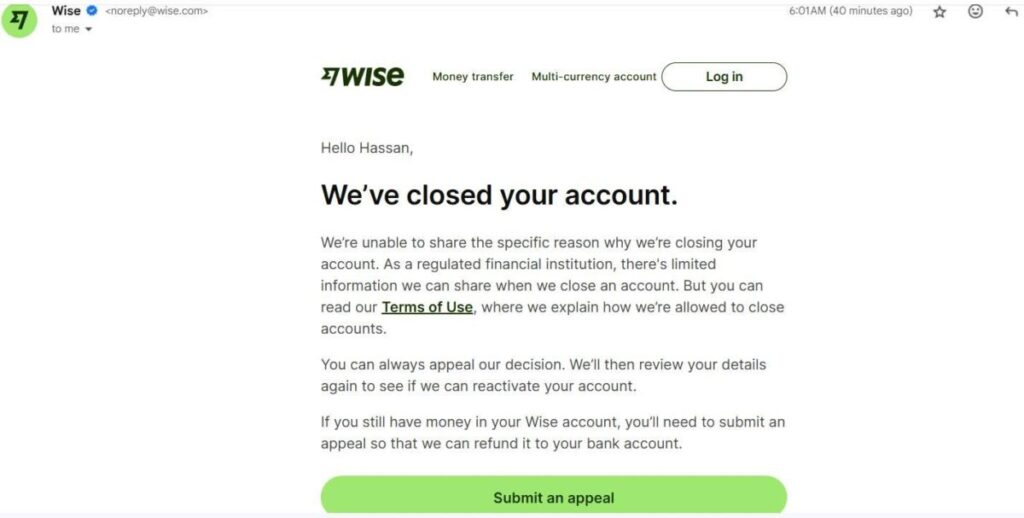
2. Find the actual notification. Check email — including spam — and in-app notifications. Wise’s message contains the specific links you need: usually “Appeal our decision” and “Request a refund”. Don’t rely on the chat widget to reproduce what that email says.
3. Submit the refund request. This is a separate action from an appeal, and it’s the one that moves your money. You’ll need external bank details — an account in your own name, matching the name on your Wise profile. A mismatch stalls everything.
4. File an appeal if you want the account back. Standard requirements: a clear photo of your ID, a selfie holding that ID, and a written explanation of what you used Wise for.
5. Screenshot everything. The notification, the balance, the reference numbers, every chat transcript. If this drags on for months, that record is the only thing you’ll have.
6. Reroute incoming payments. Anything sent to your Wise details after closure bounces back to the sender. Tell clients and networks to pause or redirect before the next payout cycle.
Wise account blocked, restricted or deactivated — what’s the difference
People use these interchangeably, but they mean different things and call for different responses.
| State | What it looks like | What to do |
|---|---|---|
| Restricted / limited | Some actions blocked, often pending a document request | Answer the request fast. Often reversible. |
| Frozen / on hold | A specific transfer or the balance is held during review | Supply the requested proof. Usually resolves. |
| Deactivated / closed | Account closed, no transfers possible | Submit a refund request. Rarely reversed. |
The practical difference: the first two are reviews you can pass. The third is a decision you’re now unwinding. If you’re in the first two, speed and a clean response genuinely change the outcome.
Why Wise blocks accounts
Wise is a licensed electronic money institution, which means it operates under anti-money-laundering obligations that aren’t optional. Accounts get restricted when activity stops matching the profile Wise has of you, or when something breaches their terms.
Crypto-related payments. This is the big one, and it catches people who don’t think of themselves as doing anything unusual. Wise’s Acceptable Use Policy does not permit payments made for the purpose of buying cryptocurrency. Receiving funds from crypto platforms and P2P trades also sits in the risk zone. Full deactivation over this is common, not rare.
Activity that doesn’t fit your profile. A sudden jump in volume, many incoming payments from different individuals, transfers that don’t match your stated purpose. All standard review triggers.
Unclear source of funds. Money arrives and the pattern doesn’t explain itself.
Duplicate accounts. You’re allowed one personal account. A second one flags both.
Association risk. If someone connected to your account turns up in problematic activity, linked accounts can be closed together. This one feels deeply unfair when it happens, and there’s no appeal path that addresses it directly.
Failed or incomplete verification.
One thing to make peace with early: support is not going to tell you the specific reason. They’re legally restricted from doing so in many cases. That isn’t bad service and pushing for an answer wastes days you could spend on the refund.
Worth knowing about the direction of travel: in July 2026 the US Office of the Comptroller of the Currency rejected Wise’s application for a national trust bank charter, citing longstanding deficiencies in its anti-money-laundering programme. Whatever else that means, it doesn’t point toward looser compliance.
What “source of funds” actually means
This phrase confuses people, and answering it badly is how a solvable review turns into a closure.
Source of funds is documented proof of where this specific money came from. It’s not the same as source of wealth, which is about your overall financial position. Wise wants a traceable chain: you earned money doing X, here’s the evidence, that’s how it reached your account.
What counts as proof, by income type:
- Salary — payslips, employment contract, bank statement showing the credits
- Freelance — invoices, contracts, statements from Upwork, Fiverr, Payoneer
- Business — invoices, contracts, company accounts
- Affiliate or ad revenue — network statements, payout reports, platform dashboards
- Asset sale — the sale agreement
- Savings — statements covering the earlier period
The rule that matters: answer honestly and provably. Do not invent a tidier-sounding source. There’s a well-known case of someone describing Stripe payouts as “dividends” — technically wrong, and it accelerated the closure rather than smoothing it over. If the money came from a business, present it as business income. Compliance teams have seen every version of creative labelling, and a mismatch between your story and your documents is worse than an unusual but honest answer.
Documents Wise asks for
| Document | What it proves |
|---|---|
| Photo or scan of your ID (passport, national ID) | Identity |
| Selfie holding your ID | That it’s actually you |
| Written explanation of how you use Wise | The nature of your transfers |
| Source of funds evidence | The money is legitimate |
| Invoices, contracts, statements, payslips | Backs specific incoming payments |
For an appeal specifically, Wise typically wants the first three: a clean ID photo, a selfie with the ID, and a description of your past and intended future use of the account.
Practical notes that save a round trip: photograph the ID flat, in daylight, no glare, all four corners visible. Send exactly what was asked for — a document dump slows the review rather than speeding it up. And make sure the names on every document match your Wise profile exactly.
How to write to Wise (with templates)
Where to send it: the self-service appeal page inside your account (Appeal our decision / Request a refund). If that page won’t load, reply directly to the deactivation email — that thread is already attached to your case.
Tone: calm, short, factual, documents attached. Nothing else lands better.
Template 1 — appeal plus refund request:
Hello,
My account was deactivated on [date]. I would like to appeal this decision and, if the closure stands, request the return of my remaining balance.
How I used Wise: [e.g. receiving payments from clients for marketing services and paying contractors].
Source of funds: [one sentence — e.g. income from freelance marketing work invoiced to clients in the EU and US]. Supporting documents attached.
Attached: photo of my ID, selfie holding my ID, [invoices / contracts / statements].
If the closure is upheld, please return the remaining balance to the following account in my name: [Account holder name / IBAN / BIC / bank name].
Thank you, [Name]
Template 2 — following up when the refund is overdue:
Hello,
Reference: [case or reference number].
My account was deactivated on [date] and I submitted a refund request on [date]. The external account details provided were [last 4 digits / bank name].
It has now been [X] business days. Could you confirm the current status of the refund and whether any further documents are required from me?
Thank you, [Name]
What to avoid. Slang or shorthand from your industry — words like “arbitrage”, “farming”, “flipping crypto” mean something specific and alarming to a compliance reader. Contradicting yourself between chat and email. Threats or legal language in the first message. And silence: an unanswered document request is read as a refusal to cooperate.
An appeal doesn’t guarantee reinstatement. A clean, consistent one does measurably speed up the refund.
How long the refund really takes
Wise returns funds “the way they came in”, once checks are complete. Official guidance by original payment method:
| How the money arrived | Stated refund time |
|---|---|
| Bank transfer / wire | 2–3 business days |
| Card | 3–10 business days |
| Bank debit / ACH (with due diligence) | up to 90 business days |
What actually happens. Where an enhanced review is running, refunds stretch into weeks and sometimes months. Holds of 30–60 days and beyond are reported regularly. If a financial intelligence unit or law enforcement investigation sits behind it, neither Wise nor you controls the timing, and nobody will explain why.
Practical details that trip people up:
- Clear any negative balance first — a refund won’t process over one.
- Currencies Wise can’t send may be converted before the payout.
- Money sent to you after closure bounces back to the sender automatically — warn your clients and networks.
- The receiving account must be in your name. Sending to a company account when your Wise profile is personal (or the reverse) creates a mismatch that restarts the clock.
If a large sum has been sitting well past any reasonable window and the review is formally closed, a formal letter from a solicitor sometimes moves things. If an investigation is active, it will not.
Alternatives to keep money moving
While your balance is in limbo, the bills don’t pause. The point of this section isn’t “Wise is bad” — it’s that a single payment rail is a single point of failure, and you’ve just learned that the expensive way.
| Service | Best for | Strengths | Watch |
|---|---|---|---|
| Payoneer | Freelancers, e-commerce, affiliates | Native integration with Upwork, Fiverr, Amazon and many networks | Higher conversion fees |
| Revolut Business | EU/UK-based businesses | Multi-currency, fast onboarding, good app | Onboarding restricted in some countries |
| Paysera (LT) | Individuals and small business | EU IBAN, cheap SEPA, accessible onboarding | Business checks as volume grows |
| Zen.com / Verifo (LT) | Personal and business | EU IBAN, flexible onboarding | Younger EMIs — check limits |
| Bunq (EU) | EU residents | Multi-currency, solid IBAN | EU residency required |
| Stablecoin accounts | Cross-border earners | Fast settlement, USD-denominated | Custody and platform risk — see our KAST review |
One thing worth being clear about: none of these EMIs welcome crypto purchases through their accounts either. The rules are broadly the same as Wise’s. If crypto is part of your flow, use a dedicated regulated on/off-ramp and keep that activity separate from your main payment rail.
How to avoid this next time
- Keep a second receiving account live and funded. Not as a backup plan — as normal infrastructure. You want to redirect a payout tomorrow, not in three weeks.
- Don’t store money on Wise. It’s built for payment flow, not balances. Large static holdings raise review risk on their own. Reserves belong in a bank.
- Keep your stated profile accurate. If what you told Wise at signup no longer matches what your account does, update it before their risk model notices for you.
- File documents before you need them. Invoices, contracts, network statements, a working website. When a request arrives you have days, not weeks.
- Answer requests the same day, with exactly what was asked.
- Never route crypto purchases through Wise. It’s the most common cause of outright closure and there’s no appeal that fixes it.
- Scale gradually. A tenfold jump in volume in one month is a trigger even when every transaction is legitimate.
For the full picture on running a business account without tripping these systems, see our Wise Business review.
FAQ
Wise deactivated my account — what do I do first? Check the email and in-app notification for the appeal and refund links. If you can still withdraw, do that immediately. If not, submit a refund request with external bank details in your own name, and file an appeal separately if you want the account back.
Will I get my money back if Wise closed my account? Yes — the remaining balance is returned to an external account after checks are completed, even when the closure was for a terms breach. The account itself is rarely reinstated.
How long does Wise take to return money after closing an account? Officially 2–3 business days for bank transfers, 3–10 for card payments, and up to 90 business days where enhanced due diligence applies. In practice, enhanced reviews often run for weeks.
What is source of funds in Wise? Documented proof of where this specific money came from — salary, freelance work, business income, affiliate payouts, an asset sale or savings — evidenced with payslips, invoices, contracts or statements. Answer honestly and provably.
Wise is asking for documents — what should I send? Usually a photo of your ID, a selfie holding it, a written explanation of how you use the account, and evidence for the specific payments in question. Send exactly what was requested, nothing more.
Why did Wise block my account for crypto? Payments made for the purpose of buying cryptocurrency are not permitted under Wise’s Acceptable Use Policy. Receiving from crypto platforms and P2P trades also carries risk. This is one of the most common causes of full deactivation.
Can I open a new Wise account after being closed? Generally no. Opening a second account after a closure typically results in that one being closed too, and it can complicate the refund of your original balance.
Will Wise tell me why my account was closed? No. Support is legally restricted from disclosing the specific reason in many cases. Pressing for it delays the part you can actually influence — the refund.
Does appealing actually work? Reinstatement is uncommon, especially for terms breaches. But a clear, consistent appeal with the right documents measurably speeds up the return of your balance, which is usually the outcome that matters.