
Most Wise Business reviews are written by people who have never had an account frozen. This one isn’t.
Wise is the default recommendation for anyone getting paid across borders — affiliate networks, agencies, freelance clients. The mid-market rate is real, the fees are genuinely low, and getting local account details in 20+ currencies solves a problem that traditional banks charge a fortune for. All true.
What those reviews skip: Wise is an aggressive compliance operation, and the payment patterns typical of affiliate marketing — irregular income, multiple networks, sudden volume spikes, new counterparties in unfamiliar jurisdictions — look exactly like what their risk models are built to flag. I found that out the hard way.
Short version: Use Wise Business as a transit account for receiving and converting payouts. Don’t use it as a place to keep money. And have a second account ready before you need it.
What changed in 2026
If you’re reading a review from last year, a good chunk of it is out of date.
The plans split (26 November 2025). Wise Business is now two products: free Essential and paid Advanced. The catch is significant — on Essential you cannot receive money. No account details, no direct debit, none of the “getting paid” functionality. For anyone whose entire use case is receiving affiliate payouts, the free plan is useless. Advanced isn’t optional, it’s the product.
Wise was refused a US banking licence (July 2026). The Office of the Comptroller of the Currency rejected Wise’s application for a national trust bank charter, citing longstanding deficiencies in its US anti-money-laundering programme. Read that as a forward signal: Wise’s compliance is getting tighter, not looser. Anyone hoping the reviews and freezes would ease off should plan for the opposite.
Cards aren’t available everywhere. As of 2026, business debit cards are not available for US-registered businesses or Hong Kong. If a card for team spend was part of your plan, check your specific jurisdiction before you open anything.
What Wise Business actually is
Wise Business is not a bank. It’s a licensed electronic money institution — FCA-regulated in the UK under the Electronic Money Regulations, registered with FinCEN in the US. Your money is protected by safeguarding (client funds held separately from company funds), not by deposit insurance like FSCS or FDIC.
That distinction matters more than it sounds. Safeguarding protects you if Wise goes under. It does nothing for you if Wise Business decides to freeze your account while they review it — and that’s the scenario affiliates actually run into.
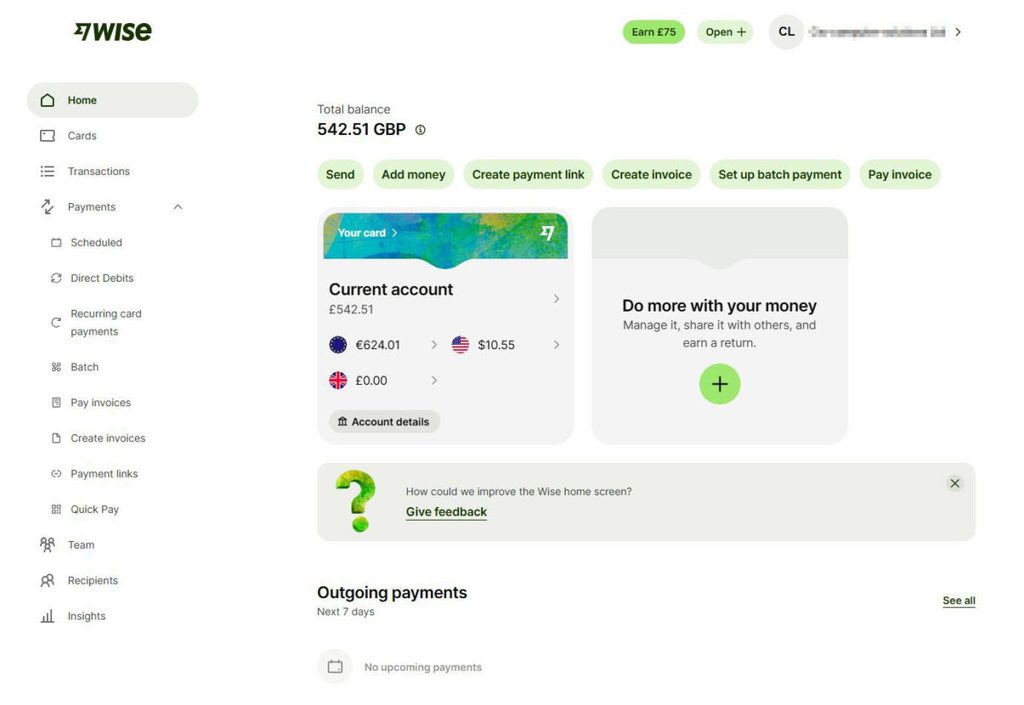
What you get: hold 40+ currencies, receive in 20+ via local account details, convert at the mid-market rate, issue cards (region depending), send batch payments to up to 1,000 recipients from a CSV, and sync with Xero or QuickBooks.
The Essential vs Advanced trap
| Essential | Advanced | |
|---|---|---|
| Cost | Free | £50 UK / $31 US, one-time |
| Hold currencies | 40+ | 40+ |
| Send payments | Yes | Yes |
| Receive payments | No | Yes — details in 20+ currencies |
| Direct debit | No | Yes |
| Batch payments | Yes | Yes |
Treat Wise Business as a £50 one-off cost and move on. If you plan to get paid into it — and you do, that’s the point — Essential doesn’t do the job.
Real fees, with numbers
This is where Wise earns its reputation. The fee is shown before you confirm, and there’s no markup buried in the exchange rate.
- Currency conversion: from 0.33%. Wise’s average fee across all transactions runs around 0.53%.
- Incoming SWIFT: from roughly $6 per transfer. Incoming to local account details: free — which is the entire point of paying for Advanced.
- ATM (US): free up to $250/month, then $1.95 + 1.95%.
- Monthly fee: none, on any plan.
On a $5,000 transfer, Wise Business typically saves $150–260 against a bank wire with an FX markup, and a similar margin against PayPal. If you’re receiving five-figure monthly payouts, the £50 setup pays for itself in the first week.
Why it fits affiliate payouts
Four things make Wise Business genuinely good for this line of work:
Local account details. Give a US network a USD routing number, a European one an IBAN, a UK one a sort code. You get paid as a local — no intermediary fees, no week-long SWIFT waits.
Mid-market conversion. Networks pay in USD, you spend in EUR or your local currency. Converting at 0.33% instead of a bank’s 2–3% spread is real money at volume.
Batch payments. If you’re paying a team — media buyers, designers, content writers — a CSV of up to 1,000 recipients goes out in one action.
Multi-currency balances. Hold USD from networks and EUR for ad spend without converting back and forth every cycle.
Why affiliates get flagged
Here’s the part no other review will tell you plainly: the normal shape of affiliate income looks suspicious to an automated risk model.
Think about what your account activity looks like from the outside. Income arrives irregularly — nothing for two weeks, then a large payout. It comes from multiple counterparties you’ve never transacted with before. Volumes jump when a campaign scales. Money moves out quickly to ad platforms and contractors. Some of your counterparties are registered in jurisdictions that score poorly on risk models.
Every one of those is a documented review trigger. None of them means you did anything wrong.
Specific things to avoid:
Don’t let large balances sit. Wise is built for payment flow, not storage. A big static balance raises review risk on its own. Keep your reserve in a traditional bank.
Don’t split payments to stay under a threshold. This is the single worst move. Deliberately breaking up a payment is textbook structuring and attracts far more scrutiny than the original amount would have.
Expect the first big payout to be delayed. Any payment well outside your normal pattern will likely trigger a source-of-funds request. Don’t schedule it against a deadline.
Never use Wise Business to buy crypto. Payments made for the purpose of purchasing cryptocurrency are explicitly prohibited under Wise’s Acceptable Use Policy, and it’s one of the most common reasons accounts get closed outright. If part of your flow touches crypto, route it somewhere else entirely.
Keep your stated profile honest. If you registered as “marketing consulting” and your account receives from twelve affiliate networks, that mismatch is the first thing a reviewer notices.
Opening an account: steps and documents
Registration takes 15–20 minutes: pick Business, find your company in the registry, fill in your business profile and trading address, list directors and anyone owning 25%+, verify yourself with ID and a selfie, upload company documents, pay for Advanced.
Verification is the slow part: 1–3 working days for a simple structure, up to 10 for anything with multiple directors or higher-risk jurisdictions.
Documents you’ll need:
- Certificate of incorporation or registry extract
- Proof of ownership structure (shareholder register, articles, partnership agreement)
- ID for directors, 25%+ owners, and the account admin
- Proof of registered address
- Proof of trading address, if different from the registered one
That last one is where remote founders get stuck, and it deserves a warning. Wise Business wants a utility bill or bank statement in the company’s name, dated within three months. A personal bill in your own name does not verify the company — it gets rejected. If your company is registered at an agent’s address while you work from another country, sort this document out in advance. There’s nowhere to find it once the request lands.
Inside the account
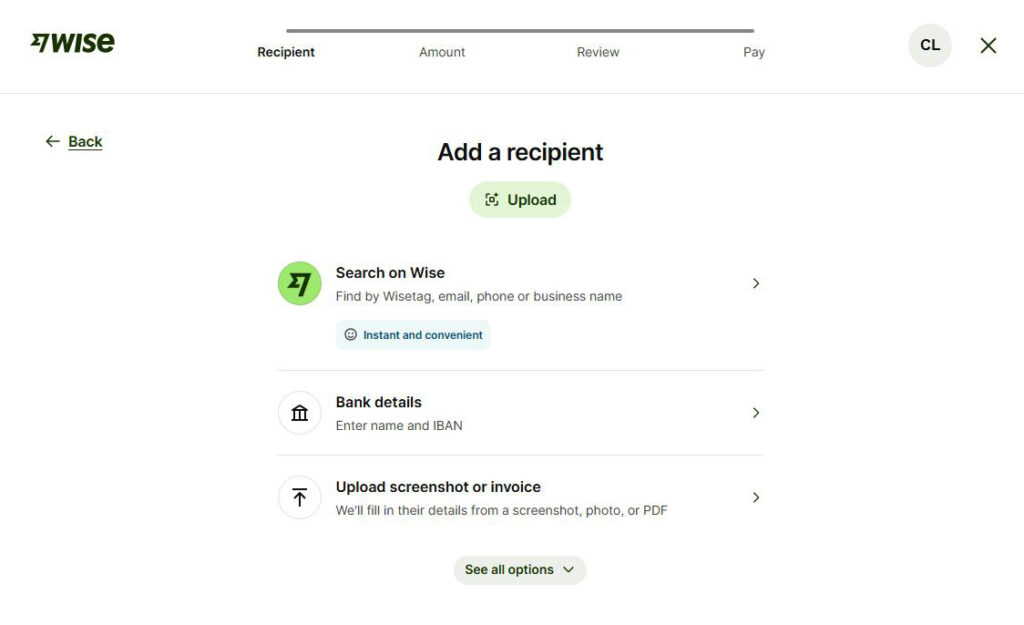
Sending. Four steps: recipient, amount, review, pay. You can find recipients by Wisetag or email, enter bank details manually, or upload a screenshot of an invoice and let Wise parse it. Europe needs a name and IBAN; elsewhere the fields change by country.
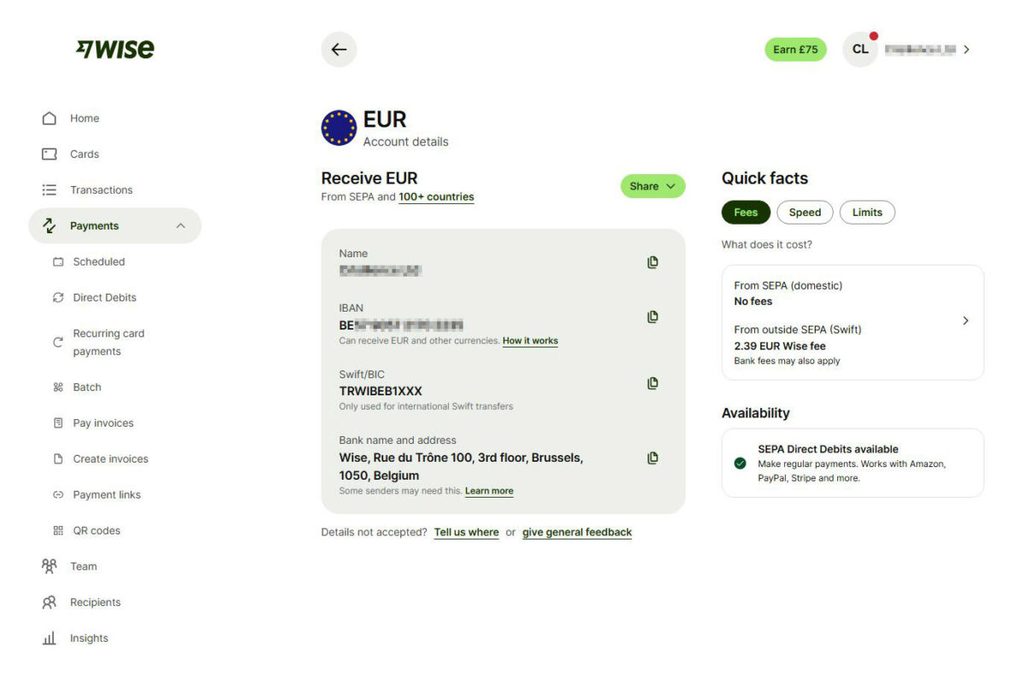
Receiving. Advanced unlocks your own local details per currency. This is the feature you’re paying for and the one that makes affiliate payouts cheap.
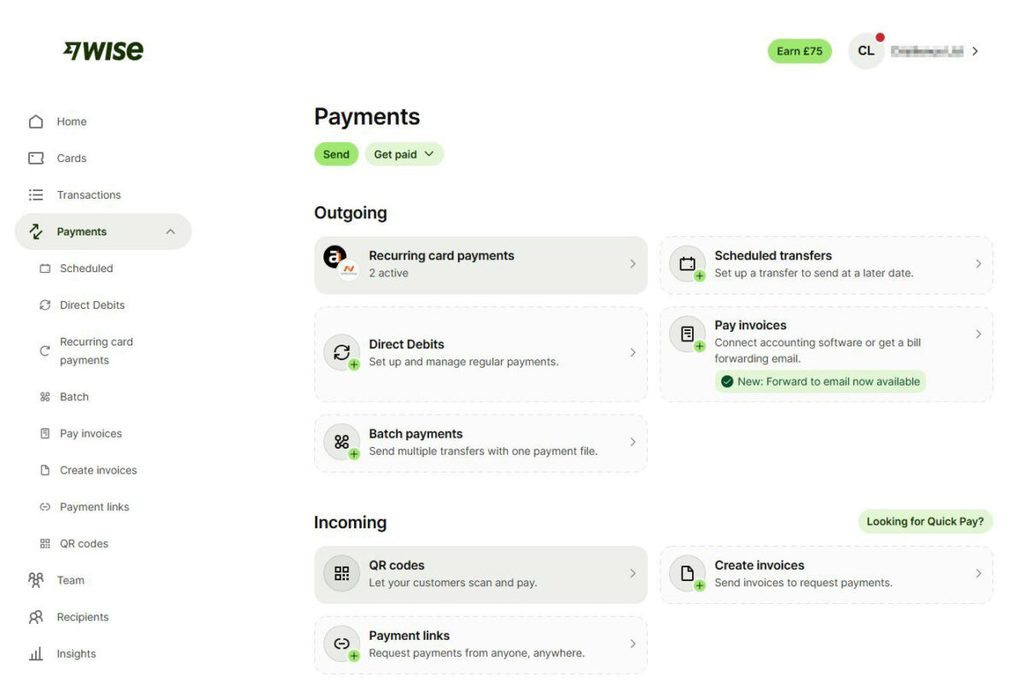
Payments hub. Invoices, batch payments from CSV, payment links, QR codes, recurring debits.
Team access. Add people with different permission levels and payment approvals. Note that every team member goes through their own identity verification — budget time for it.
How to respond to an AML request
If you get a documents request, how you handle the first 48 hours matters.
Only respond to official requests — an email from the wise.com domain or a request inside the app. Wise explicitly warns against sending documents that weren’t requested through those channels. Phishing around account-freeze panic is a real and active scam.
Send exactly what’s asked for. Not everything you have. A focused response processes faster; a document dump slows the review down.
Explain in plain language — what the payment was, where the money came from, who the counterparty is. Compliance reviewers are not trying to decode your business model.
Don’t wait. Every day you delay is a day the restriction stays on.
| What they ask for | What to have ready |
|---|---|
| Company registration | Current registry extract |
| Beneficial owner ID | Passport/ID, clean photo |
| Source of funds | Statement showing where the money came from |
| Proof of business activity | Live website, LinkedIn, social profiles |
| Invoices or contracts | The document matching that exact payment |
| Trading address | Utility bill or statement in the company’s name, under 3 months old |
Alternatives worth having
The real lesson isn’t “don’t use Wise.” It’s don’t have a single point of failure in how you get paid.
Affiliate income is lumpy, international, and compliance-sensitive by nature. Having one account means one frozen review can stop your cash flow entirely while ad spend keeps burning.
What to run alongside:
- A traditional bank account — for reserves and for when something freezes.
- A second fintech with receiving details — so you can redirect a payout tomorrow, not next month.
- A stablecoin rail for networks that pay in crypto — see our KAST review — with clear eyes about its own risks.
FAQ
Is Wise Business good for affiliate marketers? Yes, with a caveat. The local account details and mid-market conversion make receiving network payouts genuinely cheap. But affiliate income patterns trigger compliance reviews more often than salaried income does, so treat it as a transit account and keep a backup.
Is Wise Business a bank? No. It’s a licensed electronic money institution. Funds are safeguarded, not covered by FSCS or FDIC. No credit, overdraft, or cash handling.
How much does Wise Business cost? No monthly fee. Essential is free but can’t receive payments. Advanced costs £50 (UK) or $31 (US) one-time and unlocks receiving. Conversion from 0.33%.
Why did Wise Business freeze my account? Common triggers: a sudden jump in volume, payments that don’t match your stated business profile, new counterparties or jurisdictions, large static balances, or anything connected to buying cryptocurrency, which is prohibited.
How long does Wise take to return money after closing an account? It varies by case and depends on whether the review is complete and your external account details are confirmed. See our account-frozen guide for the process.
Can I buy crypto with Wise Business? No. Payments for the purpose of buying cryptocurrency are explicitly prohibited under the Acceptable Use Policy and are a frequent cause of account closure.
Does Wise Business give you a card? Depends on your country of registration. As of 2026, business cards are not available for US or Hong Kong registered companies.
Wise Business vs Payoneer for affiliates? Wise wins on conversion cost and transparency. Payoneer has deeper native integration with some networks and marketplaces. Plenty of affiliates run both — which is also the right answer from a redundancy standpoint.
Last updated: [19 september 2026] · Fees and plan details verified against Wise’s official pricing pages. Informational only, not financial advice — confirm current terms at wise.com before making decisions.