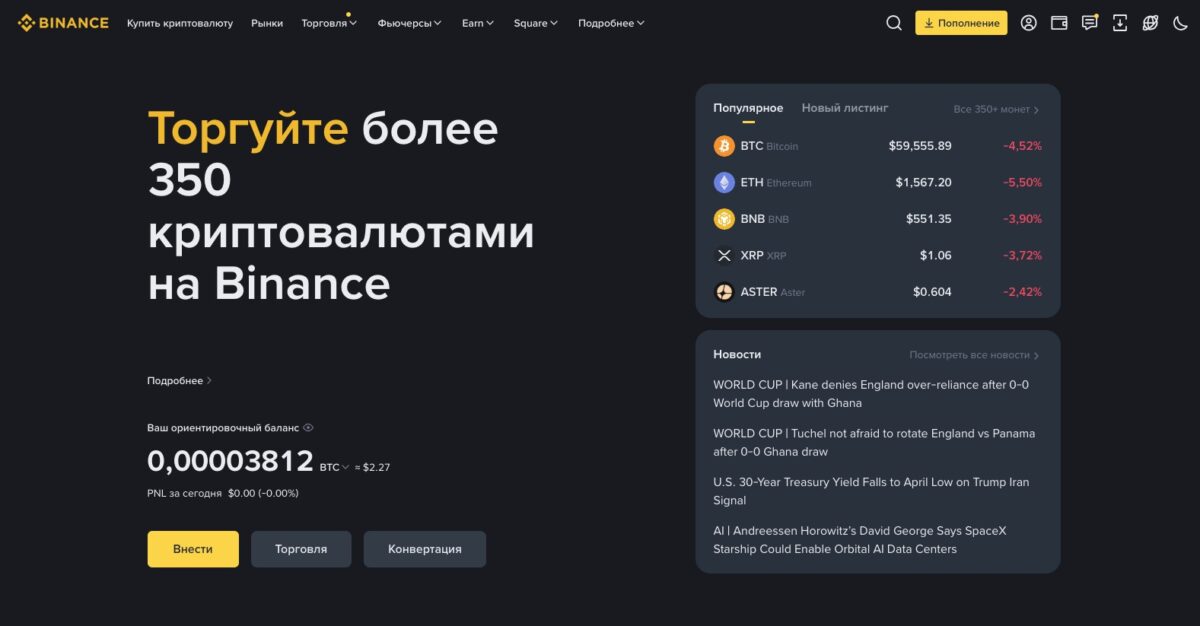
Crypto exchange Binance is the world’s largest exchange by trading volume and number of users (275+ million across 180+ countries), founded in 2017 by Changpeng Zhao (CZ). It is the “#1 exchange” by liquidity: daily volume exceeds $200 billion, with minimal slippage even on large trades. It offers everything: spot (~500-600 coins, 1,500+ pairs), futures with leverage up to 125x, options, margin, P2P (100+ payment methods, often 0%), copy trading, Earn, Launchpad, a Web3 wallet, and a card. Fees are among the lowest: spot 0.1% (0.075% with BNB), futures 0.02%/0.05%.
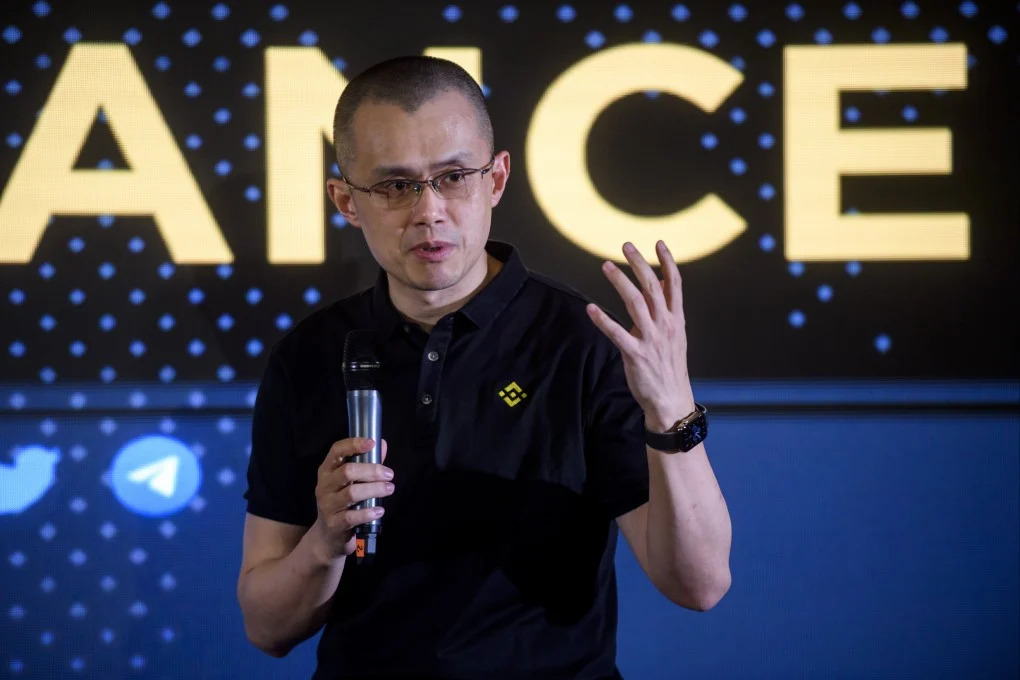
But its reputation is controversial: in November 2023, Binance paid a record $4.3 billion fine to the U.S. Department of Justice, founder CZ pleaded guilty to AML violations and served time in prison (pardoned by Trump in October 2025). The exchange is now led by former regulator Richard Teng, and the company has made compliance its priority.
Disclaimer: This material is for informational purposes only and does not constitute financial advice. Cryptocurrency trading, especially leveraged derivatives, is a high-risk activity, and you may lose your entire deposit. Terms, fees, and service availability may change — please verify the latest information on the official Binance website.
- What’s Important to Know About Binance in 2026
- What Is Binance
- A Brief History
- What the Binance crypto exchange offers
- Two app modes
- Who Is the Binance Exchange Suitable For
- Who is NOT suited for it
- KYC Registration
- Step 1: Creating an account
- Step 2: Security Setup
- Step 3: KYC Verification
- Buy Crypto with a Card
- How to Buy Crypto with a Card (Step by Step)
- Important nuances of buying with a card
- Deposits via SEPA (for the EEA)
- P2P
- How P2P works
- Advantages of P2P
- Spot Trading
- How to Trade on the Spot Market
- The Liquidity Advantage
- Futures
- A Warning First
- Binance Contract Types
- How to Trade Futures (Step by Step)
- Key Concepts
- Key Features
- Unmatched liquidity
- Binance Alpha
- Launchpad and Launchpool
- Simple Earn and broad passive income options
- BNB ecosystem
- Binance Academy
- Binance Card and Binance Pay
- Fees
- Trading fees
- Deposit/withdrawal fees
- Security
- Security Measures
- What the user should do
- KYC AML
- What AML checks
- What may raise questions
- How to protect yourself
- Dark Pages
- $4.3 Billion Fine and CZ’s Prison Sentence (2023)
- New allegations in 2026
- An “ugly story” for Ukrainians: card withdrawals suspended
- Binance Ukraine
- Does the Binance exchange operate in Ukraine
- How Ukrainians Can Withdraw Funds in 2026
- Comparison
- Brief conclusion
- Risks
- How to minimize risks
- Frequently Asked Questions (FAQ)
- What is the Binance exchange, and is it safe?
- How do I register on Binance?
- How to buy cryptocurrency on Binance with a card?
- What are the fees on Binance?
- How to trade futures on Binance?
- Does the Binance exchange operate in Ukraine?
- Why was Binance fined $4.3 billion?
- Who currently runs Binance?
- Crypto exchange Binance or Bybit — which is better?
- Is it safe to store crypto on Binance?
- What is the SAFU fund?
- What is BNB and what is it used for?
- Can you trade on Binance without verification?
- Conclusion
What’s Important to Know About Binance in 2026
- Founded in 2017 by Changpeng Zhao (CZ) and Yi He, the world’s largest exchange
- 275+ million users across 180+ countries
- Deepest liquidity — daily volume exceeds $200 billion, with minimal slippage
- Spot — ~500-600 coins, 1,500+ trading pairs
- Futures — 460+ markets, leverage up to 125x, options, margin
- Low fees: spot 0.1% (0.075% with BNB), futures 0.02%/0.05%
- P2P — 100+ payment methods, often 0% fees
- CEO — Richard Teng (former financial regulator), focused on compliance
- Security: SAFU fund ($1+ billion), Proof of Reserves, 2FA
- $4.3 billion fine paid to the U.S. Department of Justice (2023), CZ pleaded guilty and served time
- Restrictions: U.S. (Binance.US only), UK, Canada, and others
- December 2025 — withdrawals to Ukrainian bank cards suspended
Binance is the benchmark of the crypto market in terms of liquidity and product breadth. But it is also the exchange with the most high-profile regulatory history in the industry. After settling with the U.S., it radically overhauled its compliance framework — becoming more “boring,” but more transparent. This review covers both its strengths and its darker chapters.
What Is Binance
Binance is the world’s largest centralized cryptocurrency exchange (CEX). Within six months of its launch in 2017, it became No. 1 by trading volume and has maintained its leadership ever since.
A Brief History
- 2017 — founded (Changpeng Zhao “CZ” and Yi He), originally in China
- Within 6 months — the world’s largest exchange by trading volume
- 2023 — record $4.3 billion fine paid to the U.S. Department of Justice, leadership change
- Since November 2023 — CEO Richard Teng (former regulator)
- 2026 — 275+ million users, 180+ countries, MiCA application in Greece
What the Binance crypto exchange offers
It is an “all-in-one” solution — the broadest ecosystem in the industry:
- Spot — ~500-600 coins, 1500+ pairs
- Futures — 460+ markets, leverage up to 125x
- Options and margin trading (up to 10x cross)
- P2P — 100+ payment methods, 50+ currencies
- Copy trading — copy traders’ positions
- Trading bots (Grid, DCA, arbitrage)
- Simple Earn — flexible and fixed staking for 100+ coins
- Launchpad / Launchpool — early access to new tokens
- Binance Alpha — a platform for early-stage crypto projects
- Binance Card, Binance Pay, Web3 Wallet
- NFT marketplace and Binance Academy (education)
- Convert — simple exchange without a trading terminal
Two app modes
- Lite — simplified mode for beginners (buy/sell)
- Pro — advanced mode with charts, indicators, and all order types
Who Is the Binance Exchange Suitable For
✅ Those who need maximum liquidity — minimal slippage
✅ Active traders — the widest selection of instruments
✅ Altcoin enthusiasts — a huge selection + Launchpad + Alpha
✅ Beginners — Lite mode, Binance Academy, copy trading
Who is NOT suited for it
❌ US residents (only the stripped-down Binance.US is available), the UK, Canada and others
❌ Anyone for whom a spotless reputation is critical (see Dark Pages)
❌ Anyone who wants fully non-custodial storage
KYC Registration
Let’s go through the registration process step by step.
Step 1: Creating an account
- Go to the official website binance.com (check the URL — there is a lot of phishing!) or download the app from the App Store / Google Play
- Click Sign Up / Registration
- Register using email or a phone number
- Create a strong password
- Verify your account with the code from the email/SMS
Step 2: Security Setup
Immediately after registration:
- Enable 2FA via Google Authenticator or Binance/Passkey (not just SMS!)
- Set up an anti-phishing code for emails
- Enable an address whitelist for withdrawals
Step 3: KYC Verification
Without KYC, functionality is severely limited. Verification is required for trading, fiat operations, P2P and the card.
What you’ll need:
- Photo of the document (passport, ID card, driver’s license)
- Live selfie (liveness check)
- Sometimes — proof of address for higher limits
Time: usually a few minutes, sometimes up to 24 hours or more.
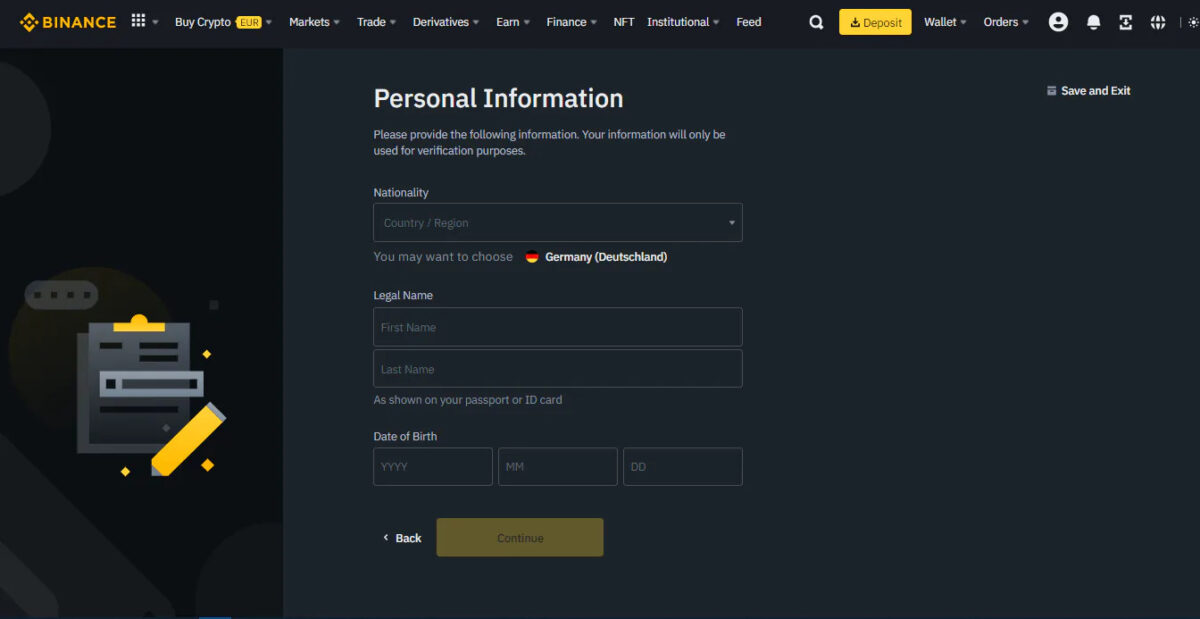
⚠️ Important: documents from prohibited countries (USA, UK, etc.) are not accepted. Enter your details exactly as they appear in your passport.
How biometric verification works is explained in our article KYC and Biometrics.
Buy Crypto with a Card
The easiest option for a beginner is the Buy Crypto section.
How to Buy Crypto with a Card (Step by Step)
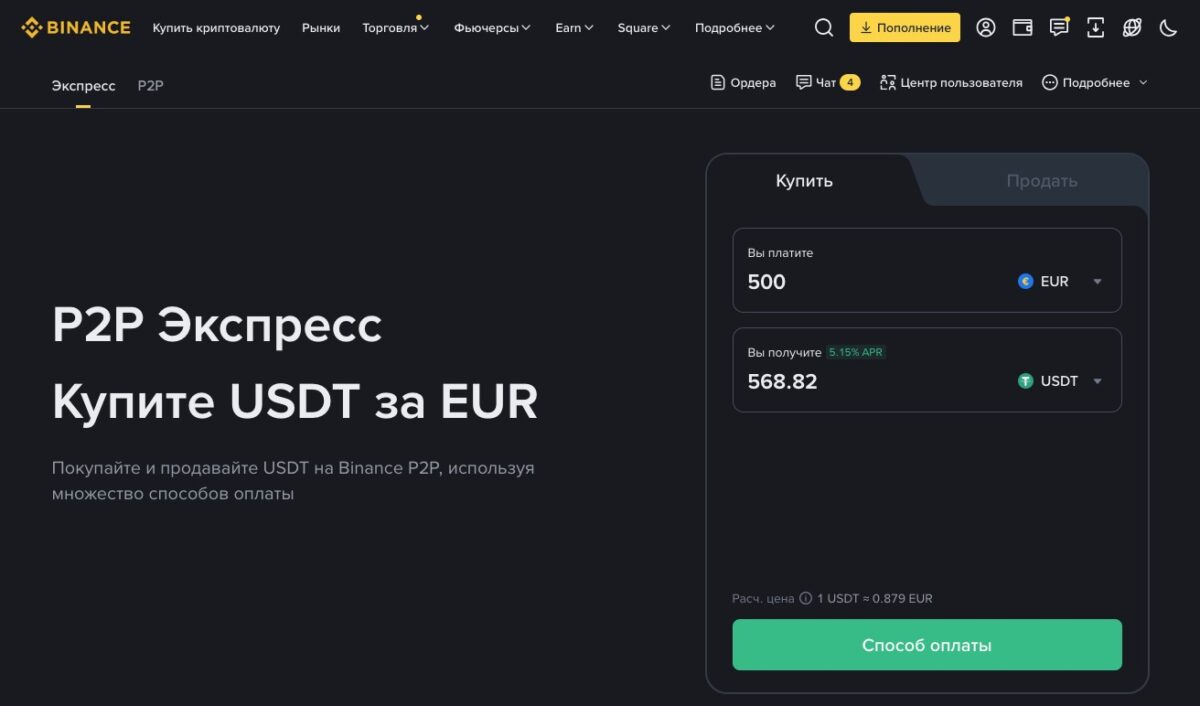
- Click Buy Crypto → Card (bank card)
- Select the currency (USD, EUR, etc.) and amount
- Select the cryptocurrency (USDT, BTC, ETH…)
- Enter your Visa/Mastercard card details (or Apple Pay / Google Pay)
- Check the final amount including the fee (visible before confirmation)
- Confirm — the crypto will be credited to your spot wallet
Important nuances of buying with a card
- Card purchases usually cost ~2% (depending on the country, currency, and provider)
- Funds are usually credited instantly
- Method availability depends on the country
- There is a simple Convert feature — fiat/crypto exchange without a trading terminal
Tip: card payments are convenient, but expensive (~2%). For large amounts, P2P (often 0%) or a SEPA deposit (free in the EEA) followed by a spot purchase is cheaper.
Deposits via SEPA (for the EEA)
In Europe, free euro deposits/withdrawals via SEPA are available. Funds are usually credited the same day or within 1–2 business days. Learn more about SEPA in our guide.
P2P
Binance P2P marketplace is the largest in the world and is often the most cost-effective way to deposit/withdraw local currency (including hryvnia).
How P2P works
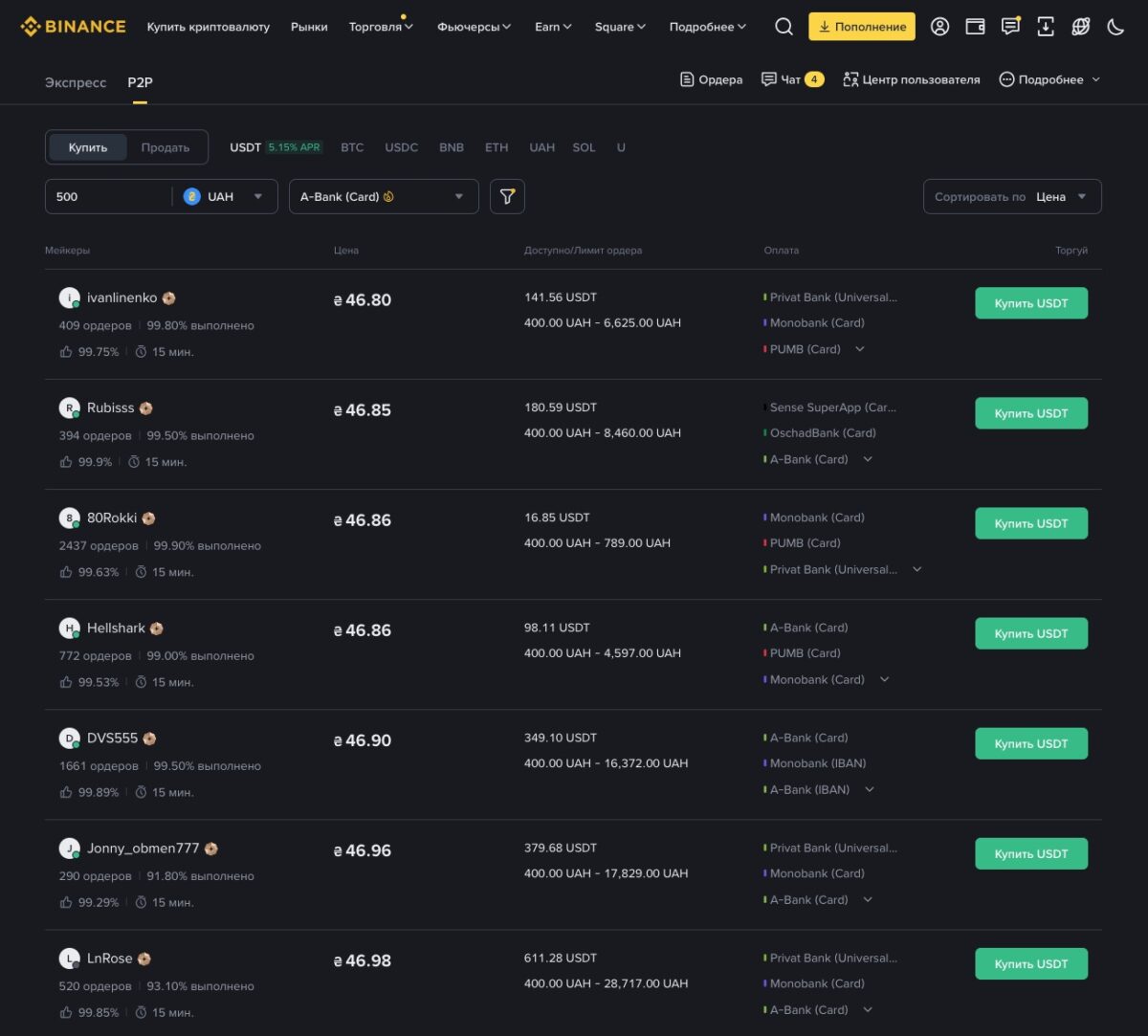
- Go to the P2P Trading section
- Select Buy or Sell, the fiat currency, and the cryptocurrency (usually USDT)
- Choose an offer (check the exchange rate, limits, and seller rating)
- Pay using a convenient method (bank card, etc. — 100+ methods)
- The crypto exchange Binance holds the crypto in escrow until payment is confirmed
- After confirmation, the crypto is credited
Advantages of P2P
- Often 0% fees
- 50+ currencies, 100+ payment methods — the largest P2P platform in crypto
- Escrow protection — the Binance exchange guarantees the transaction
- Convenient for the hryvnia (especially after card withdrawals were suspended — see below)
Be careful with P2P: check the counterparty’s rating, do not confirm receipt until the funds have actually been credited, and beware of chargebacks. An erroneous complaint from the counterparty may lead to a temporary freeze.
Spot Trading
Spot is the buying/selling of actual cryptocurrency without leverage. The safest option for beginners.
How to Trade on the Spot Market
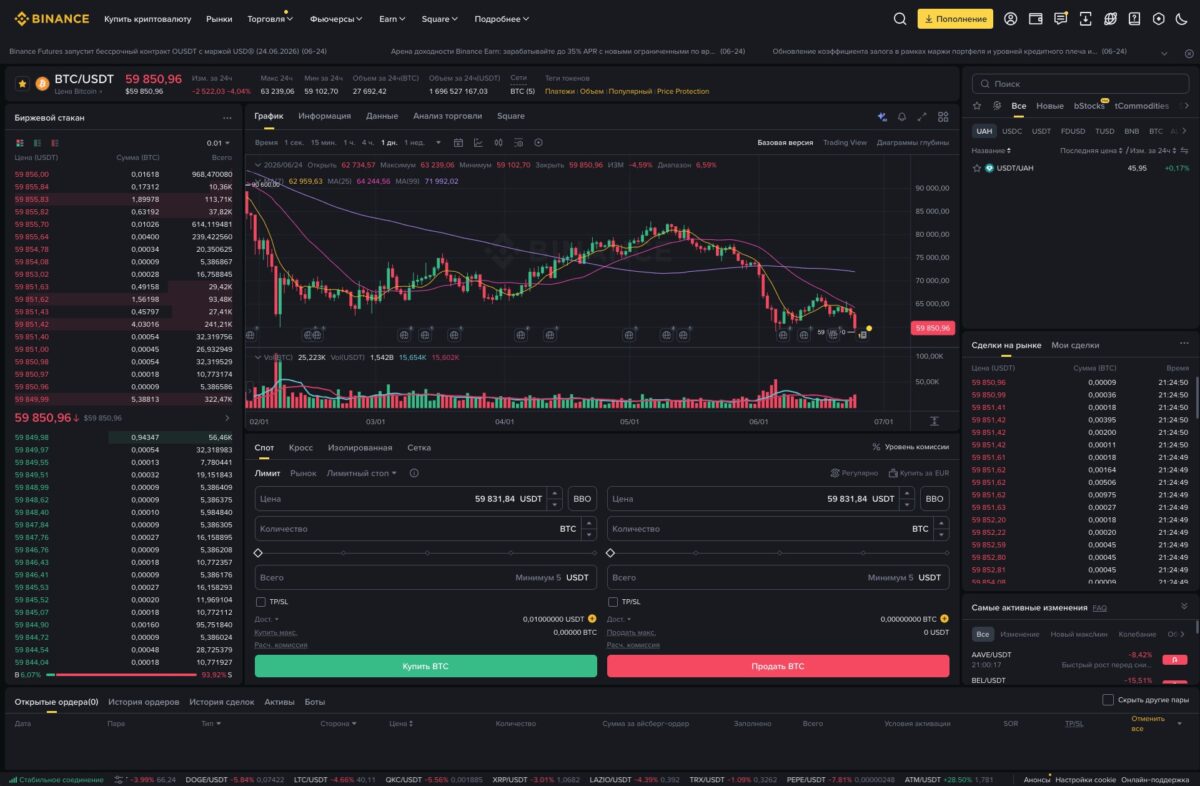
- Open the Trade → Spot section
- Select a trading pair (for example, BTC/USDT)
- Select the order type:
- Market — instantly at the current price
- Limit — at a specified price (lower fee — maker)
- Advanced: Stop-Limit, OCO, trailing stop
- Enter the amount
- Click Buy (green) or Sell (red)
The Liquidity Advantage
The main advantage of Binance is its deep order books. The BTC/USDT spread is typically $1–2 on an asset trading around $100K, and on major altcoins it is negligible. For trades of a few thousand dollars or more, this is critical: your order fills at the price you see, without the market moving against you.
Futures
Futures are leveraged trading that lets you profit from both rising (long) and falling (short) prices. The risks here are many times higher.
A Warning First
Leveraged futures are extremely risky. At 10x leverage, a 10% price move against you liquidates the position. Experienced traders rarely go above 10–20x — high leverage is the fast track to liquidation. Most beginners lose money on futures. Start small, and only after practice.
Binance Contract Types
- USDⓈ-M perpetuals — margined and settled in stablecoins (the most popular, with $15+ billion/day in volume)
- COIN-M perpetuals — settled in the base coin (to maintain crypto exposure)
- Quarterly futures — with a delivery date
- Options — European-style, on BTC and ETH
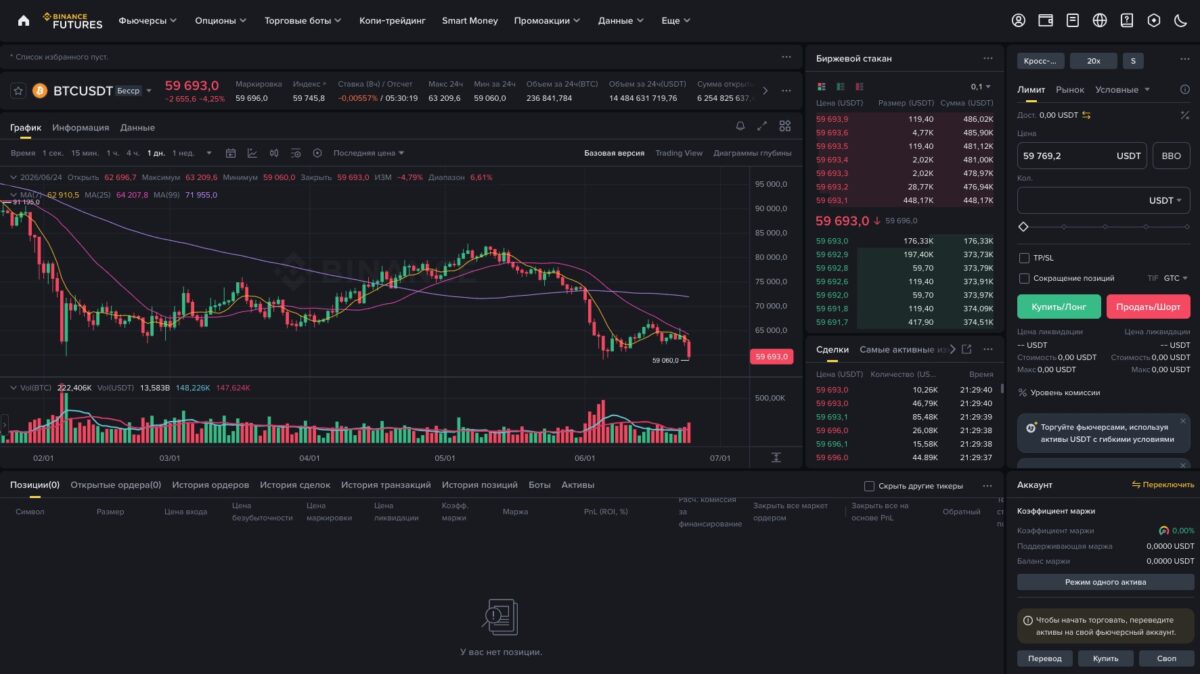
How to Trade Futures (Step by Step)
- Open Trade → Futures → USDⓈ-M
- Select a contract (for example, BTCUSDT Perpetual)
- Select the margin mode:
- Cross — the entire margin supports the position
- Isolated — risk is limited (recommended for beginners)
- Set the leverage (start with 2–3x, not 125x!)
- Choose Buy/Long (upside) or Sell/Short (downside)
- Specify the position size and order type
- Be sure to set Stop Loss and Take Profit
- Open the position
Key Concepts
- Funding Rate — a periodic fee exchanged between longs and shorts (approximately every 8 hours)
- Liquidation — forced position closure when margin is insufficient
- Margin Tiers — as the position size increases, the maximum leverage decreases
- Mark Price — the fair price used to calculate liquidations
Tip for beginners: always use isolated margin + low leverage + a Stop Loss. The mechanics of shorting are covered in the guide on how to short.
Key Features
What makes the crypto exchange Binance stand out in 2026.
Unmatched liquidity
Binance handles more volume than the next several exchanges combined. For large trades, this means minimal slippage — the platform’s key advantage.
Binance Alpha
A platform for early-stage crypto projects — access to tokens at the earliest stage. For risk-tolerant traders who want to catch new listings before they hit the market.
Launchpad and Launchpool
A Binance classic: stake BNB/coins and receive new tokens before they enter the market. One of the best-known ways to profit from new launches.
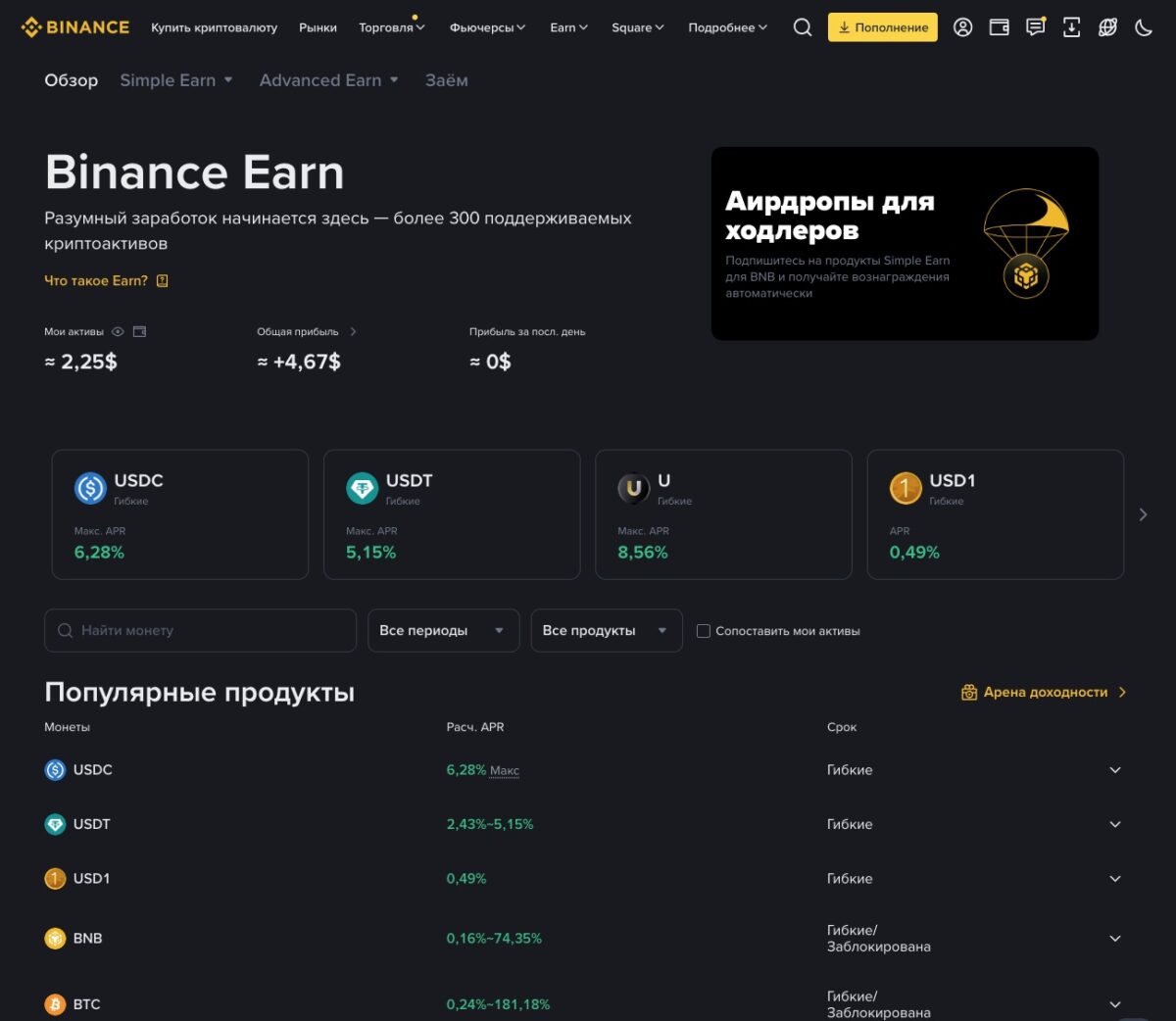
Simple Earn and broad passive income options
One of the broadest ranges of yield products: flexible and fixed staking on 100+ coins, dual investment, and liquid staking. Rates are visible before you invest.
BNB ecosystem
The native BNB token gives a 25% fee discount, access to Launchpool, and is used on the BNB Chain network (one of the largest blockchains for DeFi).
Binance Academy
A free educational platform — one of the best in the industry. A huge library of crypto articles and courses for all levels.
Binance Card and Binance Pay
A crypto card for spending from your exchange balance + an instant user-to-user transfer service with no fees.
Fees
Binance is one of the cheapest exchanges in the industry.
Trading fees
| Market | Maker | Taker |
|---|---|---|
| Spot | 0.1% | 0.1% |
| Spot with BNB | 0.075% | 0.075% |
| Futures | 0.02% | 0.05% |
- BNB discount: paying fees with the BNB token gives −25% off on spot trading
- VIP tiers: at higher volumes, fees drop to 0.011%/0.023% (spot VIP 9)
- Zero-fee trading on selected BTC and stablecoin pairs
Deposit/withdrawal fees
- Crypto deposits — free (network fee only)
- Crypto withdrawals — fixed network fee per coin (depends on the network)
- SEPA deposits — free (your bank may charge its own fee)
- Card — ~2%
- P2P — often 0%
- Binance Pay between users — free
How to reduce fees: pay in BNB, trade with limit orders (maker), increase your volume to reach VIP status, use SEPA/P2P instead of a card. For choosing a low-cost network for USDT withdrawals, see TRC20 vs ERC20 vs BEP20.
Security
Binance invests in security, but it is a centralized exchange — it holds the funds.
Security Measures
- SAFU Fund — user protection fund (over $1 billion)
- Proof of Reserves — reserve verification (funds are fully backed)
- Cold storage for the majority of assets
- 2FA (Authenticator, Passkey, SMS)
- Anti-phishing code in emails
- Withdrawal address whitelist and device management
- AI monitoring of suspicious activity
What the user should do
✅ Enable 2FA via an app/Passkey (not just SMS)
✅ Set up an anti-phishing code
✅ Enable a withdrawal address whitelist
✅ Use a unique password
✅ Check the URL (there are many phishing copies of Binance)
✅ Do not keep large amounts for long — withdraw them to a cold wallet
KYC AML
After settling with the U.S. (see below), the Binance exchange made compliance its No. 1 priority.
What AML checks
- Sanctions screening — screening against sanctions lists
- Source of funds — the origin of large sums
- Transaction monitoring — analysis of transaction patterns
- Travel Rule — sender/recipient data for large transfers
- Enhanced KYC — requirements have become stricter since 2023
What may raise questions
Triggers for freezing/requesting documents:
- Crypto with a “dirty” risk score (mixers, scams, stolen funds)
- Sharp increase in turnover
- Transactions involving sanctioned regions
- VPN/use or login from prohibited countries
- Counterparty complaint in P2P
How to protect yourself
✅ Complete KYC honestly
✅ Buy crypto from clean sources
✅ Keep a record of transactions
✅ Do not use a VPN to bypass geo-restrictions
Learn more about AML, account freezes, and proof of source of funds — how to legally transfer a large sum out of Ukraine.
Dark Pages
An honest review must show the dark pages as well. Binance has the most high-profile regulatory case in the industry.
$4.3 Billion Fine and CZ’s Prison Sentence (2023)
In November 2023, crypto exchange Binance settled a case with the U.S. Department of Justice, paying a record $4.3 billion. The company admitted:
- Lack of adequate AML controls
- Violation of the U.S. sanctions regime
Founder and CEO Changpeng Zhao (CZ) personally pleaded guilty, paid a $50 million fine, stepped down, and was sentenced to 4 months in prison (served the term in 2024). In October 2025, CZ received a pardon from President Trump.
What changed afterward:
- CEO became Richard Teng — a former regulator (Singapore, Abu Dhabi)
- Independent compliance monitoring
- Verifiable Proof of Reserves
- 21+ regulatory approvals in different countries
In other words, Binance went through a harsh reckoning and rebuilt itself. Today, it is more transparent than in the “wild” years, but the price has been the loss of some of its former aggressiveness and flexibility.
New allegations in 2026
In February 2026, Fortune reported that Binance fired at least five compliance employees who had flagged $1+ billion in USDT transactions linked to Iranian entities. CEO Richard Teng rejected the allegations, calling the report “misleading.” As of March 2026, no regulatory action on the matter has been announced.
An “ugly story” for Ukrainians: card withdrawals suspended
This directly affects our audience: in December 2025, crypto exchange Binance suspended withdrawals to Ukrainian bank cards. For many Ukrainians, this came as an unpleasant surprise and forced them to look for alternative withdrawal methods (P2P, other services).
We covered this event in detail in a separate article: Binance suspended card withdrawals in Ukraine — what to do.
Conclusion: Binance is an extremely powerful exchange, but its history shows that even the No. 1 giant is vulnerable to regulators and can unilaterally change the rules for entire countries. This supports the most important rule: do not keep everything on a single exchange, and store your long-term holdings in a cold wallet.
Binance Ukraine
Specifically for our audience.
Does the Binance exchange operate in Ukraine
Yes, the crypto exchange Binance is available to Ukrainians — it is one of the most popular exchanges in the country. Trading, P2P, Earn, and other services are available.
But there is an important nuance: since December 2025, withdrawals to Ukrainian bank cards have been suspended. This means:
- The main way to cash out into hryvnia now is P2P (selling USDT to other users with a transfer to a bank card)
- Or withdraw crypto to another service/wallet for subsequent sale
How Ukrainians Can Withdraw Funds in 2026
- P2P — sell USDT for hryvnia (the most reliable method right now)
- Withdraw USDT to a wallet → sell via another platform
- Withdraw to services like KAST or Bybit (Bybit’s cards still work)
Details and alternatives are covered in the article Binance halted card withdrawals in Ukraine and how to buy Bitcoin in Ukraine.
Comparison
How Binance compares with its competitors in 2026.
| Parameter | Binance | Bybit | KuCoin |
|---|---|---|---|
| Liquidity | Deepest in the world | High | Medium |
| Spot fee | 0.1% (0.075% with BNB) | 0.1% | 0.1% |
| Futures (maker/taker) | 0.02%/0.05% | 0.02%/0.055% | competitive |
| Leverage | up to 125x | up to 100x | high |
| Coin selection | 500-600 (depth) | ~650 | A lot of altcoins |
| P2P | Largest | Good | Available |
| Education | Binance Academy | Good | Average |
| For Ukraine | ⚠️ Cards do not work | ✅ Cards work | ✅ Works |
| Reputation | $4.3 billion fine, CZ jailed | 2025 hack, freezes | Smaller scale |
Brief conclusion
- Binance — for maximum liquidity, a broad product range, and educational resources
- Bybit — for derivatives, copy trading, and (importantly!) working withdrawals to Ukrainian bank cards (review)
- KuCoin — for hunting altcoins (review)
Many people use multiple exchanges for different purposes — this is normal and reduces risks.
Risks
An objective summary of the risks of Binance (and any CEX).
- Custodial risk — the exchange holds the keys; it may freeze an account or change the rules (as happened with Ukrainian cards)
- Regulatory risk — the most high-profile story in the industry; restrictions vary across countries
- Liquidation risk — on leveraged futures, it’s easy to lose your deposit
- Geographic risk — access may be restricted (already in the US, UK, and Canada)
- Interface complexity — many tabs and features can intimidate beginners
- Slow support — a frequent complaint on Trustpilot
How to minimize risks
✅ Do not keep large amounts on an exchange for long — withdraw them to a cold wallet
✅ Enable all security features (2FA, whitelist, anti-phishing)
✅ On futures — use low leverage, isolated margin, and Stop Loss
✅ Buy crypto from clean sources
✅ Diversify across several platforms
Golden rule: an exchange is a tool for trading, not a vault. If you trade, use an exchange; if you store, use a cold wallet.
Frequently Asked Questions (FAQ)
What is the Binance exchange, and is it safe?
Binance is the world’s largest cryptocurrency exchange by trading volume and number of users (275+ million across 180+ countries), founded in 2017 by CZ. It offers spot trading, futures, options, margin, P2P, copy trading, Earn, Launchpad, a card, and a Web3 wallet. Security: the SAFU fund ($1+ billion), Proof of Reserves, cold storage, and 2FA. However, it is a centralized exchange with a high-profile regulatory history: in 2023, it paid a $4.3 billion U.S. fine, and founder CZ pleaded guilty to AML violations and served a sentence. Safe for trading, but not for long-term storage of large amounts.
How do I register on Binance?
Go to binance.com or download the app, click Sign Up, register with your email or phone number, create a password, and verify your account. Enable 2FA, an anti-phishing code, and address whitelisting. Complete KYC by uploading a photo of your document (passport, ID, or driver’s license) and a live selfie. Verification takes from a few minutes up to 24 hours. Without KYC, functionality is severely limited.
How to buy cryptocurrency on Binance with a card?
Use the Buy Crypto → Card section: select the currency and amount, the cryptocurrency (USDT, BTC, etc.), enter your Visa/Mastercard details or use Apple Pay / Google Pay. Check the fee (visible before confirmation) and pay. The crypto will be credited to your spot wallet. Buying by card costs ~2%. For large amounts, P2P (often 0%) or deposits via SEPA (free in the EEA) are cheaper.
What are the fees on Binance?
Spot — 0.1% maker/taker (0.075% when paid in BNB). Futures — 0.02% maker / 0.05% taker. VIP levels reduce fees to 0.011%/0.023% on spot. There are zero-fee BTC and stablecoin pairs. Crypto deposits are free, withdrawals incur a network fee. SEPA deposits are free, card deposits ~2%, P2P is often 0%, Binance Pay between users is free.
How to trade futures on Binance?
Open Trade → Futures → USDⓈ-M, select the contract (BTCUSDT Perpetual), the margin mode (isolated for beginners), set the leverage (start with 2–3x), choose Long or Short, the position size, and always set a Stop Loss / Take Profit. Warning: leveraged futures are extremely risky — with 10x leverage, a 10% move against you will liquidate the position. Experienced traders rarely use more than 10–20x. Practice with small amounts.
Does the Binance exchange operate in Ukraine?
Yes, the Binance exchange works for Ukrainians — trading, P2P, and Earn are available. But there is an important nuance: since December 2025, withdrawals to Ukrainian bank cards have been suspended. Now the main way to withdraw in hryvnia is via P2P (selling USDT to other users) or by withdrawing crypto to another service/wallet and then selling it. Alternatives include KAST and Bybit (whose cards still work).
Why was Binance fined $4.3 billion?
In November 2023, crypto exchange Binance settled its case with the U.S. Department of Justice by paying a record $4.3 billion. The company admitted to lacking adequate AML controls and violating the U.S. sanctions regime. Founder CZ personally pleaded guilty, paid a $50 million fine, stepped down as CEO, and was sentenced to 4 months in prison (served in 2024, pardoned by Trump in October 2025). After that, the exchange was headed by former regulator Richard Teng, and the company radically strengthened its compliance.
Who currently runs Binance?
Since November 2023, the CEO of Binance has been Richard Teng, a former financial regulator (with three decades at the Monetary Authority of Singapore and the Abu Dhabi regulator). His appointment following CZ’s departure was a deliberate move: the exchange needed a leader with compliance as a priority. Under Teng’s leadership, Binance has secured 20+ regulatory approvals and applied for a MiCA license in Greece.
Crypto exchange Binance or Bybit — which is better?
It depends on your goals. The Binance exchange is best for maximum liquidity, a broad product range, education (Binance Academy), and P2P. Bybit is better for derivatives, copy trading, and the TradeGPT AI assistant. Important for Ukrainians: since December 2025, Binance has not supported withdrawals to Ukrainian cards, while cards work on Bybit. Fees are similar. Many people use both exchanges for different purposes.
Is it safe to store crypto on Binance?
For short-term trading, it is acceptable (SAFU fund of $1+ billion, Proof of Reserves, cold storage). For long-term storage of large amounts, it is not recommended. Reasons: custodial risk (the exchange controls the keys, can freeze the account or change the rules, as with Ukrainian cards), regulatory restrictions. The golden rule: if you trade — keep funds on the exchange; if you store — keep them in a cold wallet (Ledger, Trezor, Trust Wallet, MetaMask).
What is the SAFU fund?
SAFU (Secure Asset Fund for Users) is Binance’s user protection fund, created to cover losses in emergency situations (for example, in the event of a hack). Its size exceeds $1 billion. Together with Proof of Reserves (confirmation that user funds are fully backed), it is part of the exchange’s security system. However, SAFU does not make storing funds on the exchange completely safe — custodial risks remain.
What is BNB and what is it used for?
BNB (Binance Coin) is the native token of the Binance ecosystem. It provides a 25% discount on trading fees when used for payment, grants access to Launchpool (earning new tokens), and is used on BNB Chain—one of the largest blockchains for DeFi. Holding some BNB is beneficial for active traders specifically because of the fee discount.
Can you trade on Binance without verification?
No. KYC is required for full trading, fiat deposits and withdrawals, P2P and the card. After settling with US regulators in 2023, Binance tightened its verification requirements. Without KYC, functionality is severely limited. Verification requires an ID document (passport, ID card or driver’s license) and a live selfie.
Conclusion
Binance remains the world’s #1 exchange in 2026 — in terms of liquidity, product breadth, and scale. If you need the deepest order books, minimal slippage, a huge selection of instruments, and top-tier educational resources (Binance Academy), this is the market benchmark. But an honest review must also show the other side.
Main takeaways:
✅ Exchange #1 — deepest liquidity, minimal slippage
✅ Widest selection — spot, futures (up to 125x), options, P2P, Earn, Launchpad
✅ Low fees — 0.1% spot (0.075% with BNB), 0.02%/0.05% futures
✅ Largest P2P marketplace — 100+ payment methods
✅ Enhanced compliance — more transparent after 2023 (SAFU, Proof of Reserves)
⚠️ $4.3 billion fine and CZ’s prison sentence — the industry’s biggest scandal
🚨 For Ukraine — withdrawals to bank cards suspended (December 2025), P2P required
🔒 Custodial risk — do not store large amounts for long periods
Who the Binance crypto exchange is for:
- Active traders — liquidity, tools, low fees
- Beginners — Lite mode, Binance Academy, copy trading
- Altcoin enthusiasts — huge selection + Launchpad + Alpha
- Ukrainians — a functioning platform, but withdrawals only via P2P
The main rule when working with any exchange: use it as a trading tool, not as a safe. Enable all security features, do not store more than you are prepared to temporarily lose, and keep your long-term holdings in a cold wallet. The suspension of withdrawals to Ukrainian cards is a clear reminder: CEX rules can change at any moment. Diversify across platforms and control your own keys.
Also explore our materials: Binance halted card withdrawals in Ukraine, Bybit review, how to short, and TOP 10 crypto wallets.