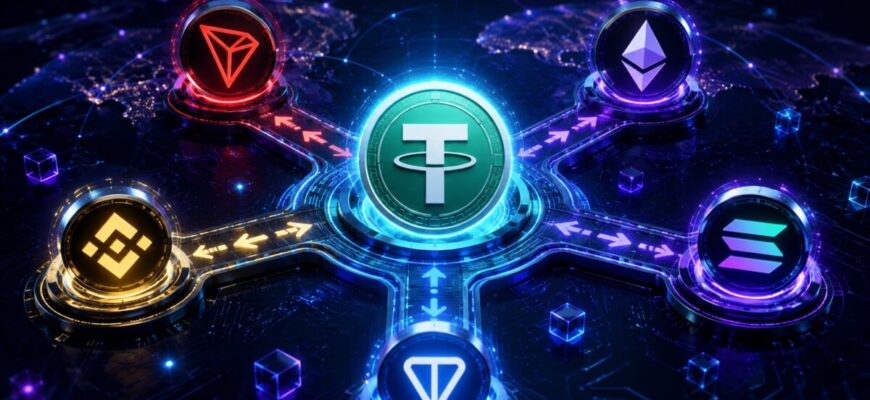
USDT is the largest stablecoin, with ~$189.5 billion in circulation, and is traded on 12+ networks simultaneously. The main mistake beginners make is confusing networks when transferring: sending to the wrong network = losing funds forever. As of 2026, the best options are TRC20 (the standard for Ukraine and exchanges, ~$1-3 per transfer), Solana (~$0.001 — the cheapest), TON (~$0.003 + convenience in Telegram), and BEP20 (~$0.10 — for the BNB Chain ecosystem). ERC20 ($5-20) is relevant only for DeFi on Ethereum. Coinbase does not support TRC20, and this creates headaches when withdrawing from an exchange. In this guide, we break down all USDT networks in full, show the real fees for May 2026, and provide a step-by-step guide on “which network to choose where.”
Disclaimer: This material is for informational purposes only. Cryptocurrency transactions involve the risk of losing funds if the wrong network is selected. Always verify the sender’s and recipient’s networks before making a transaction.
- What to know about USDT in 2026
- Quick comparison
- Actual Binance fees (May 2026)
- USDT TRC20 Tron
- Key facts
- How TRC20 fees work
- When to use TRC20
- Where TRC20 is accepted
- USDT ERC20 Ethereum
- Key facts
- When to use ERC20
- A real comparison example
- USDT BEP20 BNB Chain
- Key facts
- When to use BEP20
- Technical nuance
- USDT SPL Solana
- Key facts
- When to use Solana
- Cons of Solana for USDT
- USDT Jetton TON
- Key Facts
- When to use TON
- TON’s main feature: integration with Telegram
- USDT Polygon and L2
- When to use L2
- Main mistakes
- Mistake #1: Sending to the wrong network
- Mistake #2: Coinbase does not support TRC20
- Mistake #3: Wrong memo/tag
- Mistake #4: Sending to a smart contract without checking
- Mistake #5: Using an “expensive” network for a small amount
- Which network to choose
- By use case
- By exchange
- Best network for Ukrainians
- No. 1: TRC20 — the default standard
- No. 2: TON — the future for young people
- No. 3: BEP20 — for those who actively use Binance
- What NOT to choose in Ukraine
- A setup for Ukrainians
- How to transfer between networks
- Method 1: Through a CEX (the easiest)
- Method 2: Bridge via DEX
- Method 3: USDT0 (new in 2026)
- Method 4: OTC deal
- Frequently Asked Questions FAQ
- What is the difference between USDT TRC20 and ERC20?
- What is the cheapest network for USDT in 2026?
- Which USDT network should be used in Ukraine?
- What happens if you send USDT to the wrong network?
- Does Coinbase support USDT TRC20?
- Which USDT network is better for withdrawing from Binance?
- What is USDT0 from Tether?
- Can USDT be sent through Telegram?
- Which USDT network is for DeFi?
- Are all USDT networks equally safe?
- How can I check that I sent to the correct network?
- Which USDT network is the most popular in the world?
- Can you lose USDT if the network “goes down”?
- Conclusion
What to know about USDT in 2026
Before looking at the networks, the basic facts:
- Total supply USDT: ~$189.5 billion (DeFiLlama, May 2026) — the largest stablecoin in the world
- Operates on 12+ networks simultaneously: TRC20 (Tron), ERC20 (Ethereum), BEP20 (BNB Chain), Solana (SPL), TON (Jetton), Polygon, Arbitrum, Optimism, Base, Avalanche, and others
- USDT on different networks are DIFFERENT tokens on different blockchains. 1 USDT TRC20 ≠ 1 USDT ERC20 at the technical level, although both = $1
- Sending USDT to the wrong network = permanent loss of funds (with rare exceptions, CEX exchanges may help, but usually it is irreversible)
- USDT0 (omnichain) is a new Tether development based on LayerZero that allows USDT to be transferred between networks without classic bridges. It works on several networks, but not yet on all of them
Main rule for 2026: Before every USDT transfer, check 3 things: the sender’s network, the recipient’s network, and the address format. This saves money.
Quick comparison
If you’re in a hurry — here’s the main table right away:
| Network | Fee (~) | Speed | Where used | When to choose |
|---|---|---|---|---|
| TRC20 (Tron) | $1-3 | 3 sec | Ukraine, CIS, P2P, exchangers | Standard for most transactions |
| ERC20 (Ethereum) | $5-20 | 15 sec – 5 min | DeFi on Ethereum | Only for DeFi / large amounts |
| BEP20 (BNB Chain) | $0.10-0.50 | 3 sec | Binance, PancakeSwap, MEXC | BNB Chain ecosystem |
| SPL (Solana) | $0.001 | 1 sec | Phantom, Jupiter, Solana DeFi | The cheapest transfers |
| Jetton (TON) | $0.003 | 5 sec | Telegram Wallet, TON DApps | Telegram users |
| Polygon | $0.001-0.005 | 2 sec | DeFi with low fees | Low fees + EVM |
| Arbitrum / Base / Optimism | $0.10-0.50 | 5-10 sec | Ethereum L2, DeFi | Cheap alternative to ERC20 |
Actual Binance fees (May 2026)
Specific figures from Binance at the time of writing:
| Withdrawal network | Binance fee |
|---|---|
| USDT-TRC20 | 1 USDT |
| USDT-BEP20 | 0.29 USDT |
| USDT-SOL | 1 USDT |
| USDT-TON | 0.04 USDT |
| USDT-ERC20 | 1.6 USDT |
| USDT-Polygon | 1 USDT |
Paradox of 2026: on the exchange, TON withdrawals (0.04 USDT) are cheaper than all others, including TRC20. This makes TON one of the most interesting networks for withdrawals from CEX in 2026.
USDT TRC20 Tron
TRC20 is the most popular network for USDT in the world, especially in Ukraine, the CIS, and Southeast Asia. If you receive USDT from an exchange service or an employer, there is a 90% chance it will be TRC20.
Key facts
- 74 million+ USDT TRC20 holders (Tron Network Foundation)
- 3.37 billion transfers in the network’s history
- 3 seconds to confirm a transaction
- Fee: $1-3.50 for regular users, ~$0.20 if you rent energy
How TRC20 fees work
This is the most confusing part, which no one really explains properly. Tron does not use a classic gas model, but rather a system of Energy and Bandwidth:
- If you have staked TRX or rented Energy → the transfer costs pennies (~$0.20)
- If not → the network burns your TRX directly, and it is more expensive ($1-5)
After August 2025, when Tron lowered the energy price, a typical transfer costs:
- 6.5 TRX (~$2) — if the recipient already has a USDT account on Tron
- 13 TRX (~$4) — if the recipient is “new” (the first transaction to the address)
- ~$1.45 — if you rent energy through Tronsave
Find out: if you sent USDT to the wrong network, can you get your money back?
When to use TRC20
Ideal for:
- Transfers to Ukraine/CIS via P2P, exchangers, OTC
- Payments for services to freelancers in the CIS
- Storing USDT in medium amounts ($1k-$100k)
- Working with Ukrainian exchangers (Kuna, Whitebit, Bestchange aggregators)
Not to be used for:
- DeFi on Ethereum (only ERC20 works there)
- Coinbase — the exchange does not support TRC20!
- For very large amounts (>$100k), ERC20 is better for security
- For microtransactions, Solana or TON is cheaper
Where TRC20 is accepted
Most crypto wallets and exchanges: Binance, OKX, Bybit, KuCoin, Whitebit, Kuna, Trust Wallet, MetaMask (with Tron configured), Tronlink. Supported by all Ukrainian P2P channels.
Key exception: Coinbase does not support TRC20. If you are withdrawing USDT to Coinbase, choose ERC20 or Solana, not TRC20.
USDT ERC20 Ethereum
ERC20 — the original USDT standard on the Ethereum blockchain. The oldest and most “classic” network for USDT, but in 2026 it is used mainly for DeFi and large transactions.
Key facts
- The most regulated network for USDT — major institutional players (hedge funds, exchanges) prefer it
- Fees: $5-20+ depending on Ethereum gas
- Speed: from 15 seconds to 5 minutes (depends on gas)
- Security: maximum (backed by Ethereum’s largest ecosystem)
When to use ERC20
Ideal for:
- DeFi on Ethereum (Uniswap, Aave, Compound, Curve)
- Smart contract operations on Ethereum
- Transferring large amounts ($100k+) — the fee becomes negligible as a percentage
- Working with Coinbase (one of the two networks it supports)
Not to be used for:
- For small transfers up to $1000 — the fee will eat up 1-2%
- For P2P transactions in Ukraine — everyone uses TRC20
- For regular transfers to friends/colleagues
A real comparison example
Transfer of $1000 USDT:
- Via TRC20: fee $1-2 (0.1-0.2% of the amount)
- Via ERC20: fee $5-20 (0.5-2% of the amount)
- Via Solana: fee $0.001 (0.0001% of the amount)
Transfer of $50,000 USDT:
- Via ERC20: fee $15 (0.03% of the amount — negligible)
- Via TRC20: fee $1-3 (still cheaper, but the risk is lower on Ethereum)
Logic: for large amounts, ERC20 becomes relatively cheap and provides maximum regulatory clarity. For small amounts, it is absolutely not justified.
USDT BEP20 BNB Chain
BEP20 is the USDT version on BNB Smart Chain (formerly Binance Smart Chain). Created by Binance as Binance-Peg BSC-USD, it is not issued directly by Tether.
Key facts
- $9.18 billion in circulation
- Sub-second confirmation, typically <1 minute to finality
- Fee: $0.10-0.50 (in native BNB)
- PancakeSwap operates on USDT BEP20 as the main trading pair
- Fully EVM-compatible (like Ethereum)
When to use BEP20
Ideal for:
- Work in the BNB Chain ecosystem (PancakeSwap, Venus, Alpaca)
- Regular transactions on the MEXC exchange (it actively promotes BEP20)
- Transfers between Binance accounts
- Swaps on low-fee DEXs
Do not use for:
- Transfers to Ukraine/CIS — exchangers more often work with TRC20
- Coinbase — the exchange does not support BEP20
Technical nuance
BEP20 is wrapped USDT, not issued by Tether. Binance holds USDT ERC20 in reserve and issues an equivalent amount on BNB Chain. This is safe (Binance is one of the largest players), but formally it is not native USDT, unlike, for example, TRC20 or ERC20.
USDT SPL Solana
SPL (Solana Program Library) USDT is native USDT on the Solana blockchain. The cheapest and one of the fastest options in 2026.
Key facts
- Speed: 400 milliseconds (literally instant)
- Fee: ~$0.001 (one-thousandth of a cent!)
- Ecosystem: Phantom, Solflare, Jupiter, Raydium, Drift
- Rapid adoption growth — in 2025-2026, Solana became second only to Ethereum by DeFi volume
When to use Solana
Ideal for:
- Microtransactions (any amounts up to $100)
- High-frequency transactions (bot trading, recurring payments)
- Working in Solana DeFi (Jupiter, Marginfi, Marinade)
- DePIN projects (Helium on Solana!)
- Withdrawal from Coinbase (one of the 2 supported networks)
Not to be used for:
- Transactions with Ukrainian exchangers — most do not support
- Corporate payments with traditional counterparties
Cons of Solana for USDT
- Less adoption in P2P in the CIS
- The network periodically experiences downtime (there were outages in 2022-2023, and it has been more stable in 2024-2026)
- Not all Ukrainian exchangers support Solana yet
If you work with Helium (it runs on Solana), Solana DeFi, or often receive USDT from Coinbase, USDT SPL is your main choice.
USDT Jetton TON
TON Jetton USDT — native USDT on the TON blockchain (Telegram Open Network). The 2024-2025 revolution — Tether officially launched USDT on TON, and it immediately became popular thanks to its integration with Telegram.
Key Facts
- Available directly in Telegram via @wallet and Telegram Wallet
- Speed: ~5 seconds
- Fee: ~$0.003 (one of the cheapest)
- Especially popular in Ukraine — everyone knows TON through Telegram
- Supported on Binance, Bybit, OKX, MEXC, and major exchanges
When to use TON
Ideal for:
- Transfers to friends via Telegram Wallet — built into the messenger!
- Microtransactions (cheaper even than Solana)
- Payments in Telegram bots (stores, services, mini-apps)
- Working with TON DeFi (STON.fi, DeDust)
Not to be used for:
- Coinbase does not support TON
- Payments in the classic crypto world (exchanges, P2P) are not yet available everywhere
TON’s main feature: integration with Telegram
Unlike other networks, USDT-TON can be sent directly from Telegram — open @wallet, enter the recipient’s username, and send. No copying addresses, no QR codes. This is especially valued by those who transfer money to friends or colleagues.
Telegram Premium can also be paid for with crypto via USDT-TON, making the network even more “everyday” for Russian- and Ukrainian-speaking audiences.
Forecast: USDT-TON will grow faster than all other networks over the next 2-3 years due to Telegram’s 900+ million active users and a seamless UX.
USDT Polygon and L2
Layer 2 solutions are a separate category that is becoming mainstream in 2026. USDT is available on:
| Network | Fee | Feature |
|---|---|---|
| Polygon (POS) | $0.001-0.005 | EVM-compatible, lots of DeFi |
| Arbitrum | $0.10-0.50 | The most popular Ethereum L2 |
| Base | $0.10-0.50 | Coinbase L2, growing adoption |
| Optimism | $0.10-0.50 | One of the first L2s |
When to use L2
Ideal for:
- DeFi with low fees (Aave on Base/Arbitrum)
- Working with Coinbase projects (Base)
- An ERC20 alternative without hefty fees
Not to be used for:
- Transfers to Ukraine/CIS (exchanges do not work with L2)
- If the recipient is not on the same L2
L2 — the choice of “advanced” users who know what they are doing. For basic transfers in the CIS, choose TRC20 or TON.
Main mistakes
This section can save you thousands of dollars. Study it carefully.
Mistake #1: Sending to the wrong network
Scenario: you send USDT TRC20 to an ERC20 address (or vice versa). The result — the money is lost forever.
Why this happens: both addresses in Tron and Ethereum look similar (a long string of letters and numbers), but in fact they are different blockchains. An ERC20 address starts with 0x... (for example, 0x742d35Cc6634C0532925a3b8D8F45...), while a TRC20 address starts with the letter T (for example, TXYZabc123...).
How to avoid it:
- Before each transaction, check the sender and recipient networks 3 times
- Send a small test amount ($1-5) before making a large transfer
- If you are making a transfer with a new counterparty for the first time, make a video call and confirm the details
Mistake #2: Coinbase does not support TRC20
Scenario: you withdraw USDT from an exchange to Coinbase, choose TRC20 (it’s the cheapest!). The funds disappear.
What to do:
- To withdraw to Coinbase, use ERC20 or Solana — these are the two supported networks
- If you have USDT TRC20 and need to transfer it to Coinbase — first bridge it through an exchange (for example, on Binance: deposit TRC20 → withdraw ERC20 or SPL)
Mistake #3: Wrong memo/tag
Scenario: for some networks (TON, for example), a memo/tag is required, especially when withdrawing to an exchange. If you forget it, the funds are “stuck.”
What to do:
- Always copy the memo together with the address
- For TON withdrawals to an exchange, the memo is critical
- When withdrawing from an exchange to a personal wallet, a memo is usually not needed
Mistake #4: Sending to a smart contract without checking
Scenario: you send USDT to an address that is a DeFi contract. If it does not support USDT, the funds get “stuck” in the contract.
What to do:
- If the recipient is a DApp (Uniswap, Aave, etc.), first check whether it supports USDT
- Use wallets with warnings (Phantom and MetaMask have them built in)
Mistake #5: Using an “expensive” network for a small amount
Scenario: transferring $50 USDT via ERC20. Fee — $15. Actually received: $35 (-30%).
What to do:
- For amounts up to $1000, never use ERC20
- TRC20 / Solana / TON — the optimal options for small amounts
Which network to choose
By use case
| Use case | Best network | Why |
|---|---|---|
| 💸 P2P deal in Ukraine | TRC20 | The standard across all exchangers and P2P platforms |
| 🤝 Transfer to a friend in Telegram | TON (Jetton) | Directly in @wallet, $0.003 |
| 💼 Salary for a freelancer from the CIS | TRC20 | Everyone knows how to receive it |
| 🦄 DeFi on Ethereum | ERC20 | No alternatives |
| 🥞 Working with PancakeSwap | BEP20 | Native BNB Chain network |
| 🚀 Solana DeFi (Jupiter, Drift) | SPL | Native Solana network |
| 🏛 Coinbase withdrawal/deposit | ERC20 or SPL | Only 2 supported networks |
| 💰 Transfer of $100k+ | ERC20 | Regulatory clarity, security |
| 📱 Micropayments in Telegram | TON | $0.003 per transfer |
| 🤖 High-frequency trading | Solana | $0.001 per tx |
By exchange
| Exchange | Best network for withdrawals | Supports TRC20? |
|---|---|---|
| Binance | TRC20 / BEP20 / TON | ✅ |
| KuCoin | TRC20 | ✅ |
| Bybit | TRC20 / BEP20 | ✅ |
| OKX | TRC20 / BEP20 / TON | ✅ |
| MEXC | BEP20 / TRC20 | ✅ |
| Coinbase | ERC20 / SPL | ❌ |
| Kraken | ERC20 / SPL / TRC20 | ✅ |
Best network for Ukrainians
For Russian- and Ukrainian-speaking audiences, the picture is specific. In 2026, the following dominate in Ukraine:
No. 1: TRC20 — the default standard
Why this network in particular:
- ✅ All Ukrainian exchangers work with TRC20 (Kuna, Whitebit, BTCBIT, Bestchange aggregator)
- ✅ P2P on Binance and Bybit — USDT/UAH pairs are mostly via TRC20
- ✅ Clear fee ($1-3)
- ✅ 3-second confirmation
No. 2: TON — the future for young people
Why its popularity is growing:
- ✅ Telegram is the most popular social network in Ukraine
- ✅ Cheaper than TRC20 (fee $0.003)
- ✅ Can be sent by @username directly in Telegram
- ⚠️ Not all exchanges support it yet, but that is changing quickly
No. 3: BEP20 — for those who actively use Binance
When to choose:
- If you often transfer between Binance accounts
- You work within the BNB Chain ecosystem
- But do not use it for P2P in Ukraine — exchangers avoid it
What NOT to choose in Ukraine
- ❌ ERC20 for P2P/exchangers — use it only if you work with Ethereum DeFi or Coinbase
- ❌ Polygon/Arbitrum/Base — highly specialized, exchangers do not support them
- ❌ Solana — adoption is still low in Ukrainian exchangers (but growing)
A setup for Ukrainians
The optimal strategy for an active user:
- Main network for receiving USDT → TRC20 (from employer/clients)
- P2P withdrawal to hryvnia → via TRC20 on KuCoin or Bybit P2P
- Transfer to friends in Telegram → TON via @wallet
- Accumulation in a cold wallet → TRC20 or ERC20 (for large amounts)
Important context for 2026: after Binance stopped withdrawals to Ukrainian cards (December 2025), Ukrainians massively switched to Bybit P2P as the main channel. Bybit supports all the networks mentioned.
How to transfer between networks
Sometimes you need to transfer USDT from one network to another — for example, you have TRC20, but you need to send it to Coinbase (and it only supports ERC20). There are 4 ways:
Method 1: Through a CEX (the easiest)
Steps:
- Deposit USDT TRC20 to an exchange (Binance, KuCoin, Bybit)
- Transfer within the internal account to the same asset, but on a different network
- Withdraw USDT ERC20 (or another needed one)
Fee: 1-2 USDT Speed: 5-15 minutes Security: high (on a major exchange)
Method 2: Bridge via DEX
Used for transfers without involving a CEX, for example via Stargate, Wormhole, Across.
Cons:
- Technically more complex
- Do not work with all network pairs
- Liquidity issues may arise for rare pairs
Method 3: USDT0 (new in 2026)
Tether has launched USDT0 — an omnichain version via LayerZero OFT. It works across multiple networks (Arbitrum, Optimism, Base, etc.), allowing USDT transfers without traditional bridges.
Principle: USDT is burned on network A and minted again on network B, while maintaining 1:1 backing.
USDT0 — the future of stablecoin transfers between networks. But for now, coverage is limited — TRC20/ERC20 are not yet on USDT0.
Method 4: OTC deal
For very large amounts ($1M+), you can arrange a direct OTC deal: you give the counterparty USDT on network A and receive it on network B. Used by institutions.
Frequently Asked Questions FAQ
What is the difference between USDT TRC20 and ERC20?
USDT TRC20 is the version of USDT on the Tron blockchain, while USDT ERC20 is on the Ethereum blockchain. These are different tokens on different networks, although both are worth $1. The main differences are: TRC20 has a fee of $1-3 and a speed of 3 seconds, while ERC20 has a fee of $5-20 and a speed of 15 seconds to 5 minutes. TRC20 is used for P2P and exchangers in Ukraine/CIS, while ERC20 is used for DeFi on Ethereum and for working with Coinbase. Sending USDT to the wrong network will result in loss of funds.
What is the cheapest network for USDT in 2026?
The cheapest network for transferring USDT is Solana (SPL), with a fee of about $0.001 per transaction. Very close in price are TON Jetton (~$0.003) and Polygon ($0.001-0.005). Among the networks popular in the CIS, the cheapest is BEP20 ($0.10-0.50). The most expensive is ERC20 ($5-20). However, “cheap” does not mean “best” — choose the network supported by your recipient (exchange, trading platform, wallet).
Which USDT network should be used in Ukraine?
In Ukraine, the default standard is TRC20 — it is supported by all Ukrainian exchanges (Kuna, Whitebit, BTCBIT), P2P on Binance/Bybit/KuCoin, and most exchange services via Bestchange. Alternatives: TON (growing rapidly thanks to Telegram), BEP20 (for active Binance users). ERC20 and L2 networks are weakly supported in Ukraine.
What happens if you send USDT to the wrong network?
The money will most likely be lost forever. If you sent USDT TRC20 to an ERC20 address, the Tron network does not recognize the Ethereum address, and the transaction effectively goes “into the void.” In rare cases, if the recipient is a major exchange (Binance, KuCoin), their support may be able to help recover the funds for a paid procedure (15-50 USDT). If sent to a personal wallet, recovery is practically impossible. Always check the network before sending.
Does Coinbase support USDT TRC20?
No, Coinbase does not support TRC20. The exchange handles USDT on only two networks: ERC20 (Ethereum) and Solana (SPL). If you hold USDT TRC20 and need to move it to Coinbase, bridge it through another exchange (Binance, Bybit): first deposit USDT TRC20, then withdraw it as USDT ERC20 or SPL to your Coinbase address. This is critical — trying to send TRC20 directly to Coinbase will result in a loss of funds.
Which USDT network is better for withdrawing from Binance?
It depends on your recipient. TRC20 is the standard for P2P, exchanges, and sending to friends in the CIS (fee: 1 USDT). BEP20 is the cheapest (0.29 USDT), but only for the BNB Chain ecosystem or another Binance account. TON is the cheapest in 2026 (0.04 USDT!), but it is not accepted everywhere. ERC20 (1.6 USDT) is for Coinbase, Kraken, and DeFi on Ethereum. Solana (1 USDT) is for Coinbase and Solana DeFi.
What is USDT0 from Tether?
USDT0 is an omnichain version of USDT from Tether, built on LayerZero OFT (Omnichain Fungible Token) technology. Unlike classic bridges, USDT0 burns USDT on network A and mints it again on network B, while maintaining 1:1 backing with Tether reserves. This makes it possible to transfer USDT between networks without intermediaries. It supports several EVM networks (Arbitrum, Optimism, Base, Plasma, and others), but it does not yet work with TRC20 and ERC20 mainnet. A promising technology that could change the cross-chain transfer market.
Can USDT be sent through Telegram?
Yes, via TON Jetton. In 2024-2025, Tether launched USDT on the TON blockchain, which is integrated with Telegram through @wallet. You can send USDT simply by entering the recipient’s @username in Telegram — no need to copy addresses or QR codes. The fee is $0.003 per transaction, and the transfer takes a few seconds. This is an ideal option for sending money to friends and colleagues, or paying for services in Telegram bots. USDT-TON can also be used to pay for Telegram Premium.
Which USDT network is for DeFi?
Depends on the platform:
- Ethereum DeFi (Uniswap, Aave, Compound, MakerDAO) → ERC20 (no exceptions)
- BNB Chain DeFi (PancakeSwap, Venus, Alpaca) → BEP20
- Solana DeFi (Jupiter, Drift, Marginfi) → SPL
- Arbitrum/Base/Optimism DeFi → L2 version of USDT
- TON DeFi (STON.fi, DeDust) → Jetton
For most serious DeFi operations, ERC20 remains the standard, but L2 alternatives are growing rapidly because of low fees.
Are all USDT networks equally safe?
The basic security of USDT is the same everywhere (it is still backed by Tether reserves). But network security differs:
- ERC20 (Ethereum): maximum security, the most decentralized network
- TRC20 (Tron): good, but Tron is more centralized (Justin Sun)
- BEP20 (BNB Chain): Binance controls a significant share of validators
- Solana: there were episodes of downtime, more stable in 2024-2026
- TON: a young network, but security is improving rapidly
For very large amounts ($1M+) ERC20 has historically been chosen because of Ethereum’s maximum decentralization.
How can I check that I sent to the correct network?
Before sending:
- Compare the address format — TRC20 starts with
T, ERC20/BEP20/Polygon with0x, Solana uses a long base58 string (44 characters), and TON starts withEQorUQ - Make sure the sender network matches the recipient network (this field is shown explicitly)
- Send a test amount of $1-5 the first time
- Save the transaction hash after sending — you can track its status in an explorer (Etherscan for ERC20, Tronscan for TRC20, Solscan for Solana, etc.)
Which USDT network is the most popular in the world?
In 2026, USDT TRC20 is the most popular network, with ~$80+ billion in circulation (about 50% of total supply). The reason is low fees and faster speed compared with Ethereum. ERC20 is in second place (~$60 billion), especially among DeFi users and institutions. BEP20, Solana, and TON are growing quickly, but their volumes are still smaller. This is global statistics — distribution varies by region (in the US, the share of ERC20 is higher; in the CIS/Asia, TRC20).
Can you lose USDT if the network “goes down”?
Unlikely, but theoretically possible. If the blockchain physically stops operating (which is almost impossible for Ethereum, unlikely for Tron/BNB Chain, and possible for very small networks), Tether can stop issuing on that network and issue an equivalent on another network for holders. This has already happened with some small networks (Omni, Algorand — Tether discontinued support). For major networks (TRC20, ERC20, BEP20, Solana, TON), this risk is minimal.
Conclusion
Choosing the USDT network is a matter of $30 or $0.003 per transaction. The right choice saves money, time, and nerves. Key takeaways:
✅ TRC20 — the gold standard for Ukraine, the CIS and P2P
✅ Solana and TON — the cheapest for microtransactions
✅ TON — ideal for transfers in Telegram via @wallet
✅ BEP20 — for the BNB Chain ecosystem
✅ ERC20 — only for DeFi on Ethereum and large amounts
⚠️ Coinbase does not support TRC20 — critical to remember!
⚠️ Sending to the wrong network = losing money
Main strategy for an active user in 2026:
- Main network: TRC20 (for P2P and exchangers)
- Cheap for small amounts: TON or Solana
- Corporate: ERC20 (for DeFi/large amounts)
- Universal wallet: Trustee Plus, which supports USDT on different networks
If you’re just starting out in crypto, start with TRC20. It’s the most common and easy-to-understand network. Once you’ve got the hang of it, try TON for Telegram transfers and Solana for low-cost DeFi operations.