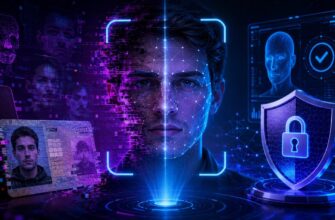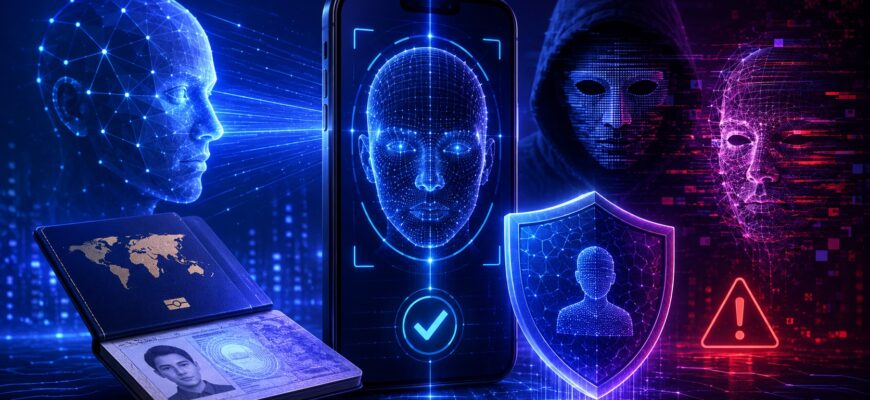
KYC (Know Your Customer) is a required identity verification procedure in banks, on crypto exchanges, and in fintech. At its core are document checks, facial recognition, and liveness detection (a “live presence” check). In 2026, the threat landscape changed dramatically: deepfakes now account for 11% of all global fraud (up from 7% in 2024), while injection attacks via virtual cameras increased by hundreds of percent over the year. This article explains how biometric verification works, what new threats emerged in 2026, and—most importantly—how both ordinary users and businesses can protect themselves.
Disclaimer: This material is for informational and educational purposes and is intended to help understand threats and build defenses. The article does not contain instructions for bypassing verification systems. Bypassing KYC for fraud, money laundering, or creating fake accounts is a criminal offense.
- What Changed in 2026
- What KYC Is in Simple Terms
- Why KYC Is Needed
- Who requires KYC in 2026
- How modern KYC works
- Level 1: Basic methods
- Level 2: Document Verification
- Level 3: Biometrics and liveness
- Biometrics and facial recognition
- Biometric binding
- Liveness Detection
- Passive methods
- Active methods
- Hardware methods
- Comparison of liveness methods
- New threats in 2026
- 1. Injection attacks
- 2. Deepfake-as-a-Service
- 3. Telegram marketplaces for tools
- 4. Real-time deepfake tools
- Synthetic identities
- Why Traditional Checks Don’t Help
- How users can protect themselves
- Basic rules for protecting your identity
- Signs that your identity is being used
- How businesses defend themselves
- Five layers of modern KYC protection
- Key countermeasures for 2026
- What Tier-1 banks are doing
- The “threat → vulnerability → countermeasure” map
- KYC/AML regulation in 2026
- Frequently Asked Questions (FAQ)
- What is KYC in simple terms?
- What is liveness detection?
- Can facial recognition be fooled with a photograph?
- What is deepfake fraud?
- What is an injection attack?
- Is biometrics safe in banks?
- What is a synthetic identity?
- Can I refuse to undergo biometrics?
- How to protect your identity from being used in synthetic fraud?
- Is it legal to complete KYC for other people for a reward?
- Which companies protect against deepfakes in KYC?
- What will happen to KYC and biometrics next?
- Conclusion
What Changed in 2026
If you read about KYC and biometrics a couple of years ago, the threat landscape is radically different:
- Deepfakes = 11% of all fraud in 2026 (Sumsub), up from 7% in 2024
- Injection attacks via virtual camera increased by 741-2665% over the year (iProov)
- For the first time, iOS is under attack — Apple devices, previously resistant to injection attacks, have become a target
- FATF (December 2025) officially recognized deepfakes as a tool for bypassing AML controls in its Horizon Scan
- WEF Cybercrime Atlas (January 2026) examined 17 face-swapping tools and 8 camera injection tools — most bypass standard checks
- Gartner: by 2026, 30% of companies consider autonomous verification solutions unreliable because of AI deepfakes
- Deloitte: 25.9% of executives have already encountered deepfake fraud in their organizations
- Deepfake-as-a-Service — deepfakes, synthetic identities, and cloned voices are sold for as little as $5 (Group-IB)
Main shift in 2026: previously, the KYC system asked, “Does this face match the photo in the document?” Now it must also ask, “Is this biometric signal real, live, and not spoofed or injected into the video stream?” Face verification alone is no longer enough.
What KYC Is in Simple Terms
KYC (Know Your Customer — “know your customer”) is an identity verification procedure that banks, crypto exchanges, fintech services, and today even taxi and dating apps are required to carry out.
In simple terms: KYC is when a service says, “before we give you access to money/services, prove that you are really you and that you are a real person.”
A typical KYC process in 2026:
- Registration (email, phone)
- Document upload (passport, ID card, driver’s license)
- Selfie or video selfie
- Liveness check — that there is a live person in front of the camera
- The system compares the face with the document and verifies authenticity
Why KYC Is Needed
KYC solves several tasks at once:
- Compliance with regulatory requirements — AML/CFT (anti-money laundering and counter-terrorism financing)
- Protection of users from fraud and identity theft
- Reducing risks for the company — reputational, financial, and legal
According to industry data, the implementation of KYC processes reduces the risk of fraud by more than 40% in the first six months. But at the same time, the game for fraudsters is becoming more complex, as they increasingly use AI, deepfakes, and synthetic documents.
Who requires KYC in 2026
| Sector | KYC level |
|---|---|
| 🏦 Banks | Full (documents + biometrics + address) |
| 💱 Crypto exchanges | Full (Binance, KuCoin, Kraken) |
| 💳 Fintech/neobanks | Full (Revolut, Wise, N26) |
| 🛒 Marketplaces | Basic to medium |
| 🚕 Taxi, delivery | Basic |
| ❤️ Dating apps | Basic to medium (often verified badges) |
How modern KYC works
The modern verification process can be divided into several levels of complexity.
Level 1: Basic methods
- Email or phone number verification
- IP and geolocation check
- Name and age verification against internal or government databases
These steps are easy to automate, but they have long since ceased to be reliable protection on their own.
Level 2: Document Verification
- OCR recognition of a passport, ID card, or driver’s license
- Comparison of the photo in the document with the user’s selfie
- Authenticity verification of the document (watermarks, holograms, MRZ zones)
Third-party KYC providers (Onfido, Veriff, Sumsub, Regula) integrated via API are actively used here.
Level 3: Biometrics and liveness
The most advanced level is biometric verification with liveness confirmation. This is where the main battle between protection and attackers is taking place in 2026.
Biometrics and facial recognition
In most fintech services, the key step has become selfie identity verification. The user takes a photo or records a video of themselves, the system compares the image with the document, and decides whether the face matches.
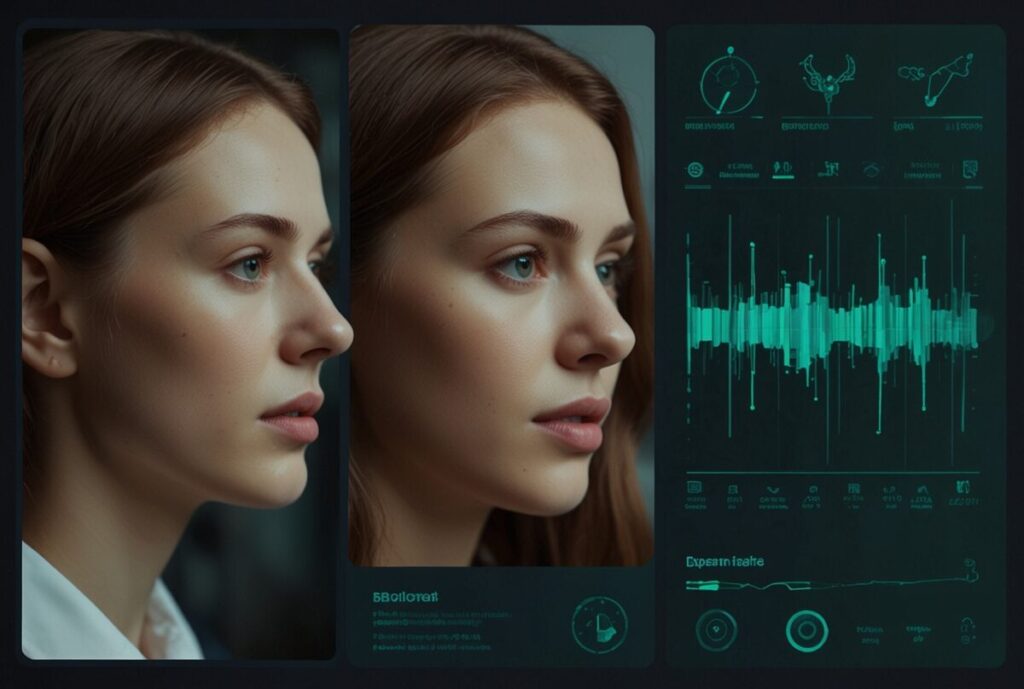
Major players (Binance, Revolut, N26) additionally implement analysis:
- Eye movements
- Facial expressions and microexpressions
- 3D facial geometry
- Depth and heat (on devices with IR sensors)
Biometric binding
The key concept of 2026 is biometric binding. This is what distinguishes a simple liveness check from full identity verification. Systems that verify a document and a face through separate API calls without cross-checking the results leave a vulnerable gap between the two checks — and that is exactly what fraudsters exploit.
Liveness Detection
Standard facial recognition is not enough. To protect against a photo shown on a screen or a video recording, liveness detection is used — confirmation that there is a real, live person in front of the camera.
Passive methods
They work invisibly to the user:
- Analysis of blinking and eye micro-movements
- Tracking head micro-movements
- Detecting inconsistencies in skin texture (screen artifacts, reflections)
- 3D facial mapping
Active methods
Require action from the user:
- Turn your head, smile, blink on command
- Show a document next to your face in real time
- Flashmark approach (iProov) — color flashes on the screen that are difficult to fake in a pre-recorded deepfake
Hardware methods
The most reliable, but they require specialized equipment:
- Infrared sensors (detect depth and heat)
- 3D scanning and structured light
- Sensors in phones (Face ID, IR cameras)
Comparison of liveness methods
| Method | Advantages | Vulnerabilities |
|---|---|---|
| Passive | Convenience, unobtrusiveness | Easier to fool with a deepfake |
| Active | High reliability | Reduces UX, friction |
| Hardware (3D) | Almost impossible to fake | Expensive, special devices required |
| Flashmark (flashes) | Protection against recorded deepfakes | Requires a screen and a camera |
New threats in 2026
The main change in 2026 is that attacks have shifted from document forgery to real-time biometric signal spoofing.
1. Injection attacks
Instead of showing a fake face to a real camera, attackers try to bypass the camera itself and inject synthetic video directly into the verification stream.
- iProov: digital injection attacks up 741% year over year
- iOS attacks up 1151% in the second half of 2025
- Use of virtual camera (VCam) software
This changes the very framing of the KYC task: the system can no longer ask only “does the face match?”; it must verify whether the signal is real, live, and not injected.
2. Deepfake-as-a-Service
Commercial services have emerged that sell ready-made tools for attacks on verification. According to Group-IB:
- Deepfakes, synthetic identities and cloned voices are sold from $5
- From January to August 2025, 8,065 attempts to bypass the liveness check of one financial institution were recorded
- An entire cybercrime-as-a-service industry
3. Telegram marketplaces for tools
An MIT Technology Review investigation (April 2026) identified 22 public Telegram channels in Chinese, Vietnamese, and English openly advertising VCam software, stolen biometric templates, deepfake video generators, and exploits for bypassing KYC.
4. Real-time deepfake tools
Tools such as JINKUSU CAM have emerged — live deepfake software specifically designed for attacks on the remote verification systems of financial institutions and crypto platforms in real time.
These threats are the reason the industry is moving from “AI vs human” to “AI vs AI”: neural network-based detection systems versus generative attacks. Both sides are evolving in parallel.
Synthetic identities
Along with deepfake videos, synthetic identity fraud is growing — when real fragments of someone else’s data (name, document number, date of birth) are combined with entirely fabricated profiles.
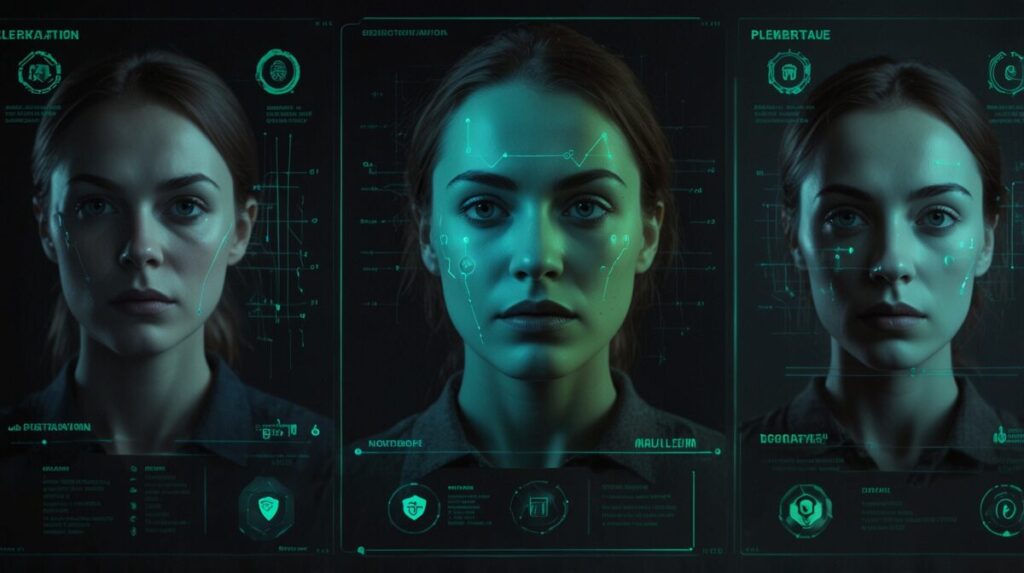
Why is this dangerous:
- Thousands of applications are being created that look legitimate but are synthetic
- According to Experian/TransUnion, the share of synthetic fraud rose sharply in 2023-2024 and reached double-digit percentages in some countries
- A systemic problem for banks — it is difficult to distinguish them from real customers
Why Traditional Checks Don’t Help
Many commercial KYC solutions use passive or active liveness detection (blinking, head turning). But in 2026:
- Modern deepfakes simulate blinking, head turns, and facial expressions
- They create short videos with realistic motion that pass simple checks
- Hardware characteristics (camera resolution, compression, artifacts) can hide signs of forgery
- Detection systems trained on data from two years ago do not recognize new tools
So a single “the user blinks” check is no longer enough. Multi-layered protection is needed.
How users can protect themselves
Although the main burden of protection falls on businesses, ordinary users can also protect themselves from having their identity stolen and used for synthetic fraud.
Basic rules for protecting your identity
- Do not share photos of documents with dubious services and Telegram bots. Your passport can become part of a synthetic identity.
- Do not send video selfies to strangers — even “for verification in a giveaway.” This is raw material for deepfakes.
- Use app-based 2FA (not SMS) — even if your identity is compromised, the account remains protected.
- Check who you give your biometrics to — a legitimate bank/exchange vs. a dubious website.
- Monitor your credit history — synthetic fraud often takes out loans using your data.
- Beware of “jobs” where you are asked to complete KYC “for a client” — this is a classic scheme for using your identity.
Signs that your identity is being used
- SMS codes are arriving from services you never registered with
- Unfamiliar inquiries appear in your credit history
- The bank notifies you about “your” application that you did not submit
- Emails saying “confirm your registration” from unfamiliar platforms
If you notice this, contact your bank immediately and change your passwords. In Ukraine, also check whether your data has been used in schemes through the dropper registry.
Important: handing over your documents and passing KYC “for a reward” for third parties is participation in a fraudulent scheme (dropper activity), for which real criminal liability will apply in 2026. A real case — a Ukrainian woman in Poland took out loans for 286 people using DeepFake and BankID.
How businesses defend themselves
For fintech in 2026, a single layer of protection is not enough. Experts (Group-IB, iProov, FATF) recommend multi-layered defense.
Five layers of modern KYC protection
Layer 1 — Document Intelligence Checking the document’s readability, completeness, and structural validity: OCR, classification, field verification, forgery detection.
Layer 2 — Face Comparison Comparing the selfie/video with the photo in the document. A basic biometric step, but it should not work on its own.
Layer 3 — Liveness Detection Confirming physical presence. Modern systems use passive methods (low friction) plus active challenges (flashes, random movements).
Layer 4 — Deepfake & Injection Detection Checking whether the signal was generated synthetically, altered, or injected into the video stream. The main innovation of 2026.
Layer 5 — Behavioral & Risk Scoring Analyzing behavior, device, session, and network. Assessing the consistency of the full picture, not just a single pass/fail result.
Key countermeasures for 2026
| Countermeasure | What it protects against |
|---|---|
| Biometric binding | Cross-checking the document and the face |
| Passive + active liveness fusion | Protection against recorded deepfakes |
| Injection detection | Protection against VCam and stream spoofing |
| 3D face mapping | Protection against 2D deepfakes |
| Flashmark (flashes) | Protection against pre-recorded video |
| Device & session fingerprinting | Detecting emulators and automation |
| Behavioral biometrics | Keystroke dynamics, gyroscope, touch patterns |
| Human-in-the-loop | Manual review of disputed cases |
What Tier-1 banks are doing
HSBC, NatWest, and JPMorgan Chase expanded behavioral biometrics in 2025-2026: analyzing keystroke dynamics, gyroscope patterns, and touch heatmaps across onboarding sessions. This creates an additional layer that is difficult for a deepfake to imitate.

The “threat → vulnerability → countermeasure” map
| Threat | Vulnerability | Recommended countermeasure |
|---|---|---|
| 2D deepfake (photo on a screen) | Weak liveness | 3D mapping, flashmark |
| Real-time deepfake video | Passive liveness | Active liveness + injection detection |
| Injection attack (VCam) | Trust in the device camera | Camera attestation, device fingerprinting |
| Synthetic identity | Isolated checks | Biometric binding, consortium data |
| Synthetic document | OCR only | MRZ verification, holograms, document forensics |
| Mass automation | No rate control | Behavioral analytics, proxy detection |
| iOS injection attack | Outdated detection models | Regular retraining on fresh attacks |
KYC/AML regulation in 2026
Regulators have responded seriously to the rise in deepfake threats:
- FATF Horizon Scan (December 2025) — deepfakes are officially recognized as a threat to AML, CDD, and digital ID in onboarding
- WEF Cybercrime Atlas (January 2026) — the “Unmasking Cybercrime” study with an analysis of evasion tools
- FinCEN FIN-2024-Alert004 — U.S. banks are required to include the code FIN-2024-DEEPFAKEFRAUD in SAR reports when deepfake media is used in onboarding
- EU AI Act + eIDAS 2.0 — requirements for the reliability of biometric verification
- For compliance teams: failure to detect deepfake fraud may now be classified as a violation of AML/KYC obligations during a regulatory review
This means fintech can no longer treat deepfake protection as an “option” — it is a regulatory requirement.
Frequently Asked Questions (FAQ)
What is KYC in simple terms?
KYC (Know Your Customer) is a customer identity verification procedure required for banks, crypto exchanges, and fintech services. It includes document verification, matching a photo with a selfie, and liveness verification (confirming that a real person is in front of the camera). The purpose is to comply with AML requirements, protect against fraud, and reduce risks.
What is liveness detection?
Liveness detection (“liveness check”) is a technology that confirms a real living person is in front of the camera, not a photograph, video recording, or deepfake. It can be passive (invisible analysis of blinking and skin texture), active (asking the person to turn their head or blink), or hardware-based (3D scanning, infrared sensors). In 2026, methods such as flashmark were added — flashes of color on the screen.
Can facial recognition be fooled with a photograph?
Simple systems could be fooled with a photo or video on a screen, which is why liveness detection appeared. Modern multi-layer systems (3D mapping, injection detection, behavioral biometrics) are much more resilient. However, in 2026, deepfakes and injection attacks have become a serious threat — that is precisely why the industry is moving toward multi-layered protection, and a single face check is no longer enough.
What is deepfake fraud?
Deepfake fraud is fraud that uses AI-generated videos, images, or voice to deceive verification systems. For example, a synthesized face video that imitates blinking and movements to pass liveness checks. According to Sumsub, in 2026 deepfakes account for 11% of all global fraud, up from 7% in 2024.
What is an injection attack?
Injection attack is when an attacker bypasses the device’s real camera and injects synthetic video directly into the verification stream through a virtual camera (VCam). This is one of the fastest-growing threats of 2026 — iProov recorded a several-hundred-percent increase in such attacks over the year, including the first large-scale attacks on iOS devices.
Is biometrics safe in banks?
Biometrics in major banks and fintech overall are safe — they are protected by multilayer systems (3D-liveness, injection detection, behavioral biometrics). However, no system provides a 100% guarantee. The main risks for the user are not a breach of bank biometrics, but the theft of your biometric data through dubious services, which are then used for synthetic fraud. That is why it is important not to share document photos and video selfies with unverified services.
What is a synthetic identity?
Synthetic identity (synthetic identity) is a fake profile created by combining real stolen data (name, document number, date of birth) with completely fabricated information. Such identities appear legitimate to KYC systems and are used to open accounts, obtain loans, and launder money. This is one of the most difficult forms of fraud to detect.
Can I refuse to undergo biometrics?
In most cases, no — for banks and crypto exchanges, biometric verification is required under AML/KYC regulatory requirements. Refusal usually means you will not be able to use the service. Some services offer alternative verification methods (a video call with an operator, visiting a branch), but it is impossible to avoid KYC entirely in regulated fintech.
How to protect your identity from being used in synthetic fraud?
Main rules: do not send document photos to dubious services and Telegram bots; do not send video selfies to strangers; use app-based 2FA; monitor your credit history for unfamiliar inquiries; beware of “jobs” that ask you to complete KYC “for a client” (this is a scam). If you notice SMS codes from services you never signed up for, your identity may already be being used.
Is it legal to complete KYC for other people for a reward?
No, this is illegal and dangerous. Handing over your documents and completing KYC for a reward on behalf of third parties is participation in a fraudulent scheme (dropper activity). In 2026, this carries real criminal liability. Ukraine has created a register of droppers, and in the EU such actions are prosecuted even more strictly. Your data may be used for money laundering and credit fraud, and the liability will fall on you.
Which companies protect against deepfakes in KYC?
Leading players in the liveness detection and deepfake protection market in 2026: iProov (flashmark technology), Sumsub, Onfido, Veriff, FaceTec, Regula, ComplyCube, Reality Defender, Group-IB. They offer multi-layered protection with injection detection, 3D liveness, and behavioral analytics. The choice depends on business needs and regulatory requirements.
What will happen to KYC and biometrics next?
Trend for 2026 and beyond is the shift from one-time checks to continuous verification and multi-layered “AI versus AI” protection. The following will continue to develop: behavioral biometrics, camera attestation (verification of camera authenticity), consortium models for sharing fraud data between banks, and regular retraining of models on fresh attacks. Regulators (FATF, EU) will tighten requirements for deepfake protection.
Conclusion
KYC and biometrics in 2026 are experiencing an arms race between defenders and attackers. Deepfakes, injection attacks, and synthetic identities have taken the threat to a new level — now it is no longer enough to ask, “does the face match?”; it is necessary to verify the authenticity of the biometric signal itself.
Key takeaways:
✅ KYC is a required procedure for banks, exchanges, and fintech
✅ Liveness detection has evolved from simple blinking to 3D and flashmark
✅ Deepfakes = 11% of fraud in 2026 — the threat has become widespread
✅ Injection attacks are the main new threat, including attacks on iOS
✅ Protection = multilayered security — a single method no longer works
✅ It is important for users to protect their documents and biometrics from theft
✅ Regulators (FATF, FinCEN) have made deepfake protection required
For the average user, the main lesson is simple: protect your biometrics and documents just as carefully as your passwords. In a world where an identity can be synthesized for $5, your face and passport are valuable assets that scammers are eager to use against you.