
In brief: A bull run is a phase of a bull market when most cryptocurrencies rise in price by tens or hundreds of percent over 12–20 months. The current cycle began after Bitcoin’s halving in April 2024, and as of May 2026 the market is in a consolidation phase after the first wave of growth, awaiting a second impulse.
Disclaimer: This material is for informational purposes only and does not constitute individual investment advice. Cryptocurrencies are a high-risk asset. Make any investments only with funds you can afford to lose.
- Update: May 2026
- What Is a Bull Run in Cryptocurrency in Simple Terms
- Bull Market vs Bear Market: Key Differences
- Main Reasons and Drivers of the Bull Run
- Bitcoin Halving
- Inflow of Institutional Money
- Macroeconomics and a Weaker Dollar
- Technology Trends and Narratives
- The FOMO Effect (Fear of Missing Out)
- Reduced Supply Through Staking and Holding
- The History of Bull Runs in Cryptocurrency
- The 2013 Bull Run: The First Frenzy
- The 2017 Bull Run: The ICO Era
- The 2021 Bull Run: Institutions and Memecoins
- Bull Run 2024–2026: The ETF Cycle
- Psychological Phases of a Bull Run
- Growth phases (bull market):
- Phases of decline (bear market):
- When Will the Crypto Bull Run Happen: Forecasts for 2026
- Targets from key analysts:
- How to Recognize an Approaching Bull Run
- Bonus indicators:
- How Long Does a Bull Run Last
- Altseason and Capital Rotation
- Stages of capital flow:
- How to identify the start of altseason:
- Investor Strategies During a Bull Run
- Scaling Out Profits in Stages (Scale-Out)
- Do Not Chase the Hype
- Use Stop Orders
- Diversify
- Keep Part of Your Portfolio in Stablecoins
- Security Comes First
- DCA Out Strategy
- Do Not Use Leverage Without Experience
- 10 Signs the Bull Run Is About to End
- What Comes After the Bull Run: The 2027 Crypto Winter
- Timeline of a Typical Crypto Winter:
- What will emerge after the next peak?
- Calendar of Key Crypto Market Events in 2026
- Frequently Asked Questions (FAQ)
- What is a bull run in simple terms?
- When will the next bull run begin?
- How long does a crypto bull run last?
- How high will Bitcoin rise in 2026?
- What is altseason and when will it happen?
- How can you profit from a bull run without taking major risks?
- When does a bull run end?
- What should you do after a bull run ends?
- Does halving affect a bull run?
- Is it possible to make a million during a bull run?
- Conclusion
Update: May 2026
More than two years have passed since the Bitcoin halving in April 2024, and the market has gone through the turbulent growth phase of late 2024 to early 2025, after which it entered a correction. As of May 2026:
- BTC is trading in the $79,000–$82,000 range after pulling back from the local highs reached at the beginning of the year;
- Bitcoin ETFs in the US continue to accumulate assets — the combined AUM of BlackRock’s largest fund (IBIT) and Fidelity’s (FBTC) has surpassed historical records;
- Ethereum, Solana, and major altcoins are showing strong consolidation, and the market is awaiting a second upward impulse;
- The main question of 2026 is whether the cycle will continue under the classic “4-year” model or whether the 2024 halving changed its duration.
Most analysts, including Arthur Hayes, PlanB, and the Bitwise team, agree on one thing: the active phase of the current bull run is not over yet, and the cycle peak may come in summer–autumn 2026.
What Is a Bull Run in Cryptocurrency in Simple Terms
A bull run — is a period of sustained and large-scale price growth in the cryptocurrency market, during which the market capitalization of most assets increases several times over, while the dominant investor sentiment becomes optimism and the fear of missing out on profits (FOMO).
The term came from the stock market back in the 19th century, when Wall Street used it to describe periods of rapid growth in railroad company stocks. It later migrated into crypto along with Bitcoin itself and became part of everyday jargon.
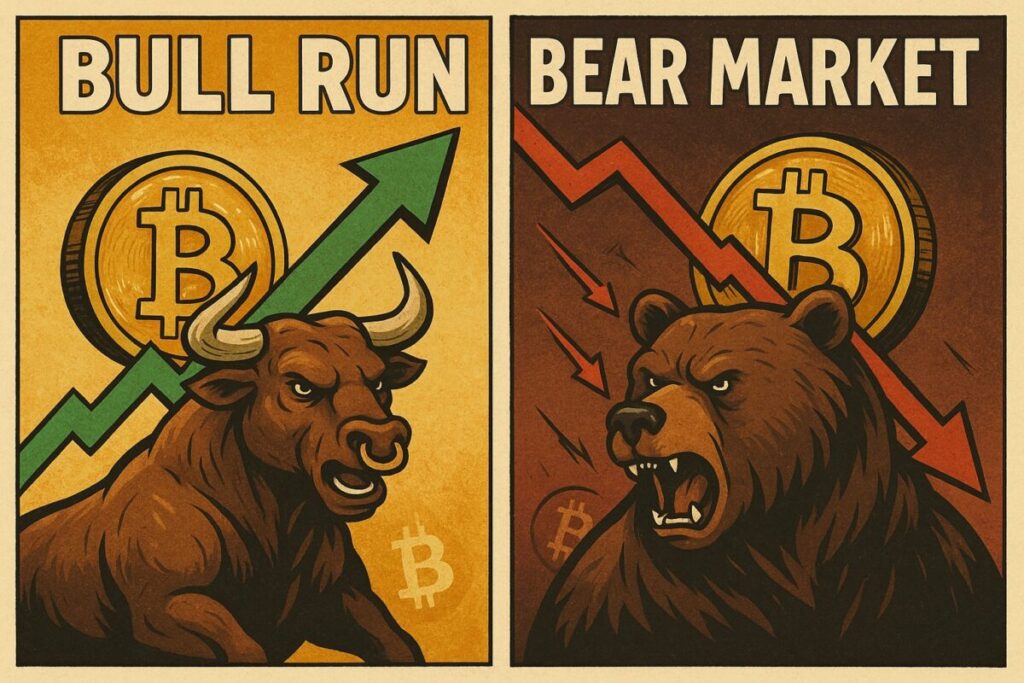
The symbolism is simple and easy to understand:
- 🐂 Bull attacks from the bottom upward, lifting its horns — this is the image of an upward trend;
- 🐻 Bear presses its paw from top to bottom — a symbol of a downward trend (bear market).
During a bull run, almost everything rises: Bitcoin breaks through all-time highs, altcoins multiply in price by 5–50 times, meme tokens deliver triple-digit percentage returns, and the media is filled with enthusiastic headlines about a “new financial era.”
Key quantitative signs of a bull run:
| Metric | Behavior During a Bull Run |
|---|---|
| Market capitalization | Growth from +200% to +1500% |
| BTC Dominance | Rises at first, then falls (altseason begins) |
| Trading volumes | Increase by 5–10 times |
| Fear & Greed Index | 70–100 (Greed / Extreme Greed) |
| Funding rate on futures | Consistently positive |
| New addresses on networks | Sharp growth, especially in Bitcoin and Ethereum |
Bull Market vs Bear Market: Key Differences
To understand where the market stands, it is important to distinguish between its phases. Below is a comparison table.
| Parameter | Bull Market (bull run) | Bear Market |
|---|---|---|
| Price dynamics | Uptrend, new ATHs | Downtrend, setting new lows |
| Duration | 12–20 months | 12–24 months |
| BTC drawdowns | Up to -30% from local highs | Up to -80% from ATH |
| Sentiment | Euphoria, FOMO, optimism | Fear, disappointment, capitulation |
| News | Positive: ETFs, regulation, partnerships | Negative: bankruptcies, hacks, bans |
| Retail demand | Huge numbers of exchange sign-ups | Declining interest, user outflows |
| “Whale” behavior | Accumulation at the beginning, profit-taking at the end | Accumulation of cheap coins |
| Altcoin behavior | Rise faster than BTC, x10–x100 | Fall faster than BTC, lose 90–95% |
Between these phases, there is often an intermediate one — the “crab market” (sideways market), when the price fluctuates within a narrow range without a clear trend. This is exactly the state the market is in for most of May 2026.
Main Reasons and Drivers of the Bull Run
A bull run is not a random event. It begins gradually and develops like an avalanche under the influence of 6 key factors:
Bitcoin Halving
Approximately every 4 years, the reward miners receive for a block is cut in half. This reduces the inflow of new BTC to the market and creates an artificial supply shortage. Historically, each halving has preceded a bull run with a lag of 6–18 months.
- 2012 → 2013 peak
- 2016 → 2017 peak
- 2020 → 2021 peak
- 2024 → 2025–2026 peak (current cycle)
Inflow of Institutional Money
After the approval of spot Bitcoin ETFs in the United States in January 2024, billions of dollars from pension funds, insurance companies, and family offices flowed into crypto. BlackRock IBIT became the fastest-growing ETF in history, surpassing even Gold ETFs in the speed of AUM accumulation.
In 2025, they were joined by Spot Ethereum ETFs, and in 2026 ETFs for Solana, XRP, and basket-based crypto indices are expected to appear.
Macroeconomics and a Weaker Dollar
When central banks cut rates or print money, investors look for safe-haven assets with high return potential. In recent cycles, Bitcoin has increasingly behaved like “digital gold.”
Key macro factors for 2026:
- The Fed rate-cutting cycle
- Growth in the M2 money supply
- Geopolitical tensions
- De-dollarization by BRICS+
Technology Trends and Narratives
Each cycle has its own main narrative:
- 2017 — ICO, ERC-20 tokens
- 2021 — DeFi, NFT, GameFi, metaverses
- 2024–2026 — RWA (real-world asset tokenization), AI agents, Bitcoin L2, restaking, Solana DePIN
The FOMO Effect (Fear of Missing Out)
When neighbors, taxi drivers, and hairdressers start talking about Bitcoin, it is a classic signal of the late stage of a bull run. The psychological fear of missing out drives even skeptics to buy, pushing prices to irrational levels.
Reduced Supply Through Staking and Holding
More and more BTC and ETH are moving into cold wallets, DAO treasuries, corporate balance sheets (Strategy/MicroStrategy, Tesla, Metaplanet), and staking protocols. This reduces the circulating supply and amplifies price growth at the same level of demand.
The History of Bull Runs in Cryptocurrency
The 2013 Bull Run: The First Frenzy
- Start: January 2013
- Peak: December 2013
- BTC Growth: $13 → $1163 (×90)
- Driver: the banking crisis in Cyprus, Bitcoin’s first widespread online recognition
The total market capitalization at that time did not exceed $14 billion. There were very few altcoins — mainly Litecoin, Namecoin, and Peercoin.
The 2017 Bull Run: The ICO Era
- Start: spring 2017
- Peak: December 2017
- BTC growth: $1000 → $19 800 (×20)
- Driver: the ICO boom on Ethereum, ERC-20 tokens
This was the first altseason. Ethereum rose from $8 to $1400 (×175), and hundreds of small tokens delivered x100 gains in just a few weeks. After the peak, the market fell by 84% — the first crypto winter arrived.
The 2021 Bull Run: Institutions and Memecoins
- Start: autumn 2020
- Peak: November 2021
- BTC growth: $3 800 → $69 000 (×18)
- Drivers: DeFi summer 2020, the NFT boom, MicroStrategy and Tesla entering the market, Coinbase listing on NASDAQ
The market capitalization reached $3 trillion. Dogecoin surged by 14,000% thanks to Elon Musk’s tweets, while CryptoPunks NFTs sold for millions. After the peak, the market fell by 77% by the end of 2022.
Bull Run 2024–2026: The ETF Cycle
- Start: late 2023
- Intermediate peak: late 2024 — early 2025 ($100,000+ per BTC)
- Current phase: consolidation, awaiting the second wave
- Drivers: Spot ETF approval, MicroStrategy copycats, AI narrative, RWA tokenization
A defining feature of this cycle is a smoothed amplitude: thanks to massive institutional liquidity and steady ETF buying, drawdowns have become less severe, while growth has been less exponential than in previous cycles.
Psychological Phases of a Bull Run
This model is known as the Wall Street Cheat Sheet — it describes the emotional stages the crowd goes through in any bull market. Understanding your current phase is the best protection against mistakes.

Growth phases (bull market):
- Disbelief — “This is just another dead cat bounce, the market will fall back down”
- Hope — “Maybe the bottom really is behind us?”
- Optimism — “It looks like a new cycle is beginning”
- Belief — “I was right, I need to increase my positions”
- Thrill — “I’m a genius, I need to use leverage!”
- Euphoria — “Soon every taxi driver will buy Bitcoin at $250,000” (peak)
Phases of decline (bear market):
- Complacency — “This is just a normal correction, we’ll recover soon”
- Anxiety — “Maybe it’s time to take profits?”
- Denial — “My fundamentals haven’t changed, we hold”
- Panic — “I’m selling everything before it drops even lower”
- Capitulation — “This is the end of crypto, never again”
- Despondency — “I’ve lost everything”
- Depression — “I’m never buying this crap again”
📍 Where we are now (May 2026): most analysts place the market in the Optimism — Belief phases. The Euphoria stage is still ahead.
When Will the Crypto Bull Run Happen: Forecasts for 2026
It is impossible to predict the exact date of the peak, but there are 5 signs by which analysts expect the growth to continue specifically in 2026:
- Bitcoin ETFs continue to attract capital — the total AUM of spot BTC ETFs has exceeded $200 billion, while every major dip is being bought by institutional investors.
- Fed rate cuts in 2026 are supporting risk assets.
- The launch of altcoin ETFs (Solana, XRP, Litecoin) is adding liquidity.
- The halving cycle has historically produced a peak after 18–22 months — which points to September–December 2026.
- Technological upgrades: Ethereum Pectra and Fusaka, Solana Firedancer, the development of Bitcoin L2s (Stacks, BOB, Babylon).
Targets from key analysts:
| Analyst / Institution | BTC Forecast for 2026 | ETH Forecast for 2026 |
|---|---|---|
| Bitwise | $200 000 | $7 000 |
| Standard Chartered | $135 000 | $5 500 |
| PlanB (Stock-to-Flow) | $150 000 | — |
| Arthur Hayes | $250 000 (cycle peak) | $10 000 |
| ARK Invest (Cathie Wood) | $300 000+ (long term) | — |
| Analyst Consensus | $120 000–$180 000 | $5 000–$8 000 |
Important: these are forecasts, not guarantees. Actual performance may differ, especially in the event of unexpected macro events.
How to Recognize an Approaching Bull Run
10 early signals that a new growth cycle is beginning:
- A sharp increase in the number of new wallets on the Bitcoin and Ethereum networks
- The return of crypto to mainstream media — covers in Time and Forbes, articles in Bloomberg
- Renewed activity from TikTok and YouTube influencers — “experts” are once again promising $1 million for Bitcoin
- Large positions being opened by institutions — funds’ 13F filings
- Growth in trading volumes on spot markets (not just futures)
- Inflows into spot ETFs are becoming consistently positive
- The emergence of new startups and hyped projects (Layer-2, AI, RWA)
- Consistently positive funding rate in futures markets
- Growth in Google search volume for queries like “how to buy Bitcoin” and “best crypto exchange”
- Old wallets becoming active again, dormant since the previous cycle
Bonus indicators:
- Pi Cycle Top Indicator — the crossover of MA111 and MA350×2
- MVRV-Z Score — the ratio of market capitalization to realized capitalization
- Bitcoin Dominance — its decline signals the start of altseason
- Fear & Greed Index — a move into the “Greed” zone (>70)
How Long Does a Bull Run Last
Historical statistics indicate an average duration of 12–20 months from the start of the rise to the peak. This is followed by a correction phase, and then a crypto winter.
| Cycle | Growth duration | Drawdown after the peak |
|---|---|---|
| 2013 | 12 months | -85% (2014–2015) |
| 2017 | 12 months | -84% (2018) |
| 2021 | 18 months | -77% (2022) |
| 2024–2026 | ~24+ months (ongoing) | — |
The crypto market has historically operated in four-year cycles:
- Halving year — accumulation phase
- The following year — the start of the bull run
- One more year — the peak and the beginning of the correction
- Then — crypto winter, accumulation of cheaper coins
However, the 2024–2026 cycle may turn out to be the first “extended” cycle due to massive institutional participation — peaks and declines are becoming more stretched out over time.
Altseason and Capital Rotation
Altseason is a phase of the bull run when altcoins rise faster than Bitcoin and significantly outperform it. This happens due to capital rotation: investors take profits in BTC and reallocate them into riskier assets.
Stages of capital flow:
- Bitcoin rises first (BTC.D increases)
- Ethereum catches up with and surpasses BTC
- Large-cap altcoins (Solana, BNB, XRP, Cardano) accelerate
- Mid-cap tokens deliver x5–x20
- Low-liquidity coins and memecoins go to the moon — this is the peak of altseason
How to identify the start of altseason:
- Altcoin Season Index exceeds 75 (on blockchaincenter.net)
- Bitcoin Dominance falls below 50%
- The ETH/BTC pair forms a sustained upward trend
📍 As of May 2026, the altseason index is in the 40–55 range, meaning the market is on the verge, but a full-fledged altseason is still ahead.
If you plan to profit from altcoins, we recommend preparing an account on the KuCoin exchange in advance — it has historically listed small-cap coins earlier than Binance.
Investor Strategies During a Bull Run
A bull run is a time of opportunities and elevated risks. To avoid becoming a “buyer at the top,” it is important to follow a well-thought-out strategy.
Scaling Out Profits in Stages (Scale-Out)
Do not try to catch the absolute top. Sell 10–20% of your portfolio on each major upswing or when key round-number levels are reached ($100k, $120k, $150k for BTC).
Do Not Chase the Hype
Historical statistics are ruthless: 80% of the “new stars” of altseason lose 90%+ after the peak. If someone is recommending an “insider” coin on Telegram, it is almost certainly a pumper.
Use Stop Orders
Protect your capital with technical stops. This is especially important for altcoins — they can lose 50% in a single day.
Diversify
Do not invest everything in a single asset. A classic “crypto allocation” looks like this:
- 40–60% BTC (portfolio core)
- 20–30% ETH (the second-largest network)
- 10–20% large-cap altcoins (SOL, BNB, AVAX, etc.)
- 5–10% speculative bets (RWA, AI, DePIN tokens)
- 5–10% stablecoins (for buying the dip during corrections)
Keep Part of Your Portfolio in Stablecoins
Stablecoins (USDT, USDC) are your “cash within the system.” They let you buy more assets during pullbacks and preserve purchasing power.
Security Comes First
- Cold wallet (Ledger, Trezor) for long-term holdings
- Two-factor authentication (2FA) via an app (not SMS!)
- Anti-phishing phrase on exchanges
- No private keys in the cloud or in screenshots
Learn more about security in our guide “Top 10 Cryptocurrency Wallets of 2025”.
DCA Out Strategy
This is the reverse of DCA (Dollar-Cost Averaging) when buying. Sell a fixed percentage of your portfolio every week or month during periods of euphoria. This helps average out your selling price without trying to catch the top.
Do Not Use Leverage Without Experience
During periods of euphoria, the temptation to use leverage is especially strong. Do not do this if you have no experience with futures and risk management. To learn how to work with leverage, read the article “How to Short on Binance”.
10 Signs the Bull Run Is About to End
How can you tell when euphoria has peaked and it’s time to take profits?
- Taxi drivers, hairdressers, and neighbors are asking which crypto to buy
- Magazine covers of Time / Forbes / Bloomberg featuring Bitcoin
- Fear & Greed Index is consistently above 90 (Extreme Greed)
- Funding rate on futures exceeds 0.1% (3x annualized ~36%)
- Memecoins and shitcoins are doing x100 in a week
- Top banks announce their crypto products “at the very last moment”
- Coinbase / Binance App tops the App Store rankings
- Mass “crypto marketing” appears on TV and in stadiums
- MVRV-Z Score exceeds 7 (a historical overheating signal)
- Regulators introduce new restrictions — usually this is the peak point
An old trader saying: “When your grandmother asks about Bitcoin, it’s time to sell.”
What Comes After the Bull Run: The 2027 Crypto Winter
Every Bull Run ends with a market revaluation. Weak projects disappear, while strong ones become the new leaders of the next cycle.
Timeline of a Typical Crypto Winter:
- Peak → -30% in 1–2 months (fast correction)
- -30% → -60% in 4–6 months (slow decline)
- -60% → -80% in 6–12 months (capitulation)
- Sideways movement at the bottom — 6–12 months of accumulation
- The next cycle begins 6–12 months before the halving
What will emerge after the next peak?
Every crypto winter “gives birth” to new giants:
- After 2017 — Binance, Chainlink, Uniswap, Polygon
- After 2021 — Arbitrum, Optimism, Celestia, EigenLayer
- After 2026 — breakthroughs are expected in AI agents, ZK-rollups, decentralized AI, and RWA infrastructure
A crypto winter is the best time for long-term accumulation. Those who bought BTC in 2022 at $16,000 had already locked in 6x profits by 2025.
Calendar of Key Crypto Market Events in 2026
These events can become triggers for both growth and corrections:
| Period | Event | Potential Effect |
|---|---|---|
| Q2 2026 | Ethereum Fusaka Upgrade | Lower fees, ETH growth |
| Q2–Q3 2026 | SEC decisions on Spot Solana ETF | Large capital inflow into SOL |
| Summer 2026 | Fed meetings, rate-cut cycle | Support for risk assets |
| Q3 2026 | Bitcoin Conference in Miami | Marketing momentum, rising FOMO |
| Q4 2026 | Possible cycle peak based on the halving model | All-time high? |
| Ongoing | Inflows/outflows in BTC and ETH ETFs | Main short-term driver |
Frequently Asked Questions (FAQ)
What is a bull run in simple terms?
A bull run is a period of sustained price growth in the cryptocurrency market, usually lasting 12–20 months, during which most assets rise by hundreds or even thousands of percent. It is the opposite of a bear market.
When will the next bull run begin?
The current bull run has already been underway since late 2023 to early 2024, following the approval of Spot Bitcoin ETFs in the US and the halving in April 2024. As of May 2026, the market is in a consolidation phase, awaiting a second growth impulse. According to analyst consensus, the cycle peak is expected in the second half of 2026.
How long does a crypto bull run last?
Historically, from 12 to 20 months. The 2013 bull run lasted about 12 months, the 2017 one 12 months, and the 2021 one 18 months. The current 2024–2026 cycle may turn out to be longer due to institutional capital.
How high will Bitcoin rise in 2026?
Consensus forecasts from major analysts (Bitwise, Standard Chartered, ARK Invest) point to a range of $120 000–$200 000 at the cycle peak. The most aggressive forecasts (Arthur Hayes) go up to $250 000. The most conservative are $100 000–$120 000.
What is altseason and when will it happen?
Altseason is the phase of a bull run when altcoins rise faster than Bitcoin. It usually begins in the second half of the bullish cycle, after BTC sets new highs. As of May 2026, the altseason index is below 60, but many analysts expect it to start in the second half of the year.
How can you profit from a bull run without taking major risks?
The most conservative strategies are: 1) DCA (regular purchases of BTC and ETH), 2) holding through a cold wallet, 3) staking ETH and SOL, 4) using stablecoins in low-risk DeFi protocols (Aave, Compound). Avoid leverage, memecoins, and “insider” recommendations.
When does a bull run end?
The main signs of the end of a bull run are general euphoria, even the weakest projects rising by x100, magazine covers featuring Bitcoin, and mass interest from a “non-core” audience (taxi drivers, hairdressers). Technical indicators include the Fear & Greed Index above 90 and the MVRV-Z Score above 7.
What should you do after a bull run ends?
Lock in most of your profits in stablecoins or fiat, move into defensive assets (BTC, ETH), and buy a share of highly liquid altcoins at the next bottom (usually 12–18 months after the peak). Crypto winter is the best time for accumulation.
Does halving affect a bull run?
Yes, historically every Bitcoin halving (once every 4 years) has preceded a bull run with a lag of 6–18 months. This is linked to a reduction in the supply of new BTC and a shift in the supply-demand balance. The latest halving took place in April 2024.
Is it possible to make a million during a bull run?
Technically, yes — in every cycle, “new millionaires” appear, but that is the domain of a select few with large starting capital or incredible luck. It is far more realistic to multiply your capital by 3–10 times with a disciplined approach and proper risk management.
Conclusion
A bull run is the heart of the crypto market. It turns ideas into capital, enthusiasts into millionaires, and skeptics into spectators. But behind every wave of euphoria stands cyclicality, discipline, and an understanding that the market lives by its own rules.
Right now, in May 2026, we are in the middle of the fourth crypto bull run in history. The main question is no longer “will there be a bull run?” but “how do you get the most out of it without burning out at the peak?”.
Follow fundamental events, study market cycles, do not give in to FOMO — and when the next cycle top truly arrives, you will be among those who took profits there, not those who bought last.