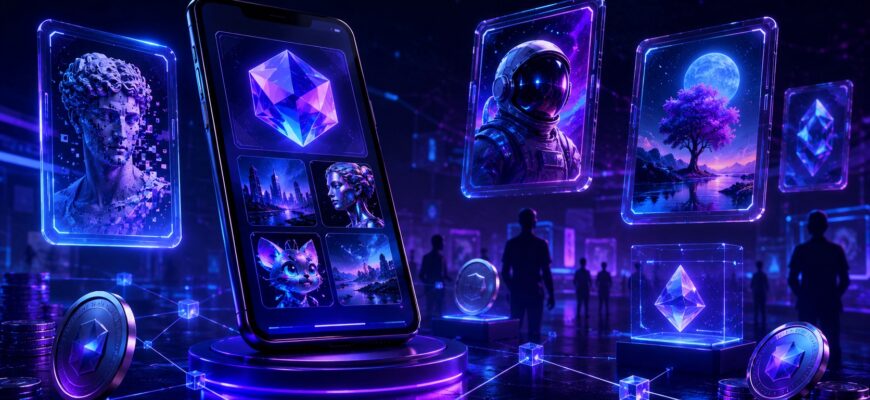
NFT (non-fungible token) is a unique digital certificate of ownership recorded on the blockchain. It confirms that you own a specific digital asset: an in-game item, an image, a ticket, a domain, or even rights to a real-world asset. In 2026, NFTs are no longer just “pictures of apes”: 38% of the total market volume consists of gaming assets, and another ~35% is real-world asset (RWA) tokenization. The NFT market went through the 2022–2024 crash and was reborn in 2025–2026 as a utility tool with real-world value.
Disclaimer: This material is for informational purposes only and does not constitute investment advice. NFTs are a high-risk asset with high volatility and low liquidity. Carry out any transactions only with funds you can afford to lose.
- Update: May 2026
- What Is an NFT in Simple Terms
- Key Properties of NFTs
- How NFTs Differ from Cryptocurrency
- How NFT Technology Works
- NFT Anatomy
- What happens when you buy an NFT
- What you actually get
- The History of NFTs
- 2013–2017: Experiments and Pioneers
- 2020–2021: NFT Mania and the Peak of the Bubble
- 2022–2024: The “Great NFT Winter”
- 2025–2026: Revival Through Utility
- NFTs in Gaming: The Main Trend of 2026
- What Are NFTs in Gaming
- How It Works: Traditional Game vs NFT Game
- The Play-to-Earn (P2E) Concept
- Advantages of NFTs in Games
- Drawbacks and Risks
- Top 10 Blockchain Games with NFTs in 2026
- 1. Axie Infinity
- 2. The Sandbox
- 3. Illuvium
- 4. Gods Unchained
- 5. Shrapnel
- 6. Off the Grid
- 7. Pixels
- 8. Big Time
- 9. Star Atlas
- 10. Apeiron
- RWA — tokenization of real-world assets
- What are RWA-NFTs
- RWA segment figures in 2026
- Main Advantages of RWA-NFTs
- Where Else NFTs Are Used
- Event Tickets
- Loyalty Programs
- Music and Content
- Digital Art
- Domain Names
- Digital Identity
- Certificates and Diplomas
- Carbon Credits
- Content and Subscriptions
- Top 7 NFT Marketplaces of 2026
- 1. OpenSea (OS2)
- 2. Blur
- 3. Magic Eden
- 4. Rarible
- 5. Binance NFT
- 6. Nifty Gateway
- 7. SuperRare
- Comparison Table: Where to Mint NFTs
- How to Create Your Own NFT (Mint): Step-by-Step Guide
- Step 1: Prepare the file
- Step 2: Create a crypto wallet
- Step 3: Buy Some Cryptocurrency
- Step 4: Choose a blockchain
- Step 5: Register on the marketplace
- Step 6: Create a collection (for an NFT series)
- Step 7: Minting an NFT
- Step 8: List it for sale
- Step 9: Promotion
- How to Buy NFTs: First Steps
- Step 1: Wallet + Cryptocurrency
- Step 2: Research the Project Before Buying
- Step 3: Purchase on the marketplace
- Step 4: Storage and Security
- How to Make Money with NFTs in 2026
- 1. Earning in NFT Games (Play-and-Earn)
- 2. Creating and Selling Your Own NFT Art
- 3. Long-Term Holding of Blue-Chip Collections
- 4. Flipping (Quick Resale)
- 5. Airdrops and Whitelist Hunting
- 6. Buying Virtual Land and Renting It Out
- 7. NFT Staking
- 8. NFT Lending
- NFT Token Standards
- Ethereum
- Solana
- Bitcoin
- Other networks
- Risks and Fraud
- Top 10 Types of NFT Fraud
- How to protect yourself
- The Future of NFTs
- Key Trends for the Coming Years
- Market Forecast Through 2030
- Frequently Asked Questions (FAQ)
- What is an NFT in simple terms?
- What are NFTs in games?
- How do NFTs work in games?
- How do people make money from NFT games?
- How much does it cost to create an NFT?
- Where is the best place to create (mint) an NFT in 2026?
- Can a beginner make money from NFTs in 2026?
- What are the most popular NFTs in 2026?
- Which is more profitable — buying NFTs or cryptocurrency?
- Are NFTs a scam or not?
- Can you buy NFTs with rubles or hryvnias?
- Are NFTs taxed?
- How many NFTs exist in the world?
- What will happen to NFTs by 2030?
- Conclusion
Update: May 2026
The NFT market in 2026 looks completely different from the era of Bored Apes and CryptoPunks in 2021:
- Average monthly trading volume for NFTs on Ethereum has stabilized at around ~$720 million (a 50% recovery from the 2024 low)
- The total NFT market capitalization is estimated at around ~$60–65 billion
- 38% of volume comes from gaming NFTs, ~30% from RWA (real-world assets), and only the remainder from collectible PFP projects
- Main marketplaces: OpenSea OS2 (all-purpose), Blur (professional traders), Magic Eden (Solana + Bitcoin Ordinals)
- Regulation: MiCA is in force in the EU, while the GENIUS Act applies in the US, which has improved security but made it harder to list anonymous projects
The main trend: the market has shifted from speculation to utility. Only projects with real use cases survived — games, tickets, loyalty programs, and tokenization of physical assets.
What Is an NFT in Simple Terms
NFT (short for non-fungible token) is a unique digital object that exists as a one-of-a-kind item, with ownership rights recorded on the blockchain.
Put even more simply, an NFT is a digital ownership passport for a particular item. That item can be:
- Digital painting or illustration
- Sword, helmet, or skin in a video game
- Music track or album
- Ticket to a concert or event
- Title document for an apartment or car
- Certificate of authenticity for a Rolex watch
- Digital identity document
- Share in an art collection
Everyday analogy. Imagine you have a copy of the Mona Lisa printed at a print shop. Millions of people have the same copies too — but there is only one original, and it hangs in the Louvre. An NFT is that very “original” in the digital world. Someone can copy your image, but there is only one owner, and that is recorded on the blockchain forever.
Key Properties of NFTs
| Property | What it means |
|---|---|
| Uniqueness | Each NFT is different from another, even within the same collection |
| Indivisibility | You cannot “give away half” of an NFT — it is whole (although fractionalization exists through ERC-20 wrappers) |
| Verified ownership | Information about the owner is recorded on the blockchain and cannot be forged |
| Transferability | An NFT can be sold, gifted, exchanged, or burned |
| Programmability | An NFT can include a smart contract with royalties, rights, and functions |
| Transparent history | All previous owners and transactions are visible on the blockchain |
How NFTs Differ from Cryptocurrency
This is the most common source of confusion for beginners. The difference is fundamental.
| Parameter | Cryptocurrency (BTC, ETH, USDT) | NFT (CryptoPunk, in-game sword, ticket) |
|---|---|---|
| Type | Fungible | Non-fungible |
| Divisibility | Can be divided into parts (1 BTC = 100 million satoshis) | Whole, not divisible |
| Equality | 1 BTC owned by Alice = 1 BTC owned by Bob | NFT #1 ≠ NFT #2, even within the same collection |
| Ethereum standard | ERC-20 | ERC-721, ERC-1155 |
| Purpose | A medium of exchange and store of value | Proof of unique ownership |
| Metadata | Simple balance | Name, image, properties, history |
A simple example: one dollar in your wallet is equal to one dollar in your neighbor’s wallet — you can exchange them without any issue. But a front-row ticket to a Coldplay concert and a ticket to the same concert in the upper tier are different things with different value. A front-row ticket is a good analogy for understanding NFTs: it is unique and non-fungible.
How NFT Technology Works
NFTs operate on a blockchain — a distributed database whose copies are stored on thousands of computers around the world. This makes forging or deleting information about the owner practically impossible.
NFT Anatomy
Each NFT consists of three parts:
- Smart contract — code that defines the token’s rules (how it can be transferred, what properties it has, and what royalties the creator receives).
- Unique identifier (Token ID) — the sequential number within a collection, for example, CryptoPunk #7804.
- Metadata — the description of the item: name, image, properties, and a link to the file. The file itself (image, video, music) is usually stored not on the blockchain, but in decentralized storage such as IPFS or Arweave.
What happens when you buy an NFT
- You go to a marketplace (for example, OpenSea) and connect your crypto wallet (MetaMask).
- Choose an NFT and click “Buy”.
- The wallet shows the amount + the network fee (gas fee).
- You confirm the transaction.
- Blockchain miners/validators record the NFT transfer in a new block.
- After a few seconds (Solana) or minutes (Ethereum), the NFT appears in your wallet.
- You become the verified owner — this is recorded on the blockchain forever.
What you actually get
There is an essential nuance here. When you buy an NFT with an image:
- ✅ You receive a record on the blockchain stating that you are the owner
- ✅ You receive the right to sell this NFT
- ⚠️ Anyone can download the image as a file
- ⚠️ Copyright to the original image remains with the author unless the smart contract explicitly states otherwise (an exception is Bored Ape Yacht Club and several other collections that transfer commercial rights)
This is the key misunderstanding that NFT critics run into. But in 2026, this issue is solved through utility — an NFT provides not a picture, but access, functions, rights.
The History of NFTs
2013–2017: Experiments and Pioneers
The first attempts at tokenization were made on the Bitcoin blockchain. In 2013, Colored Coins appeared — colored bitcoins representing ownership of an asset. In 2014 — Counterparty (Pepe the Frog memes).
The true NFT era began in 2017 with the emergence of CryptoPunks — 10,000 pixel portraits on Ethereum from Larva Labs. They were originally distributed for free; now rare examples are worth millions of dollars.
In November 2017, the first mass-market NFT game, CryptoKitties, launched — breeding virtual cats. The game put so much strain on the Ethereum network that fees surged dozens of times over, and transactions were stuck for hours.
2020–2021: NFT Mania and the Peak of the Bubble
After DeFi summer in 2020, NFTs became the next hype cycle. Key events:
- March 2021 — the British auction house Christie’s sold Beeple’s NFT titled “Everydays: The First 5000 Days” for a record $69.3 million
- March 2021 — the “Nyan Cat” meme sold for 300 ETH (~$580,000)
- March 2021 — Twitter founder Jack Dorsey sold his first tweet for $2.91 million
- 2021 — launch of Bored Ape Yacht Club (BAYC), which became the leading NFT collection at the market peak
- November 2021 — total monthly NFT volume exceeded $5 billion
2022–2024: The “Great NFT Winter”
After Bitcoin peaked in November 2021, the NFT market began cooling rapidly. By the end of 2024:
- Trading volume fell by 79% from its 2022 peak
- Most “monkey” projects lost 95–99% of their value
- Many marketplaces (LooksRare, X2Y2) have virtually stopped functioning
- On Google Trends, the query “are NFTs dead” surged to an all-time high
2025–2026: Revival Through Utility
Since late 2025, the NFT market has begun to recover, but on a different foundation:
- Recovery from the 2024 bottom by 50% — stabilization of Ethereum NFT monthly volume at $720 million in Q1 2026
- The gaming segment became the largest: 38% of total transaction volume
- RWA (real-world asset tokenization) — more than $26 billion already on-chain
- AI-NFT — around 30% of new 2026 projects use AI to evolve properties
- MiCA, DAC8, GENIUS Act — regulatory clarity, cleansing the market of fraudsters
- L2 networks (Base, Arbitrum) became the main “home” for new NFTs — low fees, fast transactions
In 2026, the market is experiencing a K-shaped recovery: high-quality projects with strong fundamentals are thriving, while junk projects are finally dying off.
NFTs in Gaming: The Main Trend of 2026
If in 2021 NFTs were associated with apes, then in 2026 they are associated with gaming assets. This is the largest and fastest-growing segment of the NFT market.
What Are NFTs in Gaming
NFTs in gaming (gaming NFTs) are unique in-game items that belong to the player rather than the developer. These can include:
- Weapons, armor, artifacts
- Land plots in virtual worlds
- Characters and heroes with unique abilities
- Skins and cosmetics
- Virtual pets and creatures
- Cards with unique properties
How It Works: Traditional Game vs NFT Game
| Parameter | Traditional game (Fortnite, CS) | Game with NFTs (Axie, Illuvium) |
|---|---|---|
| Who owns the sword/skin | The developer (you only rent it) | You — it is recorded on the blockchain |
| Can the item be sold | No (only through the gray market, with a risk of being banned) | Yes, on a marketplace for real money |
| What happens if the game shuts down | Everything disappears | The NFTs remain in your wallet |
| Transfer between games | Impossible | Possible (interoperability) |
| Player earnings | Only pros through tournaments | Possible through play-to-earn |
The Play-to-Earn (P2E) Concept
The main revolution that NFTs brought to gaming is the ability to earn money by playing. The player:
- Buys or receives an NFT character/item
- Plays and develops it
- Sells a more upgraded NFT to another player for real money
- Or receives in-game tokens, which they convert into USDT/ETH
During the 2021 peak, Axie Infinity players in the Philippines were earning more than the country’s average salary. Today, P2E has evolved into more sustainable models — Play-and-Own and Play-and-Earn, where the main goal is enjoyment, and earnings become a pleasant bonus.
Advantages of NFTs in Games
✅ True ownership of in-game assets
✅ Transparent economy — no inflation from the developer
✅ Opportunity to earn from your skills and time
✅ Interoperability — some items can be used across multiple games
✅ Protection against game shutdown — your NFTs will remain in your wallet
Drawbacks and Risks
⚠️ Often require an initial investment (although there are free options too)
⚠️ Gameplay is often primitive — the main criticism of P2E
⚠️ Dependence on an inflow of new players (risk of a pyramid-style economy)
⚠️ Price volatility — the value of NFTs can drop by dozens of times
⚠️ Barrier to entry — you need a crypto wallet and an understanding of blockchain
Top 10 Blockchain Games with NFTs in 2026
Best projects as of May 2026:
1. Axie Infinity
Genre: PvP creature battles
Blockchain: Ronin (Ethereum sidechain)
Feature: A P2E pioneer that survived the 2022–2023 downturn and stabilized. It now operates in a Play-and-Earn format with free entry via starter Axies.
2. The Sandbox
Genre: Voxel metaverse, world-building platform
Blockchain: Ethereum + Polygon
Feature: Virtual LAND as NFTs. Partnerships with Adidas, Atari, and Snoop Dogg. Strong creator community.
3. Illuvium
Genre: AAA RPG + auto-battler
Blockchain: Immutable X
Feature: Unreal Engine 5-level graphics. Considered a leader in blockchain AAA gaming.
4. Gods Unchained
Genre: Card game (TCG)
Blockchain: Immutable X
Feature: Free entry. Cards are NFTs that can be sold. A Web3 competitor to Hearthstone.
5. Shrapnel
Genre: Tactical shooter (extraction shooter)
Blockchain: Avalanche
Feature: One of the first blockchain projects with AAA graphics and standard shooter gameplay.
6. Off the Grid
Genre: Battle royale
Blockchain: GUNZ (built on Avalanche)
Feature: A shooter from Neill Blomkamp’s team (director of “District 9”). Launched in 2024, and by 2026 it is one of the most-played blockchain shooters.
7. Pixels
Genre: Pixel-art farming simulator
Blockchain: Ronin
Feature: One of the leaders in daily active users in Web3. Simple gameplay with mobile accessibility.
8. Big Time
Genre: Multiplayer RPG
Blockchain: proprietary
Feature: High-quality 3D graphics, an economy based on NFT items, and an active community.
9. Star Atlas
Genre: Space MMO strategy
Blockchain: Solana
Feature: One of the most ambitious projects — space, ships, and factions. Unreal Engine 5 graphics.
10. Apeiron
Genre: “God game” / god simulator
Blockchain: proprietary + Ethereum
Feature: Unique mechanics — the player controls planets through NFTs.
Tip for beginners: don’t invest money in NFT games right away. Start with free projects (Pixels, Gods Unchained, Off the Grid), understand how they work, and only then invest.
RWA — tokenization of real-world assets
If 2021 was the era of “monkey” NFTs, then 2026 is the era of RWA (Real-World Assets). This is the fastest-growing segment of the NFT industry.
What are RWA-NFTs
RWA-NFT is a digital token linked to a real physical or financial asset. Each such NFT is a “digital twin” of a real-world item.
Examples:
| Real-world asset | What an RWA-NFT provides |
|---|---|
| Apartment in Dubai | Ownership share, right to rental income |
| Picasso painting | Certificate of authenticity + ownership rights |
| Patek Philippe watch | Proof of authenticity upon resale |
| Government bond | Right to receive coupon payments |
| Bottle of wine from 1945 | Digital passport for a collectible item |
| 2-carat diamond | GIA certificate + ownership history |
| Car | Electronic title and service history |
RWA segment figures in 2026
- More than $26 billion in real-world assets have already been tokenized on-chain
- 4x year-over-year growth
- BlackRock, Franklin Templeton have already issued bond RWAs on the blockchain
- The Courtyard platform popularized the tokenization of physical collectibles
- Real estate tokenization forecast: $78 billion by the end of 2026
Main Advantages of RWA-NFTs
✅ Instant transfer of ownership rights (without notaries and weeks of waiting)
✅ Fractionalization of expensive assets (you can buy 0.01% of a house)
✅ Transparent ownership history — impossible to forge
✅ Global liquidity — an asset can be sold to a buyer from any country
✅ Fewer intermediaries — savings on fees
Where Else NFTs Are Used
Beyond gaming and RWA, NFTs in 2026 are used in dozens of other areas:
Event Tickets
Platforms like GET Protocol replace paper and electronic tickets with NFTs. They cannot be forged or resold through scammers.
Loyalty Programs
Starbucks Odyssey (closed in 2024) showed the way, and its successors are developing actively. Brands use NFTs as “membership cards” with unique privileges.
Music and Content
Audius, Royal, Sound.xyz allow artists to sell NFT tracks and share royalties with fans.
Digital Art
SuperRare, Foundation, Nifty Gateway — curated platforms for serious artists.
Domain Names
ENS (Ethereum Name Service) and Unstoppable Domains — Web3 domains like yourname.eth, which are also NFTs.
Digital Identity
Identity-NFTs — user passports in Web3. By the end of 2026, 12 million of these tokens had already been issued.
Certificates and Diplomas
Universities (MIT, ETH Zurich) issue NFT diplomas that cannot be forged.
Carbon Credits
Toucan, Klima DAO — tokenization of CO₂ offset credits.
Content and Subscriptions
Mirror (blogs), Patreon Pro (subscriptions) — NFTs as access to exclusive content.
Top 7 NFT Marketplaces of 2026
The marketplace sector has fully consolidated. Here are the best platforms as of May 2026:
1. OpenSea (OS2)
- Ethereum market share: ~71.5%
- Fee: 0.5–2.5%
- Blockchains: 22+ (Ethereum, Polygon, Solana, Base, Arbitrum, etc.)
- Best for: all-purpose, the best choice for beginners
- Feature: in 2025, it was updated to OS2 — a redesigned interface, support for 22+ networks, gas-free minting on Polygon
- Website: opensea.io
2. Blur
- Ethereum market share: ~38% of volume
- Fee: 0% (but requires a futures deposit)
- Blockchains: Ethereum
- Best for: professional traders
- Feature: bulk sweeping, portfolio analytics, BLUR token for activity
- Website: blur.io
3. Magic Eden
- Leader: Solana NFT + Bitcoin Ordinals
- Fee: 2%
- Blockchains: Solana, Ethereum, Polygon, Bitcoin (Ordinals), Base
- Best for: Solana and BTC Ordinals enthusiasts
- Feature: the “Diamonds” loyalty program, a launchpad for new projects (only 5% of applications are approved)
- Website: magiceden.io
4. Rarible
- Fee: 1–2.5%
- Blockchains: Ethereum, Polygon, Tezos, Flow, ImmutableX
- Who it’s for: a community-driven platform with its own DAO token, RARI
- Feature: tools for brands (Rarible.com Aggregator)
- Website: rarible.com
5. Binance NFT
- Fee: ~1%
- Blockchains: BSC, Ethereum, Polygon
- Best for: Binance users
- Feature: integration with the Binance exchange, exclusive drops
- Website: binance.com/nft
6. Nifty Gateway
- Fee: 5% (standard) + 5% (royalty)
- Blockchains: Ethereum
- Best for: collectors of elite digital art
- Feature: curated drops from well-known artists, card purchases (USD)
- Website: niftygateway.com
7. SuperRare
- Fee: 15% (1st sale) / 3% (secondary) + 10% royalty
- Blockchains: Ethereum
- Best for: gallery-style digital art (single-edition)
- Feature: invited artists only, high quality threshold
- Website: superrare.com
Comparison Table: Where to Mint NFTs
| Platform | Minting fee | Sales fee | Blockchain (best choice) | Best for |
|---|---|---|---|---|
| OpenSea | $0 (lazy mint) | 2.5% | Polygon, Base | Beginners |
| Magic Eden | $0 | 2% | Solana | Solana enthusiasts |
| Rarible | from $5 (depends on the network) | 1% | Polygon | Communities |
| Foundation | from $30 (Ethereum) | 5% | Ethereum | Serious artists |
| Nifty Gateway | by invitation | 5% | Ethereum | Elite creators |
How to Create Your Own NFT (Mint): Step-by-Step Guide
Minting is the process of “minting” an NFT, meaning creating a new token on the blockchain. In 2026, minting became dozens of times cheaper than in 2021 thanks to Layer-2 networks.
Step 1: Prepare the file
What can be turned into an NFT:
- Images: JPG, PNG, GIF, SVG (up to 100 MB)
- Video: MP4, WebM, MOV (up to 100 MB)
- Audio: MP3, WAV, OGG (up to 100 MB)
- 3D models: GLB, GLTF
- Documents: PDF (on some platforms)
Quality tip: image — at least 2000×2000 px, video — 1080p or 4K. On marketplaces, your NFT will compete with thousands of others — visuals make all the difference.
Step 2: Create a crypto wallet
The most popular choice for NFTs is MetaMask (Ethereum, Polygon, Base) or Phantom (Solana).
- Download the wallet from the official website (metamask.io or phantom.app)
- Create a new wallet
- Store your seed phrase in a secure place (not in the cloud, not in a screenshot!)
- Set a password
A detailed guide is available in the article “Top 10 Cryptocurrency Wallets of 2025”.
Step 3: Buy Some Cryptocurrency
To pay gas fees, you will need:
- ETH or Polygon MATIC — for Ethereum/Polygon/Base
- SOL — for Solana
You can buy on any exchange (Binance, KuCoin), then withdraw to your MetaMask or Phantom.
Minimum for minting: $5–20 for Polygon/Base, $30–100 for Ethereum, $1–3 for Solana.
Step 4: Choose a blockchain
| Network | Fees | Speed | Who uses it |
|---|---|---|---|
| Ethereum | $20–200 | 10–60 sec | Premium collections |
| Polygon | $0,01–1 | 2–5 sec | Beginners, lazy mint |
| Base | $0,10–2 | 2–10 sec | Top choice for 2026 (from Coinbase) |
| Solana | $0,01 | <1 sec | Mass-market projects |
| Immutable X | $0 (for games) | <1 sec | Gaming NFTs |
Recommendation for beginners in 2026: start with Base or Polygon — low fees, high activity, support from all major marketplaces.
Step 5: Register on the marketplace
Let’s use OpenSea as an example (a universal approach):
- Go to opensea.io
- Click “Connect Wallet” → select your wallet
- Sign the message (free, no gas fee is charged)
- Create your profile: name, avatar, social media links — this is essential for buyer trust!
Step 6: Create a collection (for an NFT series)
If you plan to release multiple works:
- On OpenSea: Create → My Collections → Create a collection
- Upload a logo (350×350), banner (1400×400), and collection image
- Fill in the name, description, and social media links
- Set royalties (Creator Earnings) — usually 5–10%
- Choose the collection blockchain
Step 7: Minting an NFT
- On OpenSea, click Create → Drop a collection or Create an NFT
- Upload the file
- Fill in the required fields:
- Name — title (format: “Collection Name #001”)
- Description — detailed description (important for SEO within the platform!)
- External Link — link to your website or social media
- Add Properties: rarity, color, type. They determine the rarity score
- Specify Supply: 1 (single edition) or more
- Choose Blockchain: Polygon (lazy minting is free!) or Ethereum (for gas fees)
- Click Create
🎉 Congratulations — your first NFT is ready!
Step 8: List it for sale
- Open the created NFT
- Click Sell
- Select the sale type:
- Fixed Price — fixed price (like a price tag in a store)
- Timed Auction — auction with a final price
- Set the price (in ETH, MATIC, USDC) and duration
- Sign the message in your wallet (free on Polygon)
- NFT is listed for sale!
Step 9: Promotion
This is where the hardest part begins. Simply listing an NFT is not enough — you need marketing:
- An active Twitter/X account with posts showing the process
- A Discord server with a loyal community
- TikTok/Instagram Reels with short videos about the work
- Collaborations with other artists
- Submitting to curated Twitter spots and channels
- Giveaway contests to grow the audience
The reality of 2026: 99% of self-created NFTs are never sold. That is normal. For not everyone, NFTs are a business tool. Many people create NFTs to document their creative work or build a personal brand.
How to Buy NFTs: First Steps
Buying NFTs is easier than creating them. Here is a step-by-step guide:
Step 1: Wallet + Cryptocurrency
Install MetaMask/Phantom and buy a small amount of ETH/SOL/MATIC.
Step 2: Research the Project Before Buying
Key questions for DYOR (Do Your Own Research):
- ✅ Who is on the team? Are there public names (doxxed), or are they anonymous?
- ✅ What utility does the project have? What will you get besides the image?
- ✅ Is the Discord and Twitter activity real or artificially inflated?
- ✅ What is the floor price (minimum price)?
- ✅ How many holders are there?
- ✅ Is the sales history organic, or is it wash trading?
- ✅ Is there a smart contract audit?
- ✅ Were large sales purchased with real money or by the project’s own wallets?
Useful services for checking:
- NFTGo — analytics and rarity
- CoinGecko NFT — rankings
- icy.tools — trend monitoring
- Rarity Sniper — rarity assessment
Step 3: Purchase on the marketplace
- Find an NFT through search or collections
- Click Buy now (or make an Offer to negotiate)
- Check the amount + gas fee
- Sign the transaction in your wallet
- Wait for confirmation (from seconds to minutes)
- The NFT is in your wallet!
Step 4: Storage and Security
Never store expensive NFTs in a hot wallet (MetaMask on your phone).
Use a cold wallet (Ledger, Trezor) — this is a hardware device that connects only when needed. Learn more in the crypto wallet guide.
How to Make Money with NFTs in 2026
After the era of easy gains in 2021, making money with NFTs has become harder, but there are still plenty of opportunities. Here are 8 proven strategies:
1. Earning in NFT Games (Play-and-Earn)
The most widespread method in 2026. You play Axie, Pixels, Big Time, or Off the Grid → earn in-game tokens and items → sell them on the marketplace.
Realistic income: $50–500 per month with 2–3 hours of daily gameplay.
2. Creating and Selling Your Own NFT Art
If you have talent, this is the best option. Don’t expect miracles right away: you need 2–3 years to build a community. But top digital artists earn hundreds of thousands of dollars per year.
3. Long-Term Holding of Blue-Chip Collections
NFT “blue chips” include CryptoPunks, Bored Ape Yacht Club, Pudgy Penguins, and Azuki. After the 2022–2024 “winter,” they stabilized and may grow in the next NFT cycle.
Risk: a high entry threshold (from $10,000+ to get in).
4. Flipping (Quick Resale)
You buy an NFT at mint for a low price → quickly sell it after trading opens with a profit of 50–500%. This requires market knowledge and fast action.
5. Airdrops and Whitelist Hunting
You connect your wallet to new NFT projects → get onto the whitelist → receive the right to a free or cheap mint → sell at a higher price after release.
Services for tracking: NFTCalendar, Rarity Sniper Drops.
6. Buying Virtual Land and Renting It Out
In Decentraland, The Sandbox, and Otherside, you can buy LAND, build something useful on it (a gallery, event venue), and rent it out.
7. NFT Staking
Many collections let you stake NFTs and receive passive tokens/rewards. Examples include stakeNFT protocols for PFP collections and farming in P2E games.
8. NFT Lending
Platforms such as NFTfi, BendDAO, Arcade.xyz let you take out a loan backed by NFTs or act as a lender and earn interest.
The main rule: do not invest more in NFTs than you are prepared to lose. This is a high-risk asset class with low liquidity.
NFT Token Standards
Technically, NFTs exist in different standards. It is useful to know them to understand compatibility with marketplaces and wallets.
Ethereum
- ERC-721 is the classic NFT standard. Each token is unique and non-fungible. Used in CryptoPunks, BAYC, and Azuki.
- ERC-1155 is an improved standard from Enjin. It allows both NFTs and regular tokens to be stored within a single contract. Often used in games.
- ERC-721A is an optimized version from Azuki. It significantly reduces gas costs during mass minting.
- ERC-998 is for “composable” NFTs (an NFT that owns other NFTs).
- ERC-4907 is an NFT standard with support for rentals (rentable NFTs).
Solana
- SPL Token Standard is the main standard for NFTs on Solana, with minting costs more than 100 times lower than on Ethereum.
- Metaplex is a framework for NFT collections on Solana.
- Compressed NFTs (cNFTs) are a revolutionary 2023–2024 format that makes minting millions of NFTs virtually free.
Bitcoin
- Ordinals — recording data directly into Bitcoin satoshis (2023+). Key feature: the NFT exists on the BTC blockchain itself, rather than via a smart contract.
Other networks
- Flow — its own standard, used by NBA Top Shot
- Tezos — the FA2 standard, popular among artists
- Polygon, Base, Arbitrum — inherit ERC-721/1155 from Ethereum
Risks and Fraud
The NFT industry is a playground for scammers. Here are the main threats of 2026 and how to protect yourself from them.
Top 10 Types of NFT Fraud
- Rug pull — the team disappears with the money after the sale
- Fake NFT — a clone collection that looks real, but is actually counterfeit
- Phishing sites — copies of OpenSea/Blur that steal wallets
- Discord bots — hack project servers and post fake mint links
- Iceberging — the seller shows a high price while hiding the true amount of fees
- Wash trading — artificial sales volume between related wallets
- Fake collabs — scammers pretend to be well-known projects
- Pump & dump — artificial price pumping followed by a crash
- Approval exploits — trick users into signing a blockchain operation that steals all NFTs
- Free mint scam — a “free mint” that grants access to the wallet
How to protect yourself
- Use Ledger/Trezor for high-value assets
- Always check the URL — OpenSea is
opensea.io, notopensea.comor0pensea.io - Read smart contracts before approving. Use Revoke.cash to revoke old approvals
- Do not trust DMs on Twitter and Discord — no legitimate team will message you first
- Check the verified badge on the marketplace
- Never sign “strange” messages in your wallet without understanding them
- Use a separate wallet for suspicious mints
- DYOR: check the team, community activity, and audits
The Future of NFTs
Where is the industry heading in 2026–2030?
Key Trends for the Coming Years
- Full interoperability — an NFT that can be used across dozens of different games and metaverses
- AI-NFT — tokens with evolving AI-based properties. 30% of new 2026 projects already use AI
- Phygital — a combination of a physical product (watch, sneakers) and a digital NFT certificate
- Tokenization of all real-world assets — real estate, stocks, bonds, art as RWA-NFTs
- NFT identity — every person will receive a blockchain passport (12+ million already issued)
- Full regulation in the EU and the US through MiCA, the GENIUS Act, and DAC8
- Bitcoin NFT via Ordinals and Runes continue to grow
- Gaming NFTs will become the standard in AAA games (Ubisoft and EA are already experimenting)
- Institutional entry — BlackRock and Franklin Templeton have already issued bond RWAs
- Lower fees to negligible levels through L2 and compressed NFTs
Market Forecast Through 2030
According to Roots Analysis, the NFT market will grow at a 34.84% CAGR through 2040, especially in North America. The main drivers are:
- Institutional adoption
- Gaming as a growth driver
- Real-world asset tokenization
- Development of RWA infrastructure
By 2030, the following is expected:
- The RWA segment will exceed $1 trillion
- Gaming NFTs will become the largest segment (>50% of volume)
- Identity NFTs will appear for 100+ million users
- NFT integration into major platforms (Apple Wallet, Google Pay)
Frequently Asked Questions (FAQ)
What is an NFT in simple terms?
NFT (non-fungible token) is a unique digital certificate of ownership recorded on the blockchain. It confirms that you are the owner of a specific digital or physical asset: an in-game item, an image, a ticket, a domain, real estate, and so on. An NFT cannot be forged, duplicated, or deleted.
What are NFTs in games?
NFTs in games are unique in-game items (weapons, skins, characters, land) that belong to the player rather than the developer. They can be sold to other players for real money, exchanged, or transferred between games. According to 2026 data, gaming NFTs account for 38% of the total market volume — making this the largest segment of the NFT industry.
How do NFTs work in games?
In a regular game, all your items are stored on the developer’s servers, and you are effectively renting them. In an NFT game, every valuable item is a blockchain token, with ownership rights recorded to your wallet. If the game shuts down, the NFTs remain yours. And if an item is valuable, you can sell it for real money on a marketplace (OpenSea, Magic Eden, etc.).
How do people make money from NFT games?
The main ways are: 1) Play-and-Earn — you play and receive in-game tokens that you exchange for USDT/ETH. 2) Selling upgraded characters and items. 3) Renting out NFTs to other players (scholarship programs). 4) Virtual real estate (LAND) in The Sandbox or Decentraland. A realistic income is $50–500 per month with active gameplay.
How much does it cost to create an NFT?
In 2026, minting an NFT can be free (lazy mint on OpenSea Polygon) or cost $0.01–3 on Solana and Base, $5–30 on Polygon, and $20–200 on Ethereum. For beginners, it is recommended to start with Polygon or Base — they offer minimal costs and broad marketplace coverage.
Where is the best place to create (mint) an NFT in 2026?
For beginners — OpenSea on the Polygon or Base blockchain (gas-free minting). For serious artists — Foundation or SuperRare (Ethereum, high quality threshold). For gaming NFTs — Immutable X. For Solana — Magic Eden. For large-scale collections — Solana via compressed NFTs (cNFTs), where you can mint millions of tokens almost for free.
Can a beginner make money from NFTs in 2026?
Yes, but not as easily as in 2021. Realistic paths for a beginner: 1) Play-and-Earn in NFT games — the lowest barrier to entry. 2) Hunting for whitelists and airdrops. 3) Creating your own art if you already have an audience. 4) Reselling undervalued NFTs. It is not worth buying expensive collections “on hype” — the 2021 peak will not repeat.
What are the most popular NFTs in 2026?
In 2026, the top segments are: Gaming NFTs (Axie Infinity, Illuvium, Off the Grid, Pixels), RWA NFTs (tokenized real estate, art, bonds from BlackRock and Franklin Templeton), Bitcoin Ordinals, classic blue-chip collections (CryptoPunks, BAYC), and AI NFTs with evolving properties.
Which is more profitable — buying NFTs or cryptocurrency?
These are different asset classes with different risks. Cryptocurrency (BTC, ETH) is more liquid, more regulated, and better suited for long-term investment. NFTs are a high-risk speculative asset with the potential for high returns, but also a high probability of losing everything. For a beginner, it is recommended to first understand cryptocurrency and only then move on to NFTs.
Are NFTs a scam or not?
NFT technology itself is simply a way of recording ownership rights on the blockchain. It is not fraudulent. But many NFT projects during the 2021–2022 era were scams or “pyramid schemes.” By 2026, the market has cleaned up: regulation (MiCA, GENIUS Act), Asset Health Score, and smart contract audits have reduced fraud by 80%+ compared with 2021. The main thing is to always DYOR and never invest more than you are prepared to lose.
Can you buy NFTs with rubles or hryvnias?
Directly with fiat money — on some platforms (Nifty Gateway, Coinbase NFT), you can pay by Visa/Mastercard in USD. But the most universal route is: buy cryptocurrency (ETH, SOL, USDT) on an exchange (Binance, KuCoin) → withdraw it to your wallet → pay for NFTs.
Are NFTs taxed?
Yes, in most countries — yes. In the EU, with the adoption of DAC8 (2026), all NFT transactions are transparent to tax authorities. Profit from selling NFTs is usually subject to capital gains tax. Check the requirements in your country — in the US it is 15–37%, in Germany — 25%, in Ukraine — 18% + 1.5%.
How many NFTs exist in the world?
It is impossible to calculate exactly (dozens of blockchains, daily minting), but according to analysts’ estimates, by 2026 there are more than 1 billion unique NFT tokens in circulation. Of these, only ~5% have a meaningful market price.
What will happen to NFTs by 2030?
According to analysts’ forecasts, by 2030 NFTs will become the standard for: 1) in-game assets in most AAA games, 2) certificates of authenticity for luxury goods, 3) real estate tokenization (a $78 billion+ market), 4) digital identity, 5) loyalty programs of major brands. The speculative “monkey” segment will disappear completely, while the utility segment will grow by 30%+ annually.
Conclusion
NFTs in 2026 are no longer hype — they are infrastructure. The era of pixel monkeys worth millions is over, but the underlying technology has not gone anywhere — on the contrary, it is being integrated into gaming, the real economy, art, and our everyday lives.
Key takeaways:
✅ NFTs are a unique digital passport of ownership on the blockchain
✅ 38% of market volume in 2026 comes from gaming NFTs
✅ The RWA segment (real-world assets) is growing 4x year over year
✅ Minting has become accessible — from $0 on Polygon to $1 on Solana
✅ OpenSea, Blur, Magic Eden are the leading marketplaces
✅ Security is ensured by a cold wallet and DYOR
✅ Earnings are possible, but they require knowledge and discipline
If you are just getting started — try buying an inexpensive NFT first on Polygon or Solana to understand how it works. Then play one of the P2E games (Pixels, Gods Unchained — free). Only after that should you create your own NFT or think about serious investments.
NFTs are not a “bubble or a myth,” as is commonly believed by the general public. They are a new class of digital ownership that is only beginning to integrate into the broader economy.