In Brief
- Since late December 2025, Binance has paused withdrawals to Visa and Mastercard cards for users in Ukraine. P2P on the exchange continues to operate.
- The main way to withdraw USDT to a card is P2P on Binance or Bybit using your Monobank, PrivatBank, or another bank card. Alternatives include a Ukrainian exchange with hryvnia withdrawals, exchangers, and crypto cards.
- The environment has become tougher: on October 28, 2026, the Rada passed a money mule law, and banks maintain limits of UAH 50,000–100,000 per month on outgoing transfers for individuals without verified income.
- The main P2P rule: the payer’s name at the bank must match the counterparty’s name on the exchange. Otherwise, do not release the crypto.
- Do not artificially split amounts or disguise the payment purpose — for the bank, these are red flags, not protection.
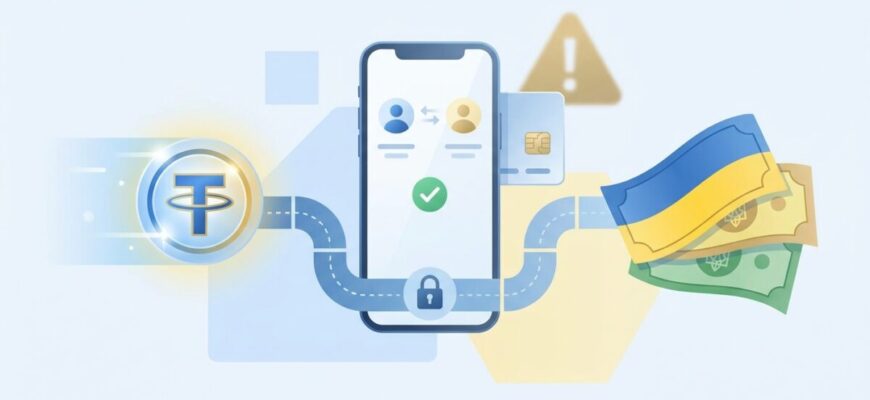
Just a year ago, withdrawing from Binance to a bank card took a couple of minutes. Since late 2025, that route has been closed, and in 2026 it was compounded by the money mule law and new bank limits. Below, we cover which methods for cashing out USDT into hryvnia actually work now, how much they cost, and how to get through financial monitoring without having your card blocked.
- What has changed: Binance and bank cards
- Ways to withdraw USDT to a card: comparison
- Step by step: selling USDT via P2P
- Withdrawal via a Ukrainian exchange with hryvnia
- Exchangers
- Crypto cards: spend without withdrawing
- How to avoid getting your card blocked
- Taxes when selling USDT
- Risks
- FAQ
- Is it currently possible to withdraw USDT from Binance directly to a bank card?
- What is the safest way to withdraw USDT to a bank card?
- Will Monobank block a card for P2P?
- How much can be withdrawn to a card per month?
- Do you need to pay tax when selling USDT?
- What should you do if a buyer on P2P paid from someone else’s card?
What has changed: Binance and bank cards
On December 29, 2025, Binance warned users in Ukraine that withdrawals to Visa and Mastercard cards had been “paused until further notice.” The reason is that the exchange ended its cooperation with the payment company Bifinity UAB, through which some fiat transactions were processed, Forbes Ukraine reports.
What remains available:
- top-ups via Visa and Mastercard, Apple Pay, and Google Pay;
- SWIFT bank transfers;
- P2P trading — according to Binance’s press service, it is operating as usual.
Details are in our news article about how Binance is suspending withdrawals to bank cards.
Ways to withdraw USDT to a card: comparison
| Method | Speed | Cost | Risk of card blocking | Who it suits |
|---|---|---|---|---|
| P2P on Binance or Bybit | 5–30 minutes | The platform fee is low or zero; the main “cost” is the exchange-rate spread | Medium: depends on the counterparty | Suitable for most users, for amounts within the bank’s limit |
| Ukrainian exchange with hryvnia withdrawals (for example, WhiteBIT) | From minutes to several hours | Withdrawal fee according to the exchange’s rates | Low: the money comes from a company with a clear payment reference | For those who value transparency for the bank |
| Exchange service via a monitoring platform | 15–60 minutes | Markup in the exchange rate, usually 0.5–5% | Medium or high: depends on the exchange service | For one-off transactions if there is no KYC on the exchange |
| Crypto card | Instant at the time of payment | Conversion fee | Does not apply to a Ukrainian card | For those who spend USDT directly |
Rates and fees change daily. Before making a transaction, compare the final amount in hryvnia, not just the stated fee.
Step by step: selling USDT via P2P
- Complete KYC in your own name. Your account on Bybit or Binance must be verified for the same person whose name is on the card.
- Transfer USDT to your P2P account. On both exchanges, this is a separate “Funding” wallet. Transfers between your own wallets within the exchange are free.
- Find a buyer. P2P → Sell → USDT → UAH → filter by your bank. Check the rating, number of trades, and the terms in the listing.
- Create an order. Your USDT is locked on the exchange until the deal is completed, and the buyer cannot receive it without your confirmation.
- Check the incoming payment in your banking app. Not by screenshot and not by SMS, but in your statement. Verify the amount and the sender’s full name against the buyer’s name on the exchange.
- Confirm the deal and release the USDT only after the money has actually been credited and the name matches.
- If something is wrong, open an appeal. If the money came from another person, the amount is incorrect, or the buyer is rushing you, do not release the crypto and resolve it through the exchange’s support team.
- Save the transaction history. An export of your P2P orders may be needed if the bank asks about the source of funds.
Before your first transaction, read our overview of the money mule law: it includes a detailed checklist for safe P2P trading.
Withdrawal via a Ukrainian exchange with hryvnia
Ukrainian crypto exchanges with hryvnia accounts allow you to sell USDT for hryvnia within the exchange and withdraw the money to a card issued by a Ukrainian bank. For the bank, such a payment looks more straightforward than dozens of P2P transfers from strangers: the money comes from a company with which you have an agreement.
Cons — withdrawal fees and the exchange’s limits. Before withdrawing, check the current rate on the fees page and the minimum withdrawal amount.
Exchangers
Exchange services are convenient for one-off transactions, but this is the least transparent option. Choose services with a long track record and reviews, start with a small amount, and do not agree to a “better-than-market rate” from unknown people on Telegram. Funds from an exchange service may arrive from a random individual’s bank card — for the bank, this looks the same as risky P2P.
Crypto cards: spend without withdrawing
If you need hryvnia to pay for purchases rather than for a transfer, a crypto card lets you spend USDT directly: conversion takes place at the moment of payment. Check whether the service issues cards to residents of Ukraine, and compare the conversion fee. For Ukrainians in the EU, the selection is broader.
How to avoid getting your card blocked
- Your own card and your own account. No “friend’s cards” or accounts purchased from third parties.
- Name match. The bank payer must be the same person as the buyer on the exchange.
- No payments from third parties. “My wife will send it” or “my brother will pay” is a classic sign of a triangular scheme.
- Transaction volumes within your income level. Without verified income, individuals are subject to monthly outgoing transfer limits of UAH 50,000 or 100,000, and the bank also analyzes incoming P2P transfers.
- Do not disguise transactions. Artificially splitting amounts and using fake payment descriptions are considered signs of concealment by the bank. If you are asked about the source of funds, it is better to honestly show your transaction history.
- Respond to financial monitoring requests. We covered how to do this in the articles Monobank blocked a card after P2P and PrivatBank requested proof of source of funds.
For large amounts, such as proceeds from selling an apartment or savings, P2P is not suitable. Read the guide on how to legally transfer a large amount out of Ukraine.
Taxes when selling USDT
There is still no special tax regime for cryptocurrency in Ukraine: draft law 10225-d has been awaiting its second reading since September 2025. Under the general rules, a resident’s income is subject to 18% personal income tax and a 5% military levy, but the mechanism for calculating the tax base for cryptocurrency is not defined by law. The draft proposes taxing only profits when exchanged into fiat. Until the law is passed, keep records of your purchase and sale history — they will be needed in any scenario.
Risks
- Triangular scheme. The buyer pays with money stolen from a third party. The victim demands a refund, your card gets blocked, and the USDT is already gone.
- Card blocked by the bank. Even with legitimate deals, frequent P2P incoming transfers can trigger a review. Keep your documents ready.
- Money mule law. Any situation in which other people’s money passes through your card now threatens more than just a block.
- Exchange rate. The spread on P2P changes throughout the day. Compare offers before making a deal.
FAQ
Is it currently possible to withdraw USDT from Binance directly to a bank card?
No. Since the end of December 2025, withdrawals to Visa and Mastercard cards for users from Ukraine have been paused. You can sell USDT for hryvnia via P2P on Binance — this function is working.
What is the safest way to withdraw USDT to a bank card?
Selling through a Ukrainian exchange with hryvnia withdrawals or via P2P with a verified buyer whose name matches the payer’s. In both cases, use only your own account and your own card.
Will Monobank block a card for P2P?
It can, if the transactions look suspicious: many incoming payments from different people, turnover that does not match your income, payments from third parties. Honest trading from your own card and being ready to show your transaction history reduce the risk.
How much can be withdrawn to a card per month?
Bank limits apply to outgoing transfers: UAH 50,000 or 100,000 per month for individuals without verified income. Incoming P2P transfers have no direct limit, but the bank analyzes them. For large amounts, prepare proof of the source of funds.
Do you need to pay tax when selling USDT?
There is currently no separate law on cryptocurrency taxation in Ukraine, but under the general rules, a resident’s income is subject to 18% personal income tax and a 5% military levy. Keep a record of your transaction history and consult an accountant.
What should you do if a buyer on P2P paid from someone else’s card?
Do not release the USDT. Open an appeal on the exchange and return the money to the sender only through the bank, not using the payment details the buyer provides.