In 2026, Ukraine is not yet a full SEPA member, but a number of Ukrainian banks already accept SEPA transfers through correspondent banks and intermediaries. In practice, euros from the EU can be received to cards/accounts of A Bank (no incoming fee!), Monobank (via an intermediary, there may be a 1–3 day delay), PUMB, Sense Bank, and others. For individuals, this means a card/account with an IBAN. For businesses (sole proprietors) — a foreign currency account + compliance with currency control requirements (contract + invoice + acceptance certificate).
⚠️ Important: on December 23, 2025, a bill on Ukraine’s accession to SEPA was registered — this is the final technical step before submitting the application, after which transfers from the EU will become instant and almost free. For now, a standard SEPA transfer takes up to 1 business day. In this article — which banks accept SEPA, what individuals and businesses need to receive it, banking details, fees, currency control, and alternatives (Wise, Payoneer, Paysera).
Disclaimer: This material is for informational purposes only and does not constitute financial/legal advice. Bank terms, fees, and currency regulations change — please verify current information with your bank. For business transactions, consult an accountant.
- What You Need to Know About SEPA in Ukraine in 2026
- What Is SEPA
- Key Facts About SEPA
- Why SEPA Matters for Ukrainians
- An Essential Nuance: Ukraine’s Status in SEPA
- Which banks accept them
- Comparison table
- Main recommendation for individuals
- Main recommendation for businesses
- A-Bank
- Why A-Bank stands out
- How to receive SEPA with A-Bank
- Who it is suitable for
- Monobank
- How it works at Monobank
- Important Note for 2026
- How to Receive SEPA Transfers to Monobank
- Who it is suitable for
- PUMB Sense
- PUMB
- Sense Bank
- PrivatBank
- Raiffeisen Bank
- For individuals
- Minimum requirements
- Step-by-step process
- When a personal card is enough
- When a sole proprietorship is required
- For business
- What a sole proprietor needs to accept SEPA
- How it works for a sole proprietor freelancer
- Important nuance: export of services
- Taxes for individual entrepreneurs
- Bank Details
- Standard Set of Bank Details
- BIC codes of popular Ukrainian banks
- For businesses — payment purpose is required
- Foreign Exchange Control
- What Is Foreign Exchange Control
- Documents for Foreign Exchange Control for Sole Proprietors
- Simplifications for Service Exports
- Settlement Deadlines
- Fees and Processing Times
- Fee Structure
- Crediting timeframes
- Calculation example
- Alternatives
- Wise (formerly TransferWise)
- Payoneer
- Paysera
- KAST
- Important warning about alternatives
- SEPA vs SWIFT
- When to choose SEPA
- When to choose SWIFT
- The Future
- What Has Already Happened
- What will change after it takes effect
- An important nuance about banking secrecy
- When to expect it
- Frequently Asked Questions FAQ
- Which banks in Ukraine accept SEPA transfers in 2026?
- Which bank is best for receiving SEPA in Ukraine?
- Does Monobank accept SEPA transfers?
- What does a sole proprietor (FOP) need to receive a SEPA transfer?
- How much does a SEPA transfer to Ukraine cost?
- How long does a SEPA transfer to Ukraine take?
- Can you receive SEPA to a personal card of an individual?
- What is the difference between SEPA and SWIFT?
- When will Ukraine fully join SEPA?
- Can Wise or Payoneer be used instead of a Ukrainian bank?
- Is a foreign currency account required to receive SEPA?
- What documents are required for foreign exchange control?
- Conclusion
What You Need to Know About SEPA in Ukraine in 2026
- SEPA (Single Euro Payments Area) — a euro transfer system covering 36 countries (27 EU countries + Iceland, Liechtenstein, Norway, Switzerland, Monaco, the United Kingdom)
- Ukraine is not yet a full SEPA member — banks accept transfers through correspondent/intermediary banks
- On December 23, 2025, a bill on joining SEPA was registered — the final technical step before applying to the European Payment Council
- A-Bank — accepts SEPA with no incoming fee (to a hryvnia card and a euro card)
- Monobank — accepts via an intermediary (UK), with a possible delay of 1–3 days
- For businesses (sole proprietors) — a foreign currency account + foreign exchange control are required (contract + invoice)
- Speed: usually up to 1 business day
- Sender’s fee in the EU: usually ~€5 + intermediary fee (0.33%, min €0.65, max €150)
- Alternatives: Wise, Payoneer, Paysera (with nuances for sole proprietors and foreign exchange control)
The main shift: after Ukraine fully joins SEPA (expected in 2026–2027), transfers from the EU will become as fast and cheap as those between Privat and Mono. For now, this works through intermediaries — slower and with fees, but already available.
What Is SEPA
SEPA (Single Euro Payments Area) is a standard for cashless euro payments within Europe. The system standardizes rules and banking details, so an international euro transfer is processed just as easily as a domestic payment in Germany or France.
Key Facts About SEPA
- Coverage: 36 countries — 27 EU member states + Iceland, Liechtenstein, Norway, Switzerland, Monaco, the United Kingdom
- Euro only — SEPA works exclusively with EUR
- Speed: standard SEPA — up to 1 business day, SEPA Instant — 10 seconds
- Low-cost: under EU legislation, a euro transfer between SEPA countries must not cost more than a domestic transfer
Why SEPA Matters for Ukrainians
SEPA is especially relevant for hundreds of thousands of Ukrainians working in the EU, as well as for freelancers/IT specialists receiving payments from European clients or from platforms (Upwork, Admitad, etc.).
The main advantage of SEPA over SWIFT is fee predictability. With SWIFT, deductions can be unexpectedly high; with SEPA, they are usually a fixed ~€5 paid by the sender.
An Essential Nuance: Ukraine’s Status in SEPA
⚠️ Ukraine is not yet a full member of SEPA. This is a key point that many people do not understand.
What this means in practice:
- Ukrainian banks accept SEPA transfers, but via correspondent banks or intermediaries in the EU/UK
- This may add a delay (1–3 days instead of instant processing) and an intermediary fee
- After full accession (expected in 2026–2027), everything will become instant and almost free
Learn more about the system itself in our guide SEPA and SEPA Instant in 2026.
Which banks accept them
Let’s look at which Ukrainian banks actually work with incoming SEPA transfers in 2026.
Comparison table
| Bank | SEPA acceptance | Incoming credit fee | Features |
|---|---|---|---|
| A-Bank | ✅ | 0% (to UAH and euro card) | Best for individuals, no fee |
| Monobank | ✅ (via an intermediary) | low/0 | A delay of 1–3 days is possible |
| PUMB | ✅ | depends on the tariff | Well-developed foreign currency infrastructure |
| Sense Bank | ✅ | depends on the tariff | Former Alfa, euro accounts |
| Privat (PrivatBank) | ✅ | depends on the tariff | The largest bank, foreign currency accounts |
| Raiffeisen Bank | ✅ | depends on the tariff | Part of an international group |
| Universal Bank | ✅ | depends on the tariff | Monobank infrastructure |
Important: the list and terms change. Before receiving a large transfer, check with the bank whether they accept SEPA, which account it should go to (UAH/euro), what the fee is, and the processing time.
Main recommendation for individuals
A-Bank — as of 2026, one of the best options for individuals: it accepts SEPA with no incoming fee for crediting both hryvnia and euro cards. The recipient receives the full amount.
Main recommendation for businesses
For sole proprietors and legal entities, a foreign currency account is required at a bank with well-developed foreign exchange infrastructure (PUMB, PrivatBank, Raiffeisen, Sense Bank) + compliance with foreign exchange controls. There is a separate section on this below.
A-Bank
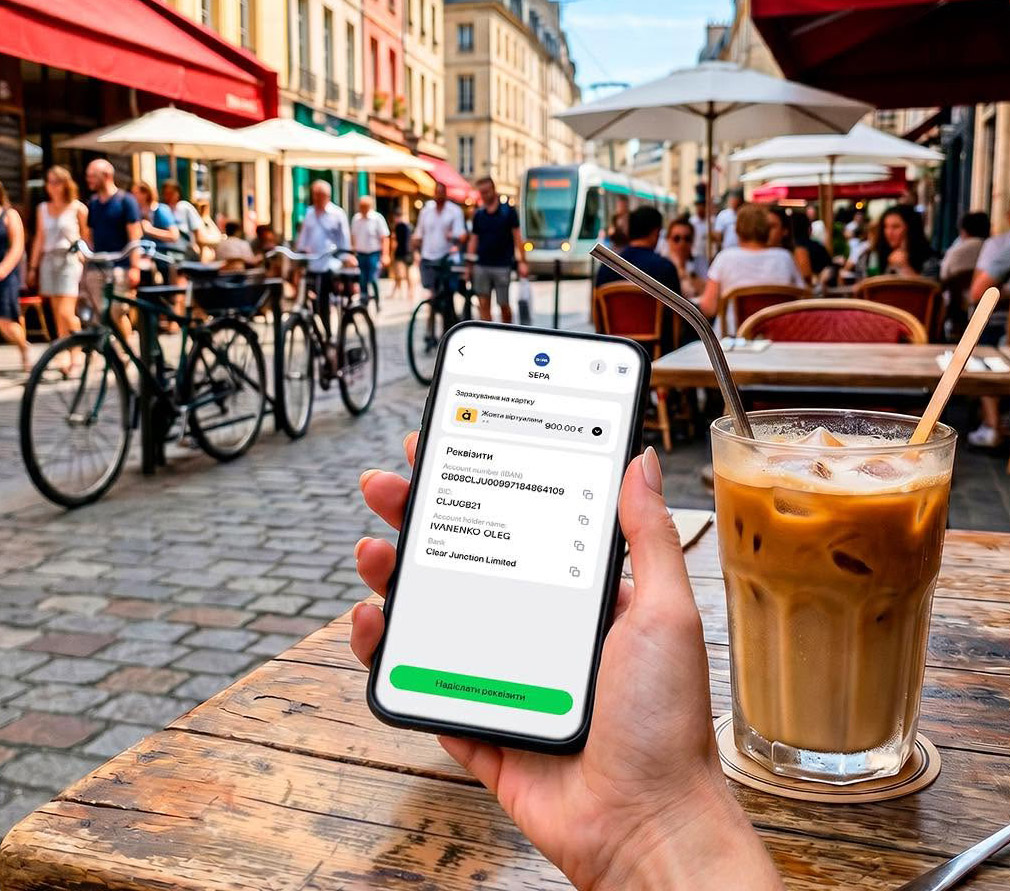
A-Bank — as of 2026, one of the most convenient banks for receiving SEPA transfers by individuals.
Why A-Bank stands out
- 0% fee for incoming transfers via SEPA — neither to a hryvnia card nor to a euro card
- The recipient receives the full amount (the sender pays only a symbolic fee to their bank in the EU)
- Average crediting time — up to one banking day
- Easy receipt to personal cards
How to receive SEPA with A-Bank
- Open an ABank card (in hryvnia or euro)
- Get the bank details for SEPA (IBAN, BIC, recipient name)
- Send the bank details to the sender in the EU
- The sender makes a standard SEPA transfer
- The money arrives within ~1 business day with no incoming transfer fee
Who it is suitable for
✅ Individuals receiving money from relatives/employers from the EU
✅ Freelancers (taking into account the need to register as a sole proprietor in case of regular income)
✅ Those who want minimal fees
Important for freelancers: if you receive income on a regular basis, this is entrepreneurial activity, and the law requires registering as a sole proprietor with payments received into a separate account + foreign exchange control. Receiving payments to a personal card is suitable for one-off/personal transfers.
Monobank
Monobank is Ukraine’s most popular neobank and also accepts SEPA transfers, but with important nuances.
How it works at Monobank
⚠️ Since Ukraine is not a full SEPA member, Monobank accepts such transfers through an intermediary (historically, through a partner in the United Kingdom).
What this means:
- A delay is possible — the transfer may take 1–3 days (not instant)
- Fee — usually low or zero for incoming funds, but the intermediary’s terms may affect this
- This is not “full-fledged” participation in SEPA with zero fees, as with EU banks
Important Note for 2026
There is an ongoing discussion in the professional community: some experts note that receiving transfers through an intermediary with a 2–3 day delay is not full participation in SEPA. Full participation (with all conditions met, including the transaction fee level) will become possible only after Ukraine officially joins SEPA.
How to Receive SEPA Transfers to Monobank
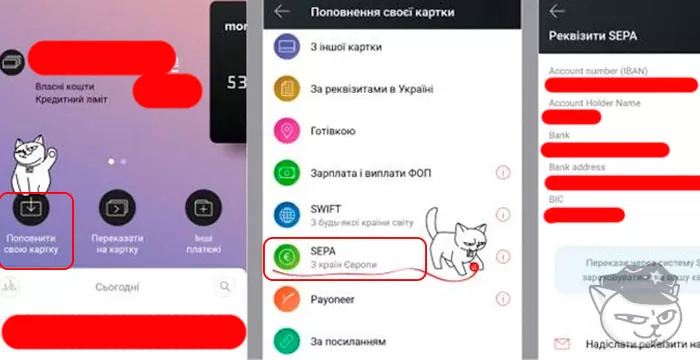
- In the Monobank app, find the currency transactions section
- Get the details for an incoming transfer
- Pass them on to the sender
- Wait for the funds to be credited (this may take 1–3 days via an intermediary)
Who it is suitable for
✅ Existing Monobank customers for one-off transfers
✅ Those who are prepared for a possible delay
⚠️ For urgent or business transfers, it is better to consider A-Bank or a specialized foreign currency account
Business note: for sole proprietors, Monobank offers business accounts (plata by mono for acquiring is a separate product). To receive SEPA transfers as foreign currency revenue, you need a foreign currency account for a sole proprietor — check the current terms.
PUMB Sense
Other banks with well-developed foreign currency infrastructure.
PUMB
PUMB (First Ukrainian International Bank) is one of the largest banks with well-developed foreign currency infrastructure.
- Receiving SEPA transfers to foreign currency accounts
- Suitable for businesses (sole proprietors, legal entities)
- Well-developed foreign exchange control support
- Fees depend on the pricing plan
Sense Bank
Sense Bank (formerly Alfa-Bank Ukraine) — offers euro accounts and SEPA transfers.
- Euro cards and accounts
- SEPA acceptance
- Check current fees and processing times
PrivatBank
PrivatBank is the largest bank in Ukraine:
- Currency accounts, SEPA acceptance
- Extensive infrastructure
- Suitable for both individuals and businesses
Raiffeisen Bank
Raiffeisen Bank is part of the international Raiffeisen Group:
- Receiving SEPA transfers to foreign currency accounts
- The trust of an international group
- Well suited for businesses exporting services
For business, the choice of bank depends on the convenience of foreign exchange control, fees, and the quality of support. Many sole proprietor IT specialists use PrivatBank or PUMB for foreign currency revenue.
For individuals
What an individual needs to receive a SEPA transfer.
Minimum requirements
- Card or account with a bank that accepts SEPA (A-Bank, Monobank, etc.)
- IBAN — international bank account number (UA… format)
- Transfer details (IBAN, BIC, recipient name)
Step-by-step process
- Open a card/account with a suitable bank (A Bank is optimal for a 0% fee)
- In the app/bank, obtain the full account details for incoming SEPA transfers
- Provide the account details to the sender in the EU
- The sender makes a SEPA transfer (for them, this is a standard transaction costing ~5 euros)
- The money arrives within ~1 business day
When a personal card is enough
✅ One-time transfers from relatives/friends
✅ Salary from a European employer (if you are a tax resident with an employment contract, clarify the details)
✅ Personal non-commercial transfers
When a sole proprietorship is required
If you regularly receive income for services/work, this is entrepreneurial activity. The law requires:
- Registration of a sole proprietor
- Receiving payments into a separate account of the sole proprietor
- Undergoing foreign exchange control
Receiving commercial income to a personal card = a risk of problems with the tax authorities.
For business
Accepting SEPA for businesses and sole proprietors is a separate topic with important rules.
What a sole proprietor needs to accept SEPA
- Foreign currency account for an individual entrepreneur at a bank (PrivatBank, PUMB, Raiffeisen, Sense Bank)
- Agreement with a foreign client (service contract)
- Invoice (bill) for each payment
- Certificate of completed work (for confirmation)
- Relevant KVED code (types of business activity)
How it works for a sole proprietor freelancer
- You enter into a contract with a European client
- You issue an invoice for services
- The client pays via SEPA to your sole proprietor foreign currency account
- The bank carries out foreign exchange control (checks the contract + invoice)
- The funds are credited, and you declare the income
Important nuance: export of services
⚠️ Under the general rule of the State Tax Service, foreign currency proceeds must be credited to accounts in Ukrainian banks. However, there is an resolution of the NBU clarifying that the restrictions do not apply to the export of services when properly documented.
This means that an individual entrepreneur in IT exporting services may work with foreign currency proceeds if they have a contract and an invoice.
Taxes for individual entrepreneurs
- Sole proprietor, Group 3: usually a 5% single tax + military levy on income
- Income is recorded in hryvnia at the exchange rate on the date of crediting
- The Income Ledger reflects the amount actually credited to the account
Tip: keep clear records — contracts, invoices, acceptance certificates, bank statements. This will protect you during foreign exchange control and tax inspections. For complex cases, consult an accountant.
Bank Details
What bank details are required for someone to send you a SEPA transfer.
Standard Set of Bank Details
Beneficiary (Recipient): YOUR_NAME (in Latin letters, as in your passport)
IBAN: UAxxxxxxxxxxxxxxxxxxxxxxxxxx (your Ukrainian IBAN)
BIC/SWIFT: BIC_of_your_bank
Bank Name: bank name
Bank Address: bank address
Purpose (Payment purpose): what the payment is for (for business — invoice number)
BIC codes of popular Ukrainian banks
| Bank | BIC/SWIFT |
|---|---|
| PrivatBank | PBANUA2X |
| Monobank (Universal Bank) | COMRUAUK |
| PUMB | FUIBUA2X |
| Raiffeisen Bank | AVALUAUK |
| Sense Bank | ALFAUAUK |
Check the exact BIC and bank details with your bank — for SEPA transfers via an intermediary, the details may differ (the bank may provide the details of a correspondent bank in the EU).
For businesses — payment purpose is required
For sole proprietors/legal entities, the payment purpose must include:
- Contract/invoice number
- What the payment is for (for example: «Payment for software development services, invoice #2026-04»)
This is required to pass foreign exchange control.
Foreign Exchange Control
An essential topic for business.
What Is Foreign Exchange Control
Foreign exchange control is the bank’s verification of the legality of a foreign currency transaction on behalf of the state. The bank checks that an incoming foreign currency payment has a legal basis.
Documents for Foreign Exchange Control for Sole Proprietors
- Foreign economic agreement (contract) with the client
- Invoice (bill)
- Certificate of completed work/services provided
- Payment purpose indicating the agreement/invoice
Simplifications for Service Exports
Good news: for service exports (IT, freelancing, consulting), documentation requirements have been simplified by law. Law No. 4496 (on removing administrative barriers to service exports) streamlined the paperwork.
This means that a freelance exporter does not need to gather a mountain of paperwork — a basic package is enough (contract + invoice).
Settlement Deadlines
⚠️ Under foreign exchange legislation, there are settlement deadlines for foreign economic transactions. Funds from a non-resident for exports must be credited to the resident’s account within the established time limits. Check the current deadlines, as they changed during wartime.
Main point: work transparently — with contracts and invoices. This is not only a legal requirement, but also protection: if any questions arise, you have documentary support for every payment.
Fees and Processing Times
How much a SEPA transfer to Ukraine costs and how long it takes.
Fee Structure
Sender’s fee (in the EU):
- Usually ~€5 for a SEPA transfer
- Under EU rules, it must not exceed the cost of a domestic transfer
Intermediary bank fee:
- ~0.33% of the amount
- Minimum €0.65, maximum €150
- This is the fee for the fact that Ukraine is not yet a full SEPA member
Deposit fee (at a Ukrainian bank):
- ABank: 0%
- Other banks: depends on the tariff
Crediting timeframes
- Standard SEPA: up to 1 business day
- Through an intermediary (Monobank): 1–3 days
- After Ukraine joins SEPA: it will become instant (SEPA Instant — 10 seconds)
Calculation example
Transfer of €1000 from Germany to an A-Bank card:
- The sender pays: €1000 + ~€5 (their bank’s fee)
- Intermediary: ~€3.30 (0.33%)
- ABank: €0 for crediting
- You receive: ~€996-1000 (depends on who pays the intermediary fee)
Fee predictability is the main advantage of SEPA over SWIFT, where charges can be unexpectedly high.
Alternatives
If a direct SEPA transfer to a Ukrainian bank is not suitable, there are alternatives.

Wise (formerly TransferWise)
- Real exchange rate, low fees
- You can get a European IBAN
- For sole proprietors: the position of the State Tax Service is ambiguous (foreign currency proceeds must go to a Ukrainian account), but there is a nuance regarding the export of services
- More details: Wise/Revolut/N26/Monzo review
Payoneer
- Popular among freelancers (Upwork, Fiverr)
- Accepting payments via invoices
- For sole proprietors — withdraw to a Ukrainian sole proprietor account with the payment purpose specified
- Account blocks are possible — operate with proper documentation
Paysera
- Lithuanian fintech, euro IBAN
- Low-cost SEPA transfers
- Learn more: Paysera review
KAST
- Virtual EU IBAN for receiving SEPA transfers
- Auto-conversion to USDC, withdrawal to a crypto wallet
- Learn more: KAST review
Important warning about alternatives
⚠️ For sole proprietors, using foreign systems (Wise, Payoneer) has a nuance: according to the position of the State Tax Service, foreign currency revenue must be credited to a Ukrainian account. The NBU resolution makes an exception for service exports, but practice is inconsistent. Consult an accountant to operate legally.
SEPA vs SWIFT
When to use SEPA and when to use SWIFT.
| Parameter | SEPA | SWIFT |
|---|---|---|
| Currency | EUR only | Any |
| Geography | 36 SEPA countries | Worldwide |
| Speed | Up to 1 day (via an intermediary 1–3) | 1–3 days |
| Fee | ~€5 + 0.33% intermediary | Can be high and unpredictable |
| Predictability | High | Low |
| Best for | Euro payments from the EU | Payments from the US/Asia, other currencies |
When to choose SEPA
✅ Sender is in the EU/SEPA zone
✅ Payment in euros
✅ Predictable fees matter
When to choose SWIFT
✅ Sender is outside SEPA (US, Asia)
✅ Payment in dollars or another currency
✅ No alternatives
Learn more about SWIFT in our guide SWIFT in 2026: How the System Works.
The Future
What will change once Ukraine fully joins SEPA.
What Has Already Happened
- 23 December 2025 — The Cabinet of Ministers registered a bill on joining SEPA
- This is presented as the final technical step before the official application to the European Payment Council
What will change after it takes effect
- Instant transfers — like between Privat and Mono
- Zero/minimal fees — without intermediaries
- Access to a market of 500+ million potential clients/employers
- Simplification for freelancers, exporters, and businesses
An important nuance about banking secrecy
⚠️ The SEPA law is also connected to issues of access to banking information. Joining the European system means greater transparency of transactions. This is a topic of discussion — follow the details of the legislation.
When to expect it
The exact timeline for full accession depends on the application process with the European Payment Council. It is expected in 2026-2027. Follow updates from the NBU and specialized sources.
After accession, the article will be updated — accepting SEPA will become much simpler and cheaper for everyone.
Frequently Asked Questions FAQ
Which banks in Ukraine accept SEPA transfers in 2026?
SEPA transfers are accepted by: A-Bank (no incoming fee — best for individuals), Monobank (via an intermediary, possible delay of 1–3 days), PUMB, Sense Bank, PrivatBank, Raiffeisen Bank, Universal Bank. Important: Ukraine is not yet a full SEPA member, so banks operate through correspondents/intermediaries. After official accession (expected in 2026–2027), incoming transfers will become instant and almost free.
Which bank is best for receiving SEPA in Ukraine?
For individuals in 2026, one of the best options is A-Bank: it accepts SEPA transfers with no incoming fee to both hryvnia and euro cards, the recipient receives the full amount, and funds are credited within up to 1 business day. For business (sole proprietors/FOPs), you need a foreign currency account at a bank with well-developed FX infrastructure — PrivatBank, PUMB, Raiffeisen, or Sense Bank — with foreign exchange control procedures.
Does Monobank accept SEPA transfers?
Yes, Monobank accepts SEPA transfers, but through an intermediary bank (since Ukraine is not yet a full SEPA member). Because of this, a delay of 1–3 days is possible instead of instant crediting. The incoming fee is usually low or zero. For urgent transfers or business use, it is worth considering A-Bank or a dedicated foreign currency account at another bank.
What does a sole proprietor (FOP) need to receive a SEPA transfer?
A sole proprietor (FOP) needs: a foreign currency account at a bank (PrivatBank, PUMB, Raiffeisen, Sense Bank), a foreign economic contract with the client, an invoice for each payment, a certificate of completed work, the relevant KVED activity code, and a payment reference stating the contract/invoice number. The bank conducts foreign exchange control. For service exports, documentation requirements are simplified by law No. 4496.
How much does a SEPA transfer to Ukraine cost?
The fee structure is as follows: the sender in the EU pays about €5 to their bank, the intermediary bank charges about 0.33% (minimum €0.65, maximum €150) — this is the cost of Ukraine not yet being a full SEPA member. The incoming fee at a Ukrainian bank depends on the bank: A-Bank — 0%, others — according to their tariff schedule. The main advantage of SEPA is predictable fees, unlike SWIFT, where deductions can be unexpectedly high.
How long does a SEPA transfer to Ukraine take?
A standard SEPA transfer takes up to 1 business day. Via an intermediary (as with Monobank) — 1–3 days. After Ukraine officially joins SEPA, transfers will become instant (SEPA Instant — about 10 seconds). The speed depends on the sending bank, the intermediary bank, and the receiving bank.
Can you receive SEPA to a personal card of an individual?
Yes, you can — for example, to an A-Bank or Monobank card. This is suitable for one-off and personal transfers (from relatives, friends). But if you systematically receive income for services/work, this is entrepreneurial activity, and the law requires registering as a sole proprietor (FOP), receiving funds into a separate FOP account, and going through foreign exchange control. Receiving commercial income on a personal card creates a risk of problems with the tax authorities.
What is the difference between SEPA and SWIFT?
SEPA works only with euros and only in the 36 countries of the SEPA area, with predictable fees (about €5) and a speed of up to 1 day. SWIFT works with any currency worldwide, but fees can be high and unpredictable (correspondent banks), with a speed of 1–3 days. Use SEPA for euro payments from the EU (cheaper and more predictable), and SWIFT for payments from the US/Asia or in other currencies.
When will Ukraine fully join SEPA?
On December 23, 2025, the Cabinet of Ministers registered a draft law on joining SEPA — this is the final technical step before the official application to the European Payment Council. The exact timeline for full accession depends on the application process and is expected in 2026–2027. After accession, transfers from the EU will become instant and almost free, without intermediaries.
Can Wise or Payoneer be used instead of a Ukrainian bank?
Technically yes, but there is a nuance for sole proprietors (FOPs). According to the position of the State Tax Service, foreign currency revenue must be brought into a Ukrainian account. However, an NBU resolution provides an exception for service exports. In practice, many freelance sole proprietors use Wise/Payoneer, receiving payments against invoices with a stated payment purpose, and then withdraw to their Ukrainian FOP account. Practice is mixed — always consult an accountant to operate legally.
Is a foreign currency account required to receive SEPA?
For an individual — no, a regular card (UAH or euro) at a bank that accepts SEPA is enough. For business (sole proprietor/FOP, legal entity) — yes, a foreign currency account is required to receive euros as revenue, with foreign exchange control procedures (contract, invoice). Some banks (A-Bank) even credit SEPA to an individual’s hryvnia card with automatic conversion.
What documents are required for foreign exchange control?
For sole proprietors (FOPs): a foreign economic agreement (contract) with the client, an invoice, a certificate of completed work/services, and a payment reference indicating the contract/invoice. For service exports (IT, freelance, consulting), the requirements are simplified by law No. 4496. Keep clear records of all documents — this will protect you during foreign exchange control and tax inspections.
Conclusion
Receiving SEPA transfers in Ukraine in 2026 is already a reality, although the country is not yet a full member of the system. Ukrainian banks accept euros from the EU through correspondents and intermediaries — slower and with fees compared with what it will be after full accession, but it already works.
Main takeaways:
✅ A-Bank — best for individuals (0% incoming fee)
✅ Monobank — accepts via an intermediary (1–3 day delay)
✅ PUMB, Sense Bank, PrivatBank, Raiffeisen — for business with a foreign currency account
✅ Individuals only need a card with IBAN
✅ Sole proprietors (FOPs) need a foreign currency account + contract + invoice + foreign exchange control
✅ Fee: about €5 sender + 0.33% intermediary
✅ Timeframe: up to 1 day (via intermediary 1–3 days)
⚠️ Ukraine is not yet a full SEPA member — accession is expected in 2026–2027
Recommendations:
- For individuals for one-time transfers: ABank (no fee)
- For freelancers with income: sole proprietor registration + foreign currency account + work under contracts
- Alternatives: Wise, Payoneer, Paysera, KAST (taking into account the nuances of foreign exchange control for sole proprietors)
- For businesses: always work with contracts and invoices
Once Ukraine fully joins SEPA (expected in 2026–2027), receiving euros from Europe will become as instant and inexpensive as a transfer between Privat and Mono. This will open up huge opportunities for Ukrainian freelancers, exporters, and businesses. In the meantime, use the available banks and operate legally.
If you receive payments from the EU, also check out our guides: SEPA and SEPA Instant in 2026, SWIFT in 2026, KAST for receiving euros and Paysera.