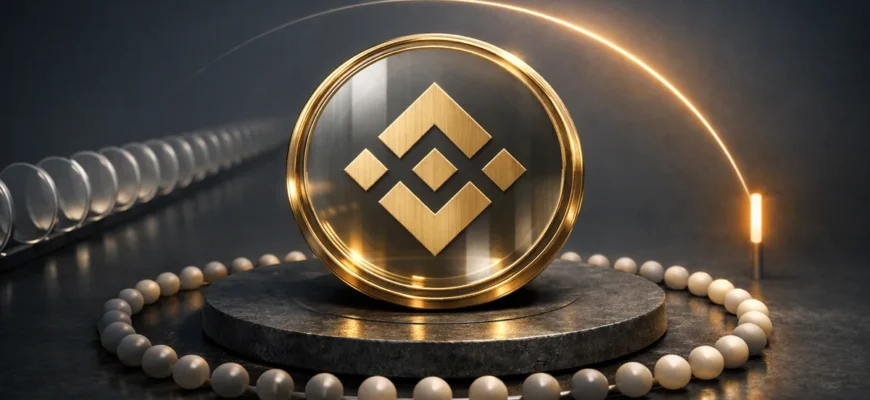
Short answer. The BNB Chain whitepaper describes BNB as the native token of BNB Smart Chain (BSC), working much like ETH does on Ethereum. The network documentation adds that BNB pays for smart contract execution (gas) and serves as the staking token.
Two documents from BNB Chain itself put the token back on the agenda. On 19 October 2026 the BNB Foundation announced the 37th quarterly burn, and on 3 November BSC client release v1.8.2 put a date on the Jenner hard fork: 8 December. Meanwhile the price has been sliding. CoinGecko shows BNB down 22.75% over 30 days; the full snapshot is in the table below.
The chain BNB runs on
BNB Chain’s documentation says BSC runs on a Proof-of-Staked-Authority (PoSA) consensus. For most users the label matters less than the performance figures the same documentation publishes.
Mainnet block time is given as 0.45 seconds, down from 3 seconds after three hard forks named Lorentz, Maxwell and Fermi. Client software was tuned to match: release v1.7.3, published on 23 April 2026, adjusted timing parameters and the broadcast queue for a 450-millisecond block. According to the documentation, BSC finalises the chain within two blocks in most cases. By BullRun’s own arithmetic, at the current block time that comes to under one second.
Compatibility is another point the documentation stresses: BSC supports all the existing Ethereum tooling. If you add BSC to a wallet you already use for Ethereum, check which network is selected before each transfer. Keep a small BNB balance as well, because gas on BSC is paid in BNB.
According to the documentation, the active validator set consists of 45 validators: 21 in the Cabinet and 24 Candidates. Validators need a minimum self-delegation of 2,000 BNB. Ordinary holders can delegate to a validator of their choice and receive credit tokens specific to that validator.
Penalties are covered in the staking documentation too. Validators can be slashed for unavailability, double signing or malicious voting in fast finality. Before delegating, read the staking overview in full and work out whether, and how, a validator’s penalty would affect the credit tokens you hold.
Supply: two burn channels and a 100 million target
BNB Chain says its Auto-Burn is meant to gradually reduce total supply to 100,000,000 BNB. Its blog reports on the 35th and 37th quarterly burns show the scale:
- 35th burn, published 15 April 2026: 1,569,307.34 BNB burned, leaving a stated total supply of 134,786,916.53 BNB;
- 37th burn, announced by the BNB Foundation on 19 October 2026: 1,646,196.44 BNB burned, leaving 131,512,085 BNB.
By BullRun’s calculation, the gap between the October figure and the 100 million target is about 31.5 million BNB, roughly 24% of the supply stated after the 37th burn.
Along the way the formula was revised. In the April report BNB Chain said the parameters were adjusted because the Lorentz, Maxwell and Fermi upgrades make BSC produce blocks more often than when the formula was defined. A second channel runs block by block. According to the whitepaper, a fixed share of the gas fees in each block is burned, and validators govern that ratio. BNB Chain also describes a Pioneer burn program that helps users recover BNB and pegged tokens lost through honest mistakes; those losses are covered through the quarterly burns.
CoinGecko’s snapshot at 21:23 Kyiv time on 23 November 2026 is below. Prices move constantly, so treat these figures as that moment only.
| Metric | Value |
|---|---|
| Price | $560.51 |
| Market capitalisation | $73,702,090,336 (rank 4) |
| 24-hour trading volume | $783,189,754 |
| 24-hour change | +0.68% |
| 7-day change | -5.01% |
| 30-day change | -22.75% |
| Circulating supply | 131,510,059 BNB |
| Total supply | 131,510,059 BNB |
| Maximum supply | 200,000,000 BNB |
| All-time high | $1,369.99 (13 October 2025) |
| Genesis date | 8 July 2017 |
Two numbers are easy to mix up. CoinGecko shows a maximum supply of 200,000,000 BNB, while 100,000,000 is the level BNB Chain wants Auto-Burn to reach. CoinGecko’s total supply is also about 2,000 BNB below the figure in the October burn report. By BullRun’s own calculation, the price stood at roughly 40.9% of the all-time high. That is arithmetic on CoinGecko’s numbers, not a view on where the price goes next.
This review is for information only and is not financial advice; check every figure independently before acting on it.
Risks and how to check for yourself
A recent security story concerned the Binance exchange rather than the chain. BleepingComputer, summarising Binance’s own report, writes that an engineer was compromised through a fake job interview and a malicious coding assignment. On 29 October 2026 the attackers then used an internal AI tool and stolen credentials to reach the wallet signing service. StepSecurity has published its own analysis of the same incident. Whether any of this touches BNB is covered in the last section.
Two lessons translate into practical habits. If you hold BNB on any exchange, decide how much of what you are not actively trading belongs in a wallet you control; our step-by-step guide to withdrawing crypto to your own wallet covers the network and address checks. And treat job offers that ask you to run a coding task on your own computer with caution, especially if crypto wallets live on that machine.
Look-alike tokens are a separate risk. The whitepaper describes BNB as the native token of BSC, in the same way ETH is native to Ethereum. So if someone offers you ‘BNB’ on BSC as a separate token with its own contract address, treat it with suspicion and check it against BNB Chain’s official documentation. If you have already approved a contract you no longer trust, our guide on revoking token approvals after a drainer attack walks through the clean-up. On Ethereum, CoinGecko lists a BNB contract at 0xb8c77482e45f1f44de1745f52c74426c631bdd52; compare it with BNB Chain’s documentation before relying on it.
CoinGecko shows BNB trading on Binance, Bitget, Bybit, Gate, Kraken and KuCoin as of 23 November. Before opening an account, confirm that the platform serves residents of your country. Readers in the EU can use our guide to checking an exchange’s MiCA licence.
A short checklist before any transfer or purchase:
- pick the network deliberately: when withdrawing, choose the network your receiving wallet supports, not just the ticker;
- match any contract address against BNB Chain’s official site and documentation, then against a block explorer for that network;
- take burn figures from the BNB Chain blog and hard fork details from the BSC client releases on GitHub;
- read market data on CoinGecko at the moment you decide, not from older coverage;
- use a wallet that supports BSC; our comparison of crypto wallets is a starting point.
What comes next: Jenner and open questions
Release v1.8.2, published on 3 November 2026, schedules Jenner for BSC mainnet at 02:30 UTC on 8 December 2026. It has been live on the Chapel testnet since 29 October; on mainnet it remains a plan, not a completed upgrade.
Its contents are set out in BEP-718 (Meta-Jenner), created on 20 September 2026 and still marked as Draft. That document lists three proposals:
- BEP-702, a compliant asset standard;
- BEP-703, a payment lane;
- BEP-706, a precompile that provides block timestamps with millisecond precision.
Node operators should read the release notes and upgrade the client ahead of the date. Ordinary holders need only follow BNB Chain’s official channels. With BEP-718 still a draft, recheck the final scope and timing closer to 8 December.
Several points that matter to holders have no answer yet:
- Whether the 29 October Binance breach has any link to the BNB token or the BSC protocol. StepSecurity lists the affected chains as Ethereum, Bitcoin, XRP Ledger, Solana and Optimism.
- The original issuance, the 2017 ICO allocation and any vesting or unlock schedules. The current whitepaper does not contain them.
- The mainnet activation dates of the Lorentz, Maxwell and Fermi hard forks.
- Which Ethereum ERC-20 address BNB Chain itself treats as official. Native BNB on BSC has no token contract address.
- Typical BSC transaction fees and current gas prices.
- Whether there is an official list of recommended wallets, or an official position on availability for users in Ukraine.
- The date of the next quarterly Auto-Burn, which has not been officially announced.
Sources
- BNB Chain whitepaper (GitHub)
- BNB Smart Chain documentation
- BNB Smart Chain introduction
- BNB Smart Chain staking overview
- 37th BNB burn, BNB Chain Blog
- 35th BNB burn, BNB Chain Blog
- BSC client releases on GitHub
- BEP-718: Hardfork Meta-Jenner
- BleepingComputer on the Binance breach
- StepSecurity on the Binance breach
- BNB on CoinGecko
Sources checked on 23 November 2026.