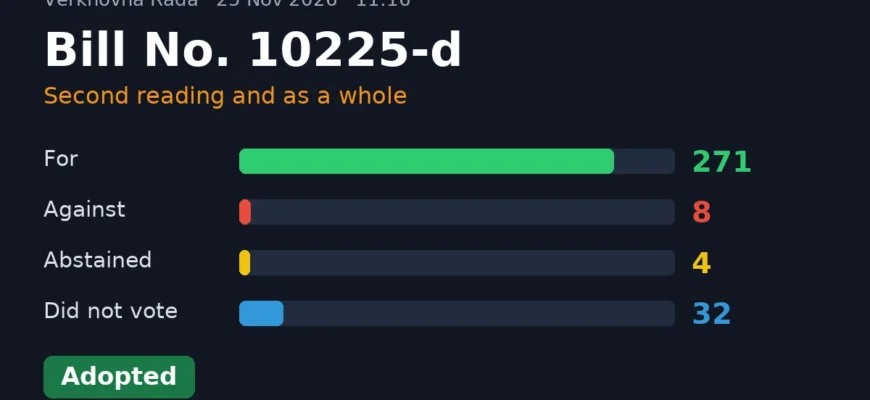
Ukraine’s parliament has passed its long-delayed crypto bill. At 11:16 on 25 November 2026 the Verkhovna Rada adopted bill No. 10225-d in second reading and as a whole, with 271 votes for, 8 against, 4 abstentions and 32 MPs not voting. The law rewrites Ukraine’s 2022 Law on Virtual Assets as a new Law on Virtual Asset Markets, brings exchanges and brokers under licensing, and adds a separate income tax regime for crypto gains to the Tax Code.
Most of it takes effect on 1 July 2027. Before that the Speaker and the President still have to sign it, and the regulators must write the secondary rules. The bill’s official page currently shows the status “being prepared for signature”.
- The vote, and what it settles
- Tax falls on the gain, not the whole trade
- A worked example
- Which costs count, and what is exempt
- The grace period: 5%, but on proceeds
- Rules for exchanges and brokers
- Licensing, KYC and AML
- Who regulates what: NBU and NSSMC
- MiCA, the EU and the IMF
- Timeline
- What it means for Bitcoin, USDT and other holders
The vote, and what it settles
The parliament’s roll-call record for vote No. 2 on 25 November describes it as a vote “in second reading and as a whole”, and the decision as adopted. That is the final parliamentary vote on the bill, not a vote on an amendment or procedure. The consideration timeline and the bill card for 10225-d carry the documents.
The bill was registered on 24 April 2025 and passed first reading on 3 September 2025 with 246 votes. MPs then filed 2,562 amendments. According to the finance committee’s conclusion, 280 were accepted, 27 partly, 112 editorially and 2,143 rejected. The committee approved the final text on 23 November 2026.
The National Bank of Ukraine came out against the previous draft on 5 November. The committee says it then incorporated further NBU proposals on risky tokens and on the split of powers with the securities regulator, and Forbes Ukraine reports that the two regulators had aligned their positions before the vote.
| Area | Final text | From |
|---|---|---|
| Personal income tax | 18% on annual net profit from selling crypto for money (Tax Code 167.1) | 1 Jul 2027 |
| Military levy | Not addressed by the bill; the Tax Code’s general 5% levy on total taxable income | 1 Jul 2027 |
| Crypto-to-crypto swaps | Not taxed unless a cash top-up is paid | 1 Jul 2027 |
| Small gains | Exempt if annual profit is no more than one minimum monthly wage as of 1 January | 1 Jul 2027 |
| Assets bought earlier | Optional 5% on sale proceeds, declared separately (Tax Code 167.2) | until 31 Dec 2028 |
| VAT | Issuing, selling and exchanging virtual assets and provider services are exempt (advice is not) | 1 Jul 2027 |
| Licensing | Applications for authorisation open at the securities regulator (NSSMC) | 1 May 2027 |
| Provider reporting | Annual report on client transactions to the tax service by 31 January | first period to 31 Dec 2027 |
Tax falls on the gain, not the whole trade
The core of the tax part is a new paragraph 170.21 of the Tax Code. What is taxed is the year’s financial result: the money received from selling virtual assets during the calendar year, minus documented, allowable costs of buying virtual assets in that same year. A “sale” is any transfer of ownership in exchange for money, plus redemption of a token by its issuer.
A losing year produces a negative result that is carried forward until it is used up. A positive result is added to the holder’s total annual taxable income and taxed at the 18% rate in paragraph 167.1. There is no withholding agent: a company buying your coins does not deduct tax, it only reports the payment. Individuals declare and pay themselves in the annual property and income return.
The bill says nothing specific about the military levy. However, under the Tax Code the 5% levy applies to the income defined in Article 163, and crypto profit is expressly added to total taxable income without an exemption. Investors should therefore plan on 18% income tax plus 5% military levy, or 23% in total, until the State Tax Service publishes guidance.
A worked example
Say that in 2028 you sell crypto for UAH 500,000. In the same year you buy assets for UAH 380,000 and pay an authorised provider UAH 2,000 in fees. Every purchase is documented and the asset is on the list of assets whose costs can be counted.
| Item | UAH |
|---|---|
| Sale proceeds for the year | 500,000 |
| Purchase costs | 380,000 |
| Provider fees | 2,000 |
| Financial result | 118,000 |
| Income tax at 18% | 21,240 |
| Military levy at 5% (general rule) | 5,900 |
| Total due | 27,140 |
Taxing the full proceeds would have meant UAH 90,000 in income tax alone. The reverse case: buy coins for UAH 200,000 in late 2027 and sell part of them for UAH 150,000. The result is minus UAH 50,000, so no tax is due and the loss reduces the 2028 profit. Our guide on calculating crypto profit and preparing a report shows how to assemble the paperwork.
Which costs count, and what is exempt
The list of deductible costs is closed, which is the practical question for anyone holding Bitcoin or USDT. Only documented cash costs count, for:
- asset-referenced tokens bought from an authorised issuer;
- e-money tokens bought from an issuer or offeror entitled to offer them publicly;
- such tokens bought on an authorised trading platform;
- other virtual assets on a list the NSSMC will set together with the Finance Ministry;
- cash top-ups paid in a crypto-to-crypto swap;
- fees paid to providers on those transactions.
Whether buying Bitcoin, Ether or USDT will reduce your tax therefore depends on a list that does not exist yet. Stablecoins pegged to an official currency get a fallback: without documents, income and costs are taken at the token’s face value.
Outside the tax base altogether:
- swaps of one virtual asset for another with no cash top-up;
- an annual profit no larger than one minimum monthly wage as of 1 January of that year;
- tokens received free from an issuer or offeror, including in exchange for personal data (airdrops).
Costs are disallowed when an issuer’s authorisation is revoked, when the asset goes to a related party, or when it is disposed of other than by sale.
The grace period: 5%, but on proceeds
Coins bought before the law takes effect get separate treatment. If they are sold for money between the law’s entry into force and 31 December 2028, the owner may report that income in the 2027 or 2028 return, separately from other income, at the 5% rate of paragraph 167.2. The base here is the sale income itself, not profit, because these proceeds are kept out of the 170.21 calculation.
That can still be the cheaper route. Under the standard rules, the 2027 result counts only income and costs arising after the law takes effect, so a purchase made in 2021 is ignored. If long-held BTC is sold in September 2027 for UAH 400,000, the grace regime means UAH 20,000 of tax; the standard regime means 18% of the full amount, UAH 72,000, plus the levy. The bill does not say whether the military levy also applies to grace-period income, so that is one for tax service guidance.
The NSSMC and the NBU will set how purchase and sale dates are proven. The law also states that the grace regime does not override anti-money-laundering rules, so banks and exchanges can still ask where the money came from. Our piece on an exchange freezing a deposit over AML covers what that looks like in practice.
Rules for exchanges and brokers
The new Law on Virtual Asset Markets follows the EU’s MiCA structure: asset-referenced tokens, e-money tokens and all other virtual assets. Public offers need a white paper, and marketing must match it and carry risk warnings.
- Exchanges, custodians, brokers and other service providers may operate only once authorised.
- Client assets held in custody are segregated from the provider’s own property.
- A provider may sub-delegate custody to another authorised provider or to a foreign firm authorised under MiCA, and must tell clients.
- Providers are registered with the tax service and file a report on all clients’ transactions by 31 January each year, whatever the client’s residence.
- Fines for reporting breaches are cut during the transition: to 0.1 of the full amount until the end of 2027 and to 0.25 in 2028 to 2030.
- Businesses that issue, sell or exchange virtual assets, and service providers, cannot use Ukraine’s simplified single-tax regime.
For three years after entry into force, assets issued in “trusted countries” can be registered through a simplified procedure. The list: EU member states, the UK, Norway, Switzerland, Canada, the US, Singapore, Australia, New Zealand and Japan. For asset-referenced tokens the NBU can issue a negative opinion if it sees risks to monetary policy, payment systems or financial monitoring.
Licensing, KYC and AML
The NSSMC has until 1 May 2027 to adopt its authorisation rules. Firms can apply from that date, and authorisations take effect on 1 July 2027.
Providers must run primary financial monitoring under Ukraine’s anti-money-laundering law, which means identifying and verifying clients, monitoring transactions and reporting suspicious ones. Failure to do so is a ground for revoking authorisation. The final text also adds procedures for seizing virtual assets, suspending contracts and accessing information, and gives the Economic Security Bureau access to information covered by professional secrecy in the market.
Who regulates what: NBU and NSSMC
Supervision is split. Under Article 4 of the new law, the National Bank is responsible for:
- authorising issuers and offerors of e-money tokens and supervising them;
- issuance, public offers and admission to trading of e-money tokens;
- authorising providers that exchange virtual assets for money;
- rules for exchanging virtual assets for foreign currency assets;
- banks’ activity in the market, including limits on the volume and types of virtual assets banks may hold.
Everything else falls to the National Securities and Stock Market Commission, which becomes the main market regulator: trading platforms, custody, public offers and market abuse.
MiCA, the EU and the IMF
From the start, the explanatory note presented the bill as a way to implement EU Regulation 2023/1114 (MiCA). The final text bears that out with MiCA’s token categories, the white paper, provider authorisation and an explicit reference to MiCA-authorised firms. The note also called provider reporting a first step towards CARF and DAC8 tax-information exchange. Our article on exchanges asking for a tax ID under DAC8 explains how that works in the EU already.
The IMF has wanted this law for some time. Forbes Ukraine says legalising the crypto market joined the Fund’s list of requests in 2024. In November 2026 the IMF mission, reviewing Ukraine’s EFF programme, again called for virtual-asset legislation aligned with EU law and international standards, Finance.ua reported citing MP Olha Vasylevska-Smahliuk. Whether the Fund considers this version sufficient will become clear in the next programme documents.
Timeline
- After signature and publication: the NSSMC and NBU start drafting secondary rules and the authorisation procedure; a separate, non-crypto rule extending deadlines for restoring lost tax documents also takes effect.
- 1 May 2027: NSSMC rules adopted; authorisation applications open.
- 1 July 2027: the bulk of the law, including the tax rules and market regulation, takes effect.
- 1 January 2028: a few remaining provisions of the markets law and related amendments.
- 31 December 2028: the window for selling pre-existing holdings at 5% closes.
What it means for Bitcoin, USDT and other holders
- Nothing changes for tax before 1 July 2027, and Ukraine still has no dedicated crypto tax regime. Our explainer on crypto tax in Ukraine in 2026 covers the current position.
- Start keeping proof of purchases now: exchange statements, bank transfers, P2P receipts. For older coins the purchase date will matter, and the NSSMC will define how to prove it.
- After the law takes effect, swapping BTC for USDT or other coins is not a taxable event. Tax arises when you cash out.
- For pre-existing holdings, compare the 5% charge on proceeds in 2027 and 2028 with the standard regime, where the old purchase price is not counted.
- A losing year is not wasted: the loss carries forward.
- Use authorised providers. Their fees count as costs, and the paperwork for stablecoins is simpler. Until Ukrainian licences exist, an EU licence is the best signal; here is how to check an exchange’s MiCA licence.
- Banks can still ask about the source of funds when you withdraw USDT to a card; see our guide to withdrawing USDT to a card in Ukraine. Readers living in the EU can also use our guide to cashing out crypto to euros through MiCA-licensed exchanges.
The law is not yet signed or published. The practical detail, including the list of assets with deductible costs, how purchase dates are proven and the reporting forms, will come in NSSMC, NBU and Finance Ministry rules. We will update this article when they appear.
Sources: roll-call vote, 25 Nov 2026, bill 10225-d card, committee conclusion for second reading, second-reading comparative table, Tax Code of Ukraine.