
The proxy market in 2026 is undergoing a revolution: the era of AI proxies for LLMs and AI agents has arrived, Smartproxy has rebranded to Decodo, and NodeMaven has surged into the top tier as a new leader in residential IP quality. Residential proxy prices start at $1/GB (DataImpulse) and go up to $8/GB (Oxylabs). For arbitrage, Facebook Ads, and Telegram, mobile and residential proxies are used; for scraping, datacenter proxies; for AI, specialized pools with filtering. This guide covers 24 vetted services with up-to-date pricing as of May 2026.
Disclaimer: This material is for informational purposes only. Some links to services are affiliate links — this does not affect our assessment in any way. Prices are current as of May 2026 and may change. Using proxies to violate the terms of third-party services is your responsibility.
- Update: May 2026
- What proxies are and why they are needed
- Why proxies are needed in 2026
- Types of proxies
- 1. Residential — the gold standard
- 2. Mobile — the highest trust
- 3. Datacenter — for speed
- 4. ISP (Static Residential) — a hybrid
- Comparison table of types
- Selection criteria
- Detailed Reviews of 24 Services
- Top 5 Leaders of 2026
- 1. NodeMaven — the new king of residential in 2026
- 2. Bright Data — the corporate giant
- 3. Oxylabs — the leader in speed
- 4. Decodo (ex-Smartproxy) — balance of price and quality
- 5. IPRoyal — the best option to get started
- Top corporate and specialized
- 6. SOAX — #1 mobile proxies
- 7. NetNut — static residential
- 8. Webshare — the best price for volume
- 9. ASocks — for Russian-speaking arbitrage
- 10. DataImpulse — the cheapest residential proxies
- Generalists and Specialists
- 11. ProxyEmpire — for social media
- 12. Live Proxies — a growing B2C player
- 13. Infatica — stable residential
- 14. ScrapingBee — an API-first approach
- 15. Proxy-Seller — for Russian-speaking users
- 16. Storm Proxies — budget SEO
- 17. PacketStream — budget
- 18. InstantProxies — quick start
- 19. ProxyRack — scale
- 20. GeoSurf — premium reputation
- 21. Proxys.io — flexible pricing
- Best Services for the CIS Audience 2026
- 22. IPFoxy — for Yandex and WB
- 23. GonzoProxy — premium for digital professionals
- 24. ProxyFlash — mobile 4G/5G
- 25. CyberYozh App — no traffic limits
- 26. CliProxy — budget-friendly with a trial
- Best Proxies for Arbitrage 2026
- Top 5 for arbitrage:
- By source type:
- How much should you spend on proxies in arbitrage?
- Best Proxies for Facebook Ads and TikTok
- Top 5 for Facebook Ads and TikTok:
- Rules for working with FB/TikTok in 2026:
- Best Proxies for YouTube
- Top 5 for YouTube:
- Use cases:
- Best Proxies for Telegram
- Top 5 for Telegram:
- Features of working with Telegram:
- Best Proxies for AI, ChatGPT, and LLMs
- Why AI needs proxies:
- Top 5 proxies for AI in 2026:
- What are the requirements for AI:
- Best Proxies for Crypto and Web3
- Why use proxies in crypto:
- Top 5 proxies for crypto:
- Rules for using crypto exchanges through a proxy:
- Best Proxies for Scraping and SEO
- Top 5 for Scraping:
- What is important for scraping:
- Mobile Proxies: A Detailed Breakdown
- Why mobile proxies are so “trustworthy”:
- Types of mobile proxies:
- Top 5 mobile proxies of 2026:
- How much mobile proxies cost in 2026:
- Free proxies: are they worth using?
- What’s wrong with free proxies:
- When can free ones be used:
- Free alternatives:
- How to Set Up a Proxy in an Antidetect Browser
- Setup steps in Dolphin {anty}:
- Alternatives to Dolphin {anty}:
- Compatibility of proxy services with antidetect browsers:
- Proxy Quality Check Checklist
- 🔍 Tests to run:
- 🚩 Red flags — you should walk away:
- 📊 Comparison Tables
- Prices: residential proxies (minimum plan)
- Prices: mobile proxies
- Stability and IP quality
- Strengths and weaknesses — top 10
- Legal Issues and Regulation 2026
- What changed:
- What is allowed and what is not:
- What the user should do:
- Frequently Asked Questions (FAQ)
- Which proxies are best to choose in 2026?
- How much do proxies cost in 2026?
- Which proxies are needed for Facebook Ads?
- Which is better: residential or mobile proxies?
- What is Smartproxy in 2026? Is it the same service?
- Can free proxies be used?
- Which proxies are needed for traffic arbitrage?
- How do you set up a proxy in Dolphin {anty}?
- What is a sticky session and why is it needed?
- Which proxies are best for crypto and airdrops?
- Which proxies are needed for AI and ChatGPT?
- Are proxies legal?
- Which proxies should a beginner choose?
- Which proxies are best for parsing prices on Wildberries / Ozon?
- Can one proxy be used for multiple accounts?
- Which protocols do modern proxies support?
- Conclusion
Update: May 2026
The main changes in the proxy market over the past few months:
- Smartproxy → Decodo — the largest rebrand of 2024. All mentions of Smartproxy in older rankings are now outdated.
- AI proxies have become a separate segment — Bright Data, Decodo, and NodeMaven have launched specialized pools for LLMs and AI agents.
- NodeMaven has broken into the top ranks as a leader in residential IP quality, with built-in filtering of flagged addresses.
- Bright Data introduced KYC for premium residential pools — a response to regulatory pressure.
- Prices have fallen by 15–30% compared to 2024 — competition is growing, and DataImpulse is holding the line at $1/GB.
- Local services (IPFoxy, GonzoProxy, ProxyFlash, CyberYozh App) are gaining popularity in the CIS.
- 5G mobile proxies have become mainstream — IPRoyal, ProxyEmpire, and SOAX are actively expanding their 5G pools.
Main takeaway for 2026: while in 2023 it was still possible to run campaigns on datacenter IPs, today Facebook, Google, and TikTok instantly ban such IPs. The 2026 standard is mobile or residential proxies for everything related to advertising and multi-accounting.
What proxies are and why they are needed
A proxy server is an intermediary between your computer and the internet. When you access a website through a proxy, the site sees the proxy’s IP address, not yours. This provides three key capabilities:
- Anonymity — hiding your real IP and location
- Location spoofing — access to content blocked in your region
- Multi-account — working with multiple accounts without bans
In 2026, proxies are no longer a “tool for hackers,” but core infrastructure for traffic arbitrage, SEO, scraping, AI development, marketing, and crypto.
Why proxies are needed in 2026
| Area | Why a proxy is needed |
|---|---|
| 🎯 Arbitrage | Running multiple ad accounts without bans |
| 📘 Facebook/Google Ads | working with multiple accounts through anti-detect browsers |
| 📺 YouTube | Channel promotion, regional targeting, bypassing restrictions |
| 💬 Telegram | Managing dozens of accounts for mailings and channels |
| 🤖 AI and ChatGPT | Bypassing limits, training models, AI agents |
| 💰 Crypto | Registration on exchanges, airdrop hunting, multi-accounting |
| 🔍 SEO | Parsing Google search results, competitor monitoring |
| 🛒 E-commerce | Price scraping, product monitoring on marketplaces |
| 🛡️ Security | Bypassing corporate restrictions, protection from tracking |
Types of proxies
In 2026, there are 4 main types of proxies, each with its own use case.
1. Residential — the gold standard
What it is: IP addresses of real users from home internet providers. The most “trusted” by platforms.
Price in 2026: $1-8 per GB of traffic
Speed: medium (10-50 Mbps)
Stability: high
Where to get them: Decodo, Bright Data, Oxylabs, NodeMaven, DataImpulse
Best for: Facebook Ads, Google Ads, TikTok, Instagram, scraping protected websites, AI
2. Mobile — the highest trust
What it is: IP addresses of mobile carriers (3G/4G/5G). Platforms trust them the most — thousands of real carrier users “sit” behind one IP.
Price in 2026: $5-30 per GB or $50-500 per port/month
Speed: medium (5-30 Mbps)
Stability: very high
Where to get them: SOAX, IPRoyal, ProxyEmpire, ProxyFlash, GonzoProxy
Best for: the most demanding platforms — TikTok, Facebook, Instagram, Telegram, Avito
3. Datacenter — for speed
What it is: IP addresses from data centers. The fastest and cheapest, but many platforms detect them immediately.
Price in 2026: $0.5-2 per IP/month
Speed: very high (100+ Mbps)
Stability: high
Where to get them: Webshare, IPRoyal, InstantProxies, ProxyRack
Best for: scraping public websites, monitoring, SEO parsing, not for advertising!
4. ISP (Static Residential) — a hybrid
What it is: IPs registered to internet providers but hosted on servers. They combine the trust of residential proxies with the speed of datacenter proxies.
Price in 2026: $1.3-3 per IP/month
Speed: high (50-100 Mbps)
Stability: very high
Where to get them: Bright Data, NetNut, IPRoyal, Decodo
Best for: long sessions, social media login sessions, e-commerce accounts
Comparison table of types
| Parameter | Datacenter | ISP | Residential | Mobile |
|---|---|---|---|---|
| Platform trust | Low | High | High | Very high |
| Speed | ⭐⭐⭐⭐⭐ | ⭐⭐⭐⭐ | ⭐⭐⭐ | ⭐⭐ |
| Price | 💰 | 💰💰 | 💰💰💰 | 💰💰💰💰 |
| IP stability | High | Very high | Medium | Low (rotation) |
| Facebook Ads | ❌ | ✅ | ✅ | ✅✅ |
| Scraping | ✅✅ | ✅ | ✅✅ | ⚠️ expensive |
| Telegram | ⚠️ | ✅ | ✅ | ✅✅ |
| Crypto exchanges | ❌ | ✅ | ✅ | ✅✅ |
Selection criteria
In 2026, pricing plans alone are not enough. Here are 9 main factors worth paying attention to:
- IP pool quality — how often addresses get blocked on the platforms you need
- Geography — which countries and cities are covered, and whether city/ASN targeting is available
- Proxy type — suitability for your tasks (see the table above)
- Pricing and billing — pay-as-you-go vs. prepayment, and whether unused traffic rollover is available
- Sticky sessions — the ability to keep one IP during a long session (5/10/60/120 minutes)
- Protocols — support for HTTP, HTTPS, SOCKS5 (important for antidetect browsers!)
- API and integrations — availability of an API, integration with Dolphin, AdsPower, Multilogin
- Technical support — response speed, chat availability, Russian-language support (for the CIS)
- Reviews and reputation — Trustpilot, G2, Reddit, niche forums
Tip: before purchasing, always use the free trial period (available from IPRoyal, Decodo, Webshare, CliProxy) or a refund option (offered by most premium services).
Detailed Reviews of 24 Services
Top 5 Leaders of 2026
1. NodeMaven — the new king of residential in 2026
NodeMaven broke into the market’s top 3 thanks to a unique feature: built-in filtering of flagged IPs before they are assigned to the user. This means your IP is far less likely to end up on the blacklist of the platform you need.
- Price: from $3.5/GB residential, 2-in-1 mobile+residential plans available
- Features: long sticky sessions (up to 24 hours), traffic rollover, AI IP filtering
- Reviews: on Trustpilot — 4.8/5, especially praised for “clean” IPs and stability
- Suitable for: arbitrage, multi-accounting, automation, AI tasks
- Cons: a young project — less track record than Bright Data/Oxylabs
2. Bright Data — the corporate giant
Bright Data is the largest provider with 400M+ residential IPs from 195+ countries. In 2025, it introduced KYC for premium pools, which improved legal compliance.
- Price: premium, enterprise plans from $499/month
- Features: Web Scraper IDE, open Proxy Manager, ISP from $1.3/IP
- Reviews: G2 — 4.6/5, leader in the enterprise segment
- Best for: corporations, AI training, large-scale scraping
- Cons: expensive, complex pricing, KYC for some pools
3. Oxylabs — the leader in speed
Oxylabs consistently ranks in the top 3 for speed in independent 2026 benchmarks. 175M+ IPs, advanced infrastructure.
- Price: from $8/GB residential, corporate plans
- Features: 5 free datacenter IPs for testing, AI Studio for scraping
- Reviews: G2 — 4.5/5
- Best for: large scraping projects, enterprise
- Cons: expensive for individual users
4. Decodo (ex-Smartproxy) — balance of price and quality
Decodo is the former Smartproxy after the 2024 rebrand. It is positioned as an AI-ready proxy solution, reflecting the 2026 trend.
- Price: from $7/GB residential, corporate plans are cheaper
- Features: new AI APIs, simplified dashboard, 100M+ IPs
- Reviews: Trustpilot — 4.7/5
- Best for: SMM, SEO, marketing, AI developers
- Cons: the rebranding is still not recognized everywhere — some ask, “Isn’t this Smartproxy?”
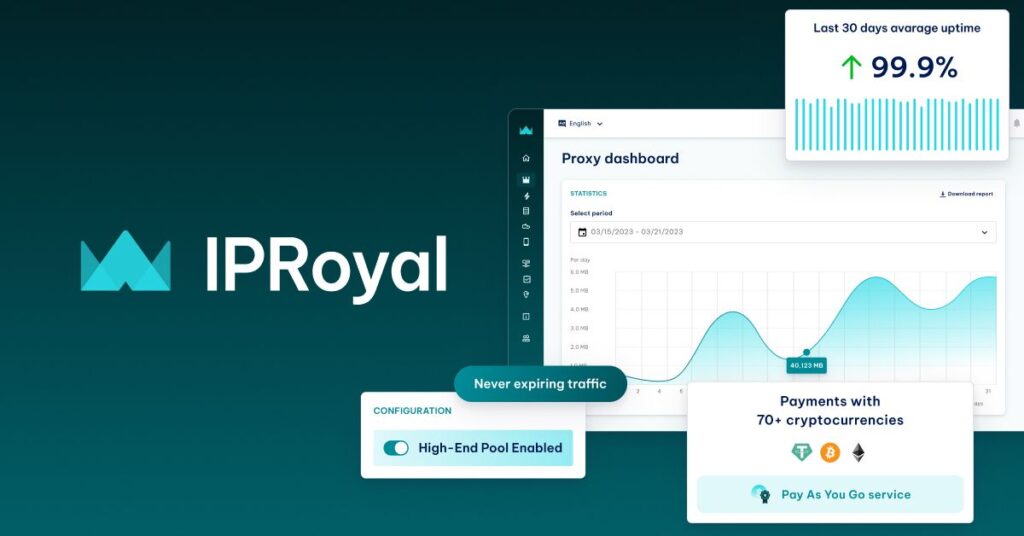
5. IPRoyal — the best option to get started
IPRoyal — the most popular entry-level option in 2026. 34M+ IPs, affordable prices, non-expiring traffic (does not expire).
- Price: from $3.5/GB residential, mobile from $90/month, datacenter from $1.3/IP
- Features: traffic does not expire, support for 195+ countries, 24/7 support
- Reviews: TechRadar — “best residential overall”
- Best for: YouTube, social media, small projects, beginners
- Cons: smaller pool than the giants, no phone support
Top corporate and specialized
6. SOAX — #1 mobile proxies
SOAX dominates the mobile and ISP proxy segment. 155M+ residential, 8 pricing plans with different volumes.
- Price: from $99/month (5 GB), residential from $2.85/GB on the 7GB plan
- Features: 4G/5G mobile proxies with ASN/city targeting, rotation on every request or up to 120 minutes
- Reviews: praised for the quality of mobile IPs, with high cost being the main drawback
- Suitable for: arbitrage, TikTok, Facebook Ads, Telegram
- Cons: high entry threshold
7. NetNut — static residential
NetNut is a leader in static residential proxies. Ideal for long sessions (logging into Facebook, Instagram).
- Price: from $99/month (previously $300+), plans for small businesses are available
- Features: static IPs (one IP for a long time), 85M+ addresses, direct ISP connections (no P2P)
- Suitable for: Telegram, long sessions, e-commerce
- Cons: more expensive than rotating residential proxies
8. Webshare — the best price for volume
Webshare is the leader in price-to-volume value in the datacenter segment.
- Price: from $2.99/month (100 datacenter IPs), residential from $6/GB
- Features: simple dashboard, free plan (10 IPs), unmetered bandwidth on premium
- Best for: SEO monitoring, small-scale scraping, testing
- Cons: mobile proxies are limited, residential pool is smaller than the giants
9. ASocks — for Russian-speaking arbitrage
ASocks has gained popularity among CIS arbitrage traders thanks to flexible filtering by ASN, countries, and cities.

- Price: $3/GB on a pay-as-you-go model
- Features: Russian-language interface, convenient filtering, Telegram support
- Suitable for: arbitrage, SEO scraping, regional campaigns
- Cons: support does not always respond quickly
10. DataImpulse — the cheapest residential proxies
DataImpulse is the true price leader for residential proxies in 2026.
- Price: from $1/GB residential (the cheapest on the market!)
- Features: simple interface, minimum price, no KYC
- Suitable for: beginners, budget projects, testing
- Cons: functionality is simpler than the giants, less city targeting
Generalists and Specialists
11. ProxyEmpire — for social media
ProxyEmpire is convenient for working with social networks and apps.
- Price: residential from $5.95/GB (on the 2GB plan)
- Features: mobile/residential/ISP/datacenter, rotating pools
- Suitable for: social media, Telegram, multi-account
12. Live Proxies — a growing B2C player
Live Proxies is a California-based provider founded in 2020. Its distinguishing feature is private B2B + ready-made B2C packages.
- Price: average, flexible packages from $7
- Features: sticky sessions up to 24 hours, HTTP/SOCKS5, 55+ countries, unlimited threads
- Suitable for: AI agents, LLM scraping, SEO
- Cons: relatively new, less well-known in the CIS
13. Infatica — stable residential
Infatica — corporate residential/mobile proxies with flexible pricing.
- Price: from $96/month
- Suitable for: businesses, large-scale scraping
- Cons: not the most beginner-friendly interface
14. ScrapingBee — an API-first approach
ScrapingBee is not a classic proxy, but an API for developers. It handles anti-bot systems for you.
- Price: from $49/month
- Features: JavaScript rendering, Cloudflare bypass, simple Python/Node SDK
- Best for: developers, scraping complex websites
- Cons: you pay for each request, not for multi-accounting
15. Proxy-Seller — for Russian-speaking users
Proxy-Seller — popular among the CIS audience. Flexible packages, a wide selection of countries.
- Price: from $1.50 per IPv4/month, residential from $7/GB
- Features: Russian-language interface, IPv4/IPv6/mobile/residential, Telegram support
- Suitable for: arbitrage, social media work, CIS projects
16. Storm Proxies — budget SEO
Storm Proxies is an affordable option for SEO tasks.
- Price: from $10/month (5 rotating residential)
- Best for: SEO, small tasks
- Cons: average stability, limited geolocation
17. PacketStream — budget
PacketStream — the cheapest residential proxy service based on a P2P model.
- Price: from $1/GB residential
- Suitable for: bypassing blocks, testing
- Cons: frequent blocks, P2P traffic source — some have ethical concerns
18. InstantProxies — quick start
InstantProxies — datacenter proxies, activated within minutes.
- Price: from $10 for 10 IPs
- Suitable for: tests, basic tasks
- Cons: not suitable for arbitrage and social media
19. ProxyRack — scale
ProxyRack is a long-established provider with a huge IP pool.
- Price: from $49.95/month
- Best for: bulk tasks, scraping
- Cons: outdated interface
20. GeoSurf — premium reputation
GeoSurf is one of the oldest services. Expensive, but legally compliant.
- Price: high
- Suitable for: corporations requiring legal clarity
- Cons: high price, outdated interface
21. Proxys.io — flexible pricing
Proxys.io is a modern service focused on simplicity and flexible pricing.
- Features: wide selection of geos, team support, competitive pricing
- Suitable for: teams, individual users
- Cons: relatively new, less documentation
Best Services for the CIS Audience 2026
These services are especially popular in the Russian-speaking arbitrage community and are tailored to our needs (VKontakte, Yandex, Ozon, Wildberries, Avito).
22. IPFoxy — for Yandex and WB
IPFoxy works well with Russian platforms: Yandex (Search + Direct), VKontakte, Telegram, Ozon, Wildberries.
- Price: from $0.8/GB (dynamic residential), static ISP available
- Features: Russian-language interface, tailored for CIS platforms
- Suitable for: arbitrage in the RU segment, multi-accounting, e-commerce
- Cons: less well-known in the EU/US segment
23. GonzoProxy — premium for digital professionals
GonzoProxy is a premium proxy service for digital professionals: arbitrage, SEO, development, crypto, SMM.
- Price: premium segment
- Features: high IP quality, optimized for Russian platforms and crypto
- Suitable for: arbitrage, crypto projects, serious SMM
- Cons: expensive
24. ProxyFlash — mobile 4G/5G
ProxyFlash specializes in renting mobile 4G/5G proxies in specific geolocations.
- Price: from $50–100/month per port
- Geo: Poland, Canada, Belarus, others
- Suitable for: arbitrage in specific geos, mobile campaigns
- Cons: limited choice of countries
25. CyberYozh App — no traffic limits
CyberYozh App — dedicated, residential, and mobile proxies for business, automation, and arbitrage.
- Features: no traffic limits, Russian-language ecosystem
- Suitable for: arbitrage, automation, multi-account
26. CliProxy — budget-friendly with a trial
CliProxy provides proxy rental services with a free trial period.
- Price: low
- Features: free trial available — excellent for testing
- Suitable for: beginners, testing
Best Proxies for Arbitrage 2026
Traffic arbitrage is a field where the cost of a mistake = an ad account ban. Free or weak proxies will quickly expose your accounts, so cutting costs here is absolutely not an option.
Top 5 for arbitrage:
- NodeMaven — the 2026 leader thanks to flagged IP filtering. Ideal for Facebook/TikTok.
- SOAX — top-trust mobile IPs for the most challenging platforms
- ASocks — the best choice for Russian-speaking arbitrage marketers
- Decodo (ex-Smartproxy) — a balance of price and quality, convenient APIs
- Bright Data — for large teams with big budgets
By source type:
- Facebook / Google Ads / TikTok: mobile-only or high-trust residential (NodeMaven, SOAX, Bright Data). Datacenter = account death.
- Push networks, Pop networks: residential is easier; you can use ASocks, IPRoyal
- Notifications, banners: datacenter may work (Webshare)
How much should you spend on proxies in arbitrage?
A sound rule for 2026: proxy costs should account for 5–15% of your traffic budget. If you run campaigns at $1000/month, it is reasonable to spend $50–150 on proxies.
Tip: work with proxies through anti-detect browsers (Dolphin, AdsPower, Multilogin) — this is an essential combination for multi-accounting in 2026.
Best Proxies for Facebook Ads and TikTok
In 2026, Facebook and TikTok have the toughest anti-fraud systems among all platforms. If in 2022 it was possible to run campaigns on cheap residential proxies, today that is risky.
Top 5 for Facebook Ads and TikTok:
- SOAX Mobile — high-trust mobile IPs ($99/month)
- NodeMaven — built-in IP verification before use
- IPRoyal Mobile — static mobile IPs from $90/month
- GonzoProxy — premium option for Russian-speaking FB arbitrage
- ProxyFlash — 4G/5G mobile proxies in niche geos
Rules for working with FB/TikTok in 2026:
- ✅ Mobile-only or residential only — datacenter gets flagged within minutes
- ✅ Sticky session for at least 30 minutes — you must not change the IP during the session
- ✅ One account = one IP for the long term (static is better than rotation)
- ✅ An antidetect browser is required (Dolphin {anty} or AdsPower)
- ✅ Warm up accounts on residential before commercial activity
- ❌ Do not use one IP for multiple accounts
- ❌ Do not change the IP in the middle of an ad campaign
Best Proxies for YouTube
YouTube is demanding when it comes to IP quality, but not as strict as FB/TikTok. Residential proxies are often used here for channel management, regional campaigns, and scraping.
Top 5 for YouTube:
- IPRoyal — the most affordable and reliable option
- Decodo (ex-Smartproxy) — stability + API
- Bright Data — for large-scale projects and analytics
- NetNut — for long-session work with a single channel
- Webshare — a budget-friendly option for basic tasks
Use cases:
- 📊 Regional ad targeting — residential for the required country
- 📈 Channel statistics scraping — datacenter or residential
- 🎬 Content uploading — static residential or ISP
- 🤖 Boosting (artificial view inflation) — risky, YouTube detects it, better not to do it
Best Proxies for Telegram
Telegram is one of the most popular platforms for arbitrage, SMM, mass messaging, and crypto projects in the CIS.
Top 5 for Telegram:
- NetNut — static residential proxies, ideal for persistent sessions
- SOAX — mobile IPs for long-term account holding
- ProxyEmpire — flexible pricing for Telegram-related tasks
- CyberYozh App — for a Russian-speaking audience
- MTProxy (a Telegram-specific protocol) — for bypassing blocks and maintaining anonymity
Features of working with Telegram:
- For one account — one IP for a long time (static, not rotating)
- For registering multiple accounts — mobile proxies with unique IPs
- MTProto vs HTTP/SOCKS5 — Telegram supports its own MTProto protocol, but most bots and APIs work through SOCKS5
- For mass messaging — mobile proxies are required, otherwise a ban for spam
Best Proxies for AI, ChatGPT, and LLMs
This is the main new segment of 2026. AI developers, AI agents, and LLM scrapers require specialized proxies with unique characteristics.
Why AI needs proxies:
- 🔓 Bypassing rate limits for OpenAI/Anthropic/Google
- 📊 Data collection for model training
- 🌍 Testing AI agents from different regions
- 🤖 Multi-account ChatGPT for testing
- 📰 Content collection for RAG systems
Top 5 proxies for AI in 2026:
- Bright Data AI Studio — specialized pools for LLM training, open Proxy Manager
- Decodo (AI-ready) — positions itself as an “AI-ready proxy solution,” specialized APIs
- NodeMaven — stable sticky sessions are essential for AI agents
- Live Proxies — sticky sessions up to 24 hours, unlimited threads
- Oxylabs AI Studio — enterprise solution for AI
What are the requirements for AI:
| Requirement | Why it matters |
|---|---|
| Sticky sessions 1-24 hours | AI agents run long sessions |
| High success rate | Every failed request means lost money and time |
| Seamless rotation | For parallel AI tasks |
| API-first integration | To embed into the pipeline |
| Large residential pool | Many AI services block datacenter proxies |
2026 Trend: AI agents today are the main consumers of proxy traffic. According to analysts’ forecasts, by 2027 AI will surpass human traffic in residential pools.
Best Proxies for Crypto and Web3
The crypto space is a separate world of proxy-related tasks. It requires specific configurations for exchanges, wallets, and Web3 applications.
Why use proxies in crypto:
- 🎁 Airdrop hunting — registering multiple wallets to receive distributions
- 🏦 Multi-accounting on exchanges — Binance, KuCoin, OKX (where permitted)
- 🚫 Bypassing regional blocks — access to exchanges from “restricted” countries
- 🌐 Web3 farming — interacting with smart contracts from different addresses
- 🔒 Anonymizing on-chain activity — especially for large amounts
- 💹 Crypto market scraping — monitoring arbitrage and news
Top 5 proxies for crypto:
- NodeMaven — high-trust IPs, which is important for bypassing KYC
- Bright Data ISP — static IPs for long-term exchange accounts
- SOAX Mobile — for airdrop farming across multiple accounts
- GonzoProxy — tailored for Russian-speaking crypto projects
- ASocks — flexible filtering for airdrops in specific geos
Rules for using crypto exchanges through a proxy:
- ⚠️ Pay attention to the Terms of Service — most exchanges prohibit multi-accounting
- 🔐 Static IPs — never change the IP within a single account
- 🌍 The geo must match the KYC documents — otherwise, your account may be blocked
- 📱 Link it with an antidetect browser and an SMS service — a complete setup
- 💰 Do not withdraw funds through suspicious IPs — the exchange may block your account
Bundles: for serious work with crypto multi-accounting, you need a complete infrastructure: an anti-detect browser + proxies + an SMS service + a cloud phone + a clean wallet.
Best Proxies for Scraping and SEO
For data scraping and SEO monitoring, you need speed and scalability, not maximum trust.
Top 5 for Scraping:
- Oxylabs — the fastest according to 2026 benchmarks
- Bright Data — Web Scraper IDE, ready-made templates
- Decodo — excellent APIs for developers
- Webshare — the best price for datacenter volume
- ScrapingBee — an API-first solution for complex websites
What is important for scraping:
- High speed (datacenter or ISP)
- Large IP pool for load distribution
- API with rotation on every request
- Bypassing Cloudflare and DataDome (ScrapingBee, Bright Data)
- Concurrency — parallel requests
Mobile Proxies: A Detailed Breakdown
Mobile proxies are the fastest-growing segment in 2026. Prices are still high for now, but they are falling.
Why mobile proxies are so “trustworthy”:
Behind a single mobile carrier IP (Vodafone, T-Mobile, MTS, Beeline), there are thousands of real users at the same time. Platforms understand that blocking such an IP means blocking thousands of real customers. That is why they ban them last.
Types of mobile proxies:
- Rotating mobile — the IP changes on a timer or on request
- Static mobile — one IP for a long time (requires redirect via a dedicated SIM)
- 5G mobile — the new 2025–2026 standard, with higher speed
- Private mobile farm — your own SIM card farm (expensive, but with maximum control)
Top 5 mobile proxies of 2026:
- SOAX Mobile — segment leader, 4G/5G
- IPRoyal Mobile — best price ($90/month basic plan)
- ProxyEmpire — flexible pricing
- GonzoProxy — for the Russian-speaking audience
- ProxyFlash — niche geos (Poland, Canada, Belarus)
How much mobile proxies cost in 2026:
| Type | Price |
|---|---|
| Shared rotating mobile | $5-15/GB |
| Dedicated rotating mobile | $50-150/month (port) |
| Private SIM (your own farm) | $200-500/month (SIM) |
| 5G dedicated | $150-300/month |
Free proxies: are they worth using?
Short answer: NO. The longer answer is almost always no, and here’s why.
What’s wrong with free proxies:
- 🚨 These are often honey pots — fraudulent servers that collect your data
- 🐌 Very slow — dozens of users share one IP
- 🚫 80%+ are already on blacklists — blocked by Google, Facebook, etc.
- 💉 Ad injection and malware — some inject code into traffic
- ⏰ Instability — they can go offline at any moment
- 📊 They log your activity — anonymity is questionable
When can free ones be used:
- 🧪 Test tasks without sensitive data
- 🎓 Training — experiment with the settings
- 📋 One-time viewing of a blocked website
Free alternatives:
- Webshare Free — 10 free datacenter IPs
- Oxylabs Free Trial — 5 datacenter IPs for testing
- CliProxy Free Trial — trial period
- ProxyScrape — public lists (low quality)
Do not use free proxies for: banking transactions, crypto wallets, logging in to important services, or handling personal data.
How to Set Up a Proxy in an Antidetect Browser
An antidetect browser + proxy is a required combination for 2026 for multi-account work. I’ll show it using Dolphin {anty} as an example (the most popular in the CIS).
Setup steps in Dolphin {anty}:
- Open Dolphin {anty} → the “Profiles” section → “New Profile”
- Fill in the basic fields: name, note, tags
- Go to "Proxy" → click “New Proxy”
- Proxy type: select HTTP, HTTPS, SOCKS5 (depends on your provider)
- Enter the data from the proxy provider:
- IP address
- Port
- Username and password (if any)
- Click "Check" — Dolphin will show the IP, country, and speed
- Save the profile
- Launch it — the browser will open already through the proxy
Alternatives to Dolphin {anty}:
- AdsPower — a competitor with similar functionality
- Multilogin — premium-level, enterprise-grade
- GoLogin — cloud-based antidetect browser
- Vision — a Ukrainian-developed solution
For a detailed comparison, see our article “TOP 10 Antidetect Browsers 2025”.
Compatibility of proxy services with antidetect browsers:
| Antidetect | IPRoyal | Decodo | SOAX | NodeMaven | Bright Data |
|---|---|---|---|---|---|
| Dolphin {anty} | ✅ | ✅ | ✅ | ✅ | ✅ |
| AdsPower | ✅ | ✅ | ✅ | ✅ | ✅ |
| Multilogin | ✅ | ✅ | ✅ | ✅ | ✅ |
| GoLogin | ✅ | ✅ | ✅ | ✅ | ✅ |
Proxy Quality Check Checklist
Before making a bulk purchase, be sure to check the proxies using this checklist.
🔍 Tests to run:
- Check the IP via whoer.net or browserleaks.com — which country the IP belongs to and whether there are any leaks
- Check blacklists via mxtoolbox.com/blacklists.aspx — the IP must not be on spammer lists
- Test on the required platform — try logging into Facebook/Instagram/the required website
- Measure the speed via fast.com — it should be at least 10 Mbps
- Check the ping via
ping <IP>— it should be up to 200ms - Check for WebRTC leaks via browserleaks.com/webrtc
- Test the sticky session — the IP should remain the same for at least 5–10 minutes
- Check the IP lifetime — how long the IP remains in the pool
- Warm it up on a safe website — Google, Wikipedia, news sites — see whether a CAPTCHA appears
🚩 Red flags — you should walk away:
- ❌ IP is on 3+ blacklists
- ❌ Speed below 5 Mbps
- ❌ Ping above 500ms
- ❌ A WebRTC leak reveals your real IP
- ❌ A CAPTCHA appears on Google on the first visit
- ❌ Sticky session does not work (the IP changes within a single session)
📊 Comparison Tables
Prices: residential proxies (minimum plan)
| Service | Price/GB | Minimum package |
|---|---|---|
| DataImpulse | $1.00 | from $1 |
| PacketStream | $1.00 | from $1 |
| IPFoxy | $0.80-1.50 | from $5 |
| Proxy-Seller | $1.50 | from $10 |
| IPRoyal | $3.50 | from $7 |
| ASocks | $3.00 | pay-as-you-go |
| NodeMaven | $3.50 | from $25 |
| ProxyEmpire | $5.95 | from $11 |
| Decodo | $7.00 | from $7 |
| Oxylabs | $8.00 | from $15 |
| Bright Data | $10.00+ | from $499 enterprise |
Prices: mobile proxies
| Service | Price | Feature |
|---|---|---|
| IPRoyal Mobile | from $90/month | 4G/5G, static |
| SOAX Mobile | $99/month (5GB) | rotating |
| ProxyFlash | $50-100/month | specific geos |
| GonzoProxy | premium | for RU arbitrage |
| ProxyEmpire | from $80/month | rotating |
Stability and IP quality
| Service | Uptime | IP quality | Support |
|---|---|---|---|
| NodeMaven | 99.9% | ⭐⭐⭐⭐⭐ | 24/7 chat |
| Bright Data | 99.99% | ⭐⭐⭐⭐⭐ | 24/7 enterprise |
| Oxylabs | 99.95% | ⭐⭐⭐⭐⭐ | 24/7 |
| IPRoyal | 99.5% | ⭐⭐⭐⭐ | 24/7 chat |
| Decodo | 99.9% | ⭐⭐⭐⭐ | 24/7 |
| DataImpulse | 98% | ⭐⭐⭐ | |
| Webshare | 99% | ⭐⭐⭐ | chat |
Strengths and weaknesses — top 10
| Service | 💪 Strengths | ⚠️ Weaknesses |
|---|---|---|
| NodeMaven | Flagged IP filtering, sticky 24h | Young provider, less documentation |
| Bright Data | Enterprise leader, AI Studio | Expensive, KYC |
| Oxylabs | Speed, 5 free datacenter | Expensive for individuals |
| Decodo | AI-ready, price/quality balance | Rebranding is not yet recognized everywhere |
| IPRoyal | Price, non-expiring traffic | Smaller pool |
| SOAX | Best mobile IPs | Expensive |
| DataImpulse | Cheapest residential | Fewer features |
| NetNut | Static residential, direct ISPs | Expensive mobile |
| ASocks | For Russian-speaking users | Average support |
| Webshare | Price for volume | Weak mobile offering |
Legal Issues and Regulation 2026
In 2026, the proxy industry faced serious regulation, especially in the EU.
What changed:
- 🛡️ GDPR + DSA in the EU — stricter requirements for residential IP sources
- 🇺🇸 KYC for residential — Bright Data and Oxylabs have introduced verification for premium pools
- 📜 Source transparency — providers must disclose opt-in models for residential
- ⚖️ Court cases — Bright Data vs Meta (ended with a win for Bright Data), Bright Data vs X (ongoing)
- 🚫 Ban on certain types — P2P residential is under close scrutiny
What is allowed and what is not:
✅ Allowed:
- Traffic anonymization for privacy
- Scraping public data (with limitations)
- Regional ad targeting
- A/B testing and QA
- AI training on public data
- Multi-accounting, if it does not violate the platform’s ToS
❌ Not allowed / risky:
- Scraping personal data without consent (GDPR)
- Bypassing geo-blocking on services that explicitly prohibit it
- Multi-accounting on services where it is explicitly prohibited (banks, government services)
- Using proxies for DDoS/spam/phishing
What the user should do:
- 📖 Carefully read the proxy provider’s Terms of Service
- 🛡️ Verify that the provider uses an opt-in residential pool (not a pirated one)
- 📋 Keep activity logs in case of claims
- ⚖️ For corporate use, legal consultation is required
Frequently Asked Questions (FAQ)
Which proxies are best to choose in 2026?
In 2026, the answer depends on the task: for Facebook/TikTok arbitrage — mobile proxies (SOAX, NodeMaven), for scraping — residential (Bright Data, Oxylabs), for AI and LLM — dedicated AI pools (Bright Data AI Studio, Decodo), for beginners on a budget — IPRoyal or DataImpulse. NodeMaven is considered the best new player of 2026 thanks to its filtering of flagged IPs.
How much do proxies cost in 2026?
Prices have dropped significantly: residential — from $1/GB (DataImpulse, PacketStream) to $10+/GB (Bright Data enterprise). Mobile — from $50/month per port to $500/month per dedicated SIM. Datacenter — from $0.50/IP/month (Webshare) to $2/IP/month. ISP (static residential) — from $1.30/IP/month (Bright Data).
Which proxies are needed for Facebook Ads?
For Facebook Ads in 2026, only mobile or residential proxies with high trust. Datacenter IPs get flagged within minutes. Top choices: SOAX Mobile, NodeMaven, IPRoyal Mobile, GonzoProxy. A sticky session of at least 30 minutes is required, along with use through an anti-detect browser (Dolphin, AdsPower).
Which is better: residential or mobile proxies?
Residential is cheaper (from $1/GB) and works well for scraping and most tasks. Mobile is more expensive ($5-30/GB), but has the highest trust from platforms. For Facebook/TikTok arbitrage — choose mobile. For general tasks, YouTube, and SEO — residential is enough.
What is Smartproxy in 2026? Is it the same service?
In 2024, Smartproxy rebranded and became Decodo. It is the same provider, but with updated infrastructure and positioning as an “AI-ready proxy solution.” Prices and plans are similar, but new AI APIs and a simplified dashboard have been added.
Can free proxies be used?
Strongly not recommended for serious tasks. 80%+ of free proxies are already on blacklists, and many are fraudulent honey pots. For testing, use free trials from paid services: Webshare (10 datacenter IPs free), Oxylabs Trial, CliProxy Free Trial.
Which proxies are needed for traffic arbitrage?
It depends on the source. For Facebook/Google Ads/TikTok — mobile (SOAX, NodeMaven). For push networks and pop notifications — residential (ASocks, Decodo, IPRoyal). Do not use datacenter for advertising platforms — it means account death.
How do you set up a proxy in Dolphin {anty}?
In Dolphin {anty}: create a new profile → the “Proxy” section → choose the type (HTTP/HTTPS/SOCKS5) → enter the IP, port, login, and password → click “Check” → save. After launching the profile, the browser will open through the proxy. All leading proxy services (IPRoyal, Decodo, SOAX, NodeMaven, Bright Data) are fully compatible with Dolphin {anty}.
What is a sticky session and why is it needed?
Sticky session is the ability to keep the same IP for a certain period of time (5/10/30/60/120 minutes or 24 hours). This is essential for working with accounts on Facebook, Telegram, and Instagram — platforms do not like it when the IP changes in the middle of a session. All top providers support sticky sessions: NodeMaven (up to 24h), Live Proxies (up to 24h), Bright Data, Decodo, SOAX.
Which proxies are best for crypto and airdrops?
For crypto-related tasks, IP stability and absence from blacklists are important: NodeMaven (flagged IP filtering), Bright Data ISP (static), SOAX Mobile (for multi-accounting in airdrops), GonzoProxy (for the Russian-speaking crypto audience). Always use a separate IP for each crypto account and do not change it within the same profile.
Which proxies are needed for AI and ChatGPT?
In 2026, a separate segment of AI proxies emerged: Bright Data AI Studio, Decodo (AI-ready), NodeMaven, Live Proxies, Oxylabs AI Studio. Requirements: long sticky sessions (for AI agents), high success rate (every failed request = money), a large residential pool, and API-first integration.
Are proxies legal?
Proxies themselves are a fully legal tool. Their use depends on the purpose: anonymization, scraping public data, and regional targeting are legal. Illegal collection of personal data, DDoS, and bypassing geo-blocks for prohibited content are illegal. In 2026, the EU introduced KYC requirements for some residential pools (Bright Data, Oxylabs).
Which proxies should a beginner choose?
Top 3 to start with: IPRoyal (from $7, clear interface), DataImpulse (the cheapest, from $1/GB), Decodo (excellent APIs, AI-ready). All three have Russian-language documentation and support. Start with residential — it is the universal option.
Which proxies are best for parsing prices on Wildberries / Ozon?
For Russian marketplaces, Russian residential IPs or Russian mobile work best. Top choices: IPFoxy (tailored for RU platforms), GonzoProxy, Proxy-Seller. You can also use ASocks with filtering by Russian ASNs.
Can one proxy be used for multiple accounts?
Absolutely not for social networks and advertising platforms. One IP = one account. If 2+ accounts on Facebook/Instagram/TikTok operate from the same IP, all accounts will be blocked for being “linked.” Exception: some scraping and SEO scenarios where no account is needed.
Which protocols do modern proxies support?
In 2026, the standard is HTTP, HTTPS, SOCKS5. Most leading providers (IPRoyal, Decodo, NodeMaven, Bright Data, SOAX) support all three. SOCKS5 is the most universal, and it is better to use it for anti-detect browsers and complex applications. UDP support is also emerging (SOAX, NodeMaven) for WebRTC without leaks.
Conclusion
The proxy market in 2026 is reaching maturity. The era of cheap datacenter proxies for every task is over — modern anti-fraud systems used by Facebook, Google, TikTok, exchanges, and AI services require high-quality residential and mobile IPs.
Main takeaways:
✅ For arbitrage — only mobile or residential (SOAX, NodeMaven, ASocks)
✅ For AI and LLM — specialized pools (Bright Data AI Studio, Decodo)
✅ For crypto — static ISP or mobile (NodeMaven, Bright Data, SOAX)
✅ For beginners — IPRoyal or DataImpulse (from $1-7/GB)
✅ Smartproxy is now Decodo — do not get confused by old articles
✅ NodeMaven — the main new player of 2026 with flagged IP filtering
Do not cut corners on proxies if you work with expensive advertising accounts or crypto wallets — losses from a ban will be dozens of times higher than the cost of quality proxies.
Top advice for 2026: a proxy, anti-detect browser, SMS service, and cloud phone are a required combination for serious multi-account work. Use trusted services — cutting costs on infrastructure will lead to losses in your core business.