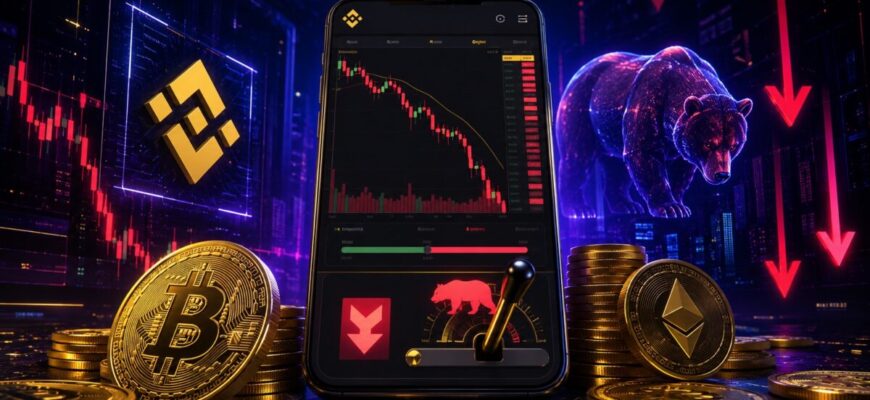
Shorting (a short position) is a bet on a cryptocurrency’s price falling. On Binance, you can short through USDT-M futures (recommended) or margin trading. For Ukrainians in 2026, it is important to understand the context: trading (including futures) is fully available, but since December 2025 direct withdrawals to Ukrainian cards have been stopped — funds are withdrawn via P2P or through a link with a European bank. Maker/taker fees: 0.02-0.04% (that is 5-10 times lower than spot). The main risk is liquidation if the price moves against you. In this guide: a step-by-step BTC short example, profit calculation, how to avoid liquidation, funding rate in simple terms, Ukraine taxes, and alternative exchanges (Bybit, OKX).
Disclaimer: Shorting and futures trading are extremely risky activities. It is possible to lose 100% of invested funds within minutes due to liquidation. This material is for informational purposes only and does not constitute trading advice. Do not trade with money needed for living expenses or emergencies.
- What to know before shorting in 2026
- What Is a Short in Simple Terms
- Everyday Analogy
- Why Short
- What is leverage
- The Main Paradox of Leverage
- Is the short available to Ukrainians
- What works on Binance for Ukrainians in 2026
- What is restricted
- Key point
- How the funnel for Ukrainians actually works in 2026
- Alternative — Zen.com (from January 6, 2026)
- Where is it more convenient for Ukrainians to trade in 2026
- Margin vs Futures
- Margin Trading
- Futures Trading (Futures)
- What to choose in 2026
- How USDT-M Futures work
- Key concepts
- Features of USDT-M Futures
- Types of orders for shorting
- Step-by-step guide
- Scenario
- Step 1: Account setup
- Step 2: Transfer USDT from Spot to Futures
- Step 3: Select a pair
- Step 4: Setting the leverage
- Step 5: Opening a short position
- Step 6: Setting Stop Loss
- Step 7: Setting Take Profit
- Step 8: Monitoring and Closing
- Step 9: Profit Withdrawal
- Profit calculation
- Basic formula
- Example 1: A simple short without leverage
- Example 2: 5x leveraged short
- Example 3: 10x leveraged short (down 5%)
- Example 4: What if the price moves against you (liquidation)
- Liquidation distance formula (simplified)
- Accounting for fees and funding rate
- Liquidation
- What is liquidation
- Liquidation Price — the key number
- How to avoid liquidation
- Cross Margin vs Isolated Margin in Liquidation
- What to do if liquidation is near
- Funding Rate
- In simple terms
- Why funding rate is needed
- How this affects your short
- Real calculation
- Where to check the funding rate
- Shorting Strategies
- Basic Strategy for Beginners
- Technical indicators for shorting
- Short on the bounce strategy
- “Pump and dump short” strategy (for experienced traders)
- Hedging strategy
- Capital Management Rules
- Short sellers’ mistakes
- Error #1: High leverage
- Error #2: No Stop Loss
- Error #3: Averaging the losing position
- Error #4: Short in a Bullish Trend
- Error #5: Ignoring the funding rate
- Error #6: Cross Margin for Beginners
- Error #7: Emotional Trading
- Error #8: Trading on “news”
- Error #9: Not closing a profitable position
- Error #10: Trading Without Understanding
- Error #11: Trading the entire deposit
- Error #12: Ignoring fees
- Alternatives to Binance
- Bybit — the main competitor in 2026
- OKX — a serious alternative
- Bitget — best for copy trading
- MEXC — for altcoin traders
- WhiteBIT — a Ukrainian exchange
- Taxes on shorts
- Current situation in 2026
- Projected rates for individuals
- Features for derivatives (futures)
- What to declare
- For sole proprietors
- Advice for accounting
- Shorting through a European bank
- Scheme for Ukrainians in the EU
- Advantages of the scheme
- Cons
- Frequently Asked Questions FAQ
- Can a Ukrainian short on Binance in 2026?
- Which is more profitable — Binance or Bybit for shorts in 2026?
- What leverage is safe for a beginner?
- What is liquidation price and how do you calculate it?
- Is funding rate a plus or a minus for shorts?
- Cross Margin or Isolated Margin?
- What are the fees on Binance Futures in 2026?
- Can you lose more than your deposit on futures?
- What are USDT-M and Coin-M Futures?
- How do you close a position manually?
- What should you do if the position is in the red?
- Are profits from shorting taxed in Ukraine?
- Can you short using a demo account before real trading?
- What should I do if I get liquidated?
- What starting deposit is needed for shorting?
- Conclusion
What to know before shorting in 2026
The context of 2026 is fundamentally different from what it was 2-3 years ago. If you read guides from 2022-2024, keep these changes in mind:
- Binance is fully available to Ukrainians for trading — futures, spot, and margin work as usual
- Withdrawals to Ukrainian cards were stopped on December 29, 2025 (this is not a trading ban, only on fiat channels to UAH cards)
- Integration with Zen.com launched on January 6, 2026 for EUR/PLN/RON/CZK
- P2P trading on Binance works as usual — the main deposit/withdrawal method
- February 2026 — crypto exchange legalized in Ukraine (including derivatives)
- Taxation of trading profits is being prepared with a preferential rate in the first year
- MiCA in the EU from 2024-2025 — additional requirements for derivatives have appeared for Ukrainians in the EU
- Bybit has become the main alternative player in Ukraine after Binance restrictions
Main point: trading (including shorts) on Binance for Ukrainians works fully in 2026. Only the fiat route has changed — withdrawals now go through P2P or a link with a European bank. But shorting via USDT-M futures is available, just as before.
What Is a Short in Simple Terms
A short (short position, sell, short) is a bet on a price decline. Unlike a regular purchase (“long”), where you profit from a rise, a short makes money when the price falls.
Everyday Analogy
Imagine you borrowed 1 bitcoin from your neighbor when it was worth $100,000. You immediately sold it on the market for those $100,000. A week later, BTC fell to $80,000 — you bought 1 bitcoin for $80,000 and returned it to your neighbor. $20,000 is your profit from the price drop.
That is exactly how shorting works on an exchange, except the exchange acts as the “neighbor” (it lends you cryptocurrency), and everything happens automatically through smart contracts.
Why Short
A short is a trader’s second tool (the first is a long). Without shorting, you only make money on the upside. Shorting gives you the ability to:
- Make money in a falling market — during the 2022 bear trend, when BTC dropped from $69K to $15K, short sellers earned many times more than long traders in any rally
- Hedge your portfolio — if you have 1 BTC in a cold wallet, you can short 1 BTC on futures to “lock in” the price
- Speculate on short moves — sell local peaks and buy back on dips
- Make money in any trend — even in a sideways market through short impulses
What is leverage
Leverage is a multiplier that allows you to trade an amount larger than what you have in your balance.
- Leverage 1x — regular trading without a multiplier
- Leverage 5x — with $100 you can open a $500 position
- Leverage 10x — with $100 → a $1000 position
- Leverage 100x — with $100 → a $10 000 position (but this is very dangerous)
The Main Paradox of Leverage
With leverage, profits increase by the same multiple as losses. This is not a “free” increase in returns; it also increases risk.
Example:
- BTC falls by 10% → your profit at 10x leverage = +100% ✅
- BTC rises by 10% → your loss at 10x leverage = -100% (liquidation!) ❌
On 100x leverage, a price move of just 1% against you is enough to wipe out your entire deposit.
Main rule: The higher the leverage, the smaller the “distance” to liquidation. For beginners, maximum leverage is 2-5x.
Is the short available to Ukrainians
It is a crucial question that most 2024–2025 guides answer with outdated information. Let’s look at the facts:
What works on Binance for Ukrainians in 2026
- Trading (spot, futures, margin) — fully available
- Shorts via USDT-M Futures — available
- Shorts via Coin-M Futures — available
- Margin trading — available
- P2P trading — operating normally
- KYC with a Ukrainian passport — available
What is restricted
- ❌ Direct withdrawals to Ukrainian cards — stopped as of December 29, 2025
- ⚠️ Direct UAH deposits from Ukrainian cards — restricted
- ⚠️ Some fiat methods (UA-specific) — unavailable
Key point
The restrictions apply to fiat UAH channels, not to trading. If you top up Binance via P2P (USDT from another exchange or from a P2P seller), you can fully use futures and short without restrictions.
How the funnel for Ukrainians actually works in 2026
- Hryvnia → USDT via P2P on Bybit or WhiteBIT (see our guide to buying BTC in Ukraine)
- USDT (TRC20) → Binance — standard transfer
- Shorting/trading on Binance Futures
- Profit → USDT on Binance
- USDT → Bybit / Trustee Plus → UAH via P2P
This is a working setup in 2026 that bypasses withdrawal restrictions.
Alternative — Zen.com (from January 6, 2026)
Binance has launched an integration with Zen.com for transactions in EUR, PLN, RON, CZK. If you have a European bank account (N26, Wise, Revolut) or a Polish account (mBank, Santander), you can:
- Withdraw USDT from Binance to EUR via Zen.com
- Receive EUR into your European account
- Optionally convert to UAH via Wise
Where is it more convenient for Ukrainians to trade in 2026
| Exchange | Availability for UA | Feature | Who it suits |
|---|---|---|---|
| Binance | ✅ Trading, P2P | Liquidity leader, but without UAH cards | Experienced traders |
| Bybit | ✅ Full | Became No. 1 for Ukrainians in 2026 | Most users |
| OKX | ✅ Full | Good futures, P2P | An alternative |
| Bitget | ✅ Full | Copy-trading | Beginners |
| MEXC | ✅ Full | Huge list of altcoins | Altcoin traders |
| WhiteBIT | ✅ Full | Ukrainian jurisdiction | Local trust |
If you are just starting out and want minimum hassle — Bybit may be more convenient. If you already have a Binance history and need maximum liquidity — Binance remains No. 1.
Margin vs Futures
On Binance, there are two main ways to short. They work differently.
Margin Trading
What it is: you borrow real cryptocurrency (for example, BTC) from Binance, sell it, then buy it back cheaper and repay the loan.
Features:
- Real crypto is used on loan (not contracts)
- Leverage up to 10x (Cross Margin) or 3-5x (Isolated Margin)
- You pay interest on the loan of cryptocurrency (usually 0.02-0.05% per day)
- You can “forget” about it and hold it for a long time (but interest keeps accruing!)
Pros:
- ✅ You can later receive real cryptocurrency in your wallet
- ✅ Suitable for long-term positions (days to weeks)
Cons:
- ❌ Lower leverage (up to 10x)
- ❌ Accrued interest “eats up” profits
- ❌ Less liquid than futures
Futures Trading (Futures)
What it is: you open a contract (a synthetic instrument) on a price decline. No actual crypto is transferred — everything is in USDT.
Features:
- These are derivatives — synthetic instruments, not the real asset
- Leverage of up to 125x (but that’s insane)
- You pay the funding rate (more on that below)
- Do not accumulate debt — the position is closed = that’s it
Pros:
- ✅ Huge liquidity in BTC, ETH, SOL
- ✅ Low fees (0.02-0.04%)
- ✅ Wide selection of pairs (200+ cryptocurrencies)
- ✅ Convenient for short-term positions
Cons:
- ❌ You won’t receive real crypto
- ❌ High risk of liquidation
- ❌ Funding rate can “eat up” profits on long positions
What to choose in 2026
For most tasks — USDT-M Futures. This is the industry standard, the most liquid instrument with the best conditions. Margin trading only makes sense if you want to receive actual crypto or hold a position for a very long time (months).
In this article, the main focus is on USDT-M Futures as the most practical way to short.
How USDT-M Futures work
USDT-M Futures are perpetual futures contracts on Binance, settled in USDT.
Key concepts
| Term | What it is |
|---|---|
| USDT-M Futures | Futures with USDT margin (settled in USDT) |
| Coin-M Futures | Futures with margin in the crypto itself (for example, BTC) |
| Perpetual contract | A perpetual contract (has no expiration date) |
| Quarterly contract | A quarterly contract (expires on a specific date) |
| Position size | Position size (including leverage) |
| Margin | Collateral (your own money) |
| Leverage | Leverage (multiplier) |
| Liquidation price | Liquidation price (when the position will be closed automatically) |
| Funding rate | Payment between longs and shorts (every 8 hours) |
| PnL | Profit and Loss (current profit/loss) |
Features of USDT-M Futures
- Settlements in USDT — profit/loss is calculated in stablecoins
- No expiration date — you can hold the position for as long as you want
- High liquidity — instant execution even for large orders
- Leverage up to 125x on BTCUSDT, up to 75x on ETHUSDT, up to 50x on others
- Fee: 0.02% maker, 0.04% taker (with BNB discount — 0.018% / 0.036%)
Types of orders for shorting
When opening a short position, you can use:
- Market — open immediately at the current price (recommended for beginners)
- Limit — open when the price reaches the specified level (for experienced users)
- Stop-Limit — open when the price reaches the trigger (for “sell on breakout” tactics)
- TWAP — open a position over time (for large amounts, so as not to move the market)
Step-by-step guide
The most valuable section of the article. Let’s break down a real BTC short from start to finish.
Scenario
- We want to short BTC (we think the price will fall)
- Deposit: $200 in USDT in the futures account
- Leverage: 5x (moderate)
- Stop Loss and Take Profit are required
Step 1: Account setup
Before your first short, make sure:
- ✅ Registration on Binance + KYC completed
- ✅ 2FA enabled via Google Authenticator
- ✅ The spot account has USDT (minimum $200 for normal trading)
- ✅ Read and accepted the futures trading terms (Binance shows a short test)
Step 2: Transfer USDT from Spot to Futures
- Go to Binance Futures (futures.binance.com or the section in the app)
- Click “Transfer” or “Transfer”
- Select: Spot → USDS-M Futures
- Enter the amount (for example, $200)
- Confirm the transfer
Important: USDS-M Futures = USDT-M Futures. Binance market abbreviations are sometimes confused.
Step 3: Select a pair
- On the futures page, select the BTCUSDT Perpetual pair
- This is a BTC-to-USDT perpetual contract
- Make sure it is Perpetual, not Quarterly (if you are unsure, choose Perpetual)
Step 4: Setting the leverage
- At the top of the screen, find “Cross” / “Isolated” and the leverage number
- Select Isolated (isolated margin is safer for beginners)
- Click the current leverage (by default, it is usually 20x)
- Set 5x (moderate leverage)
Cross vs Isolated: Isolated — risk is limited only to this position. Cross — risk extends to the entire futures balance. For beginners — only Isolated!
Step 5: Opening a short position
- On the right side of the screen, find the order block
- Select Market type (instant execution)
- Enter the margin amount: $100 (half of the deposit — we will keep a reserve)
- With 5x leverage, this will be a position worth $500
- Click the red “Sell / Short” button ❗ (NOT the green Long!)
- Confirm the order
Congratulations — you have opened a BTC short for $500 with $100 margin and 5x leverage.
Step 6: Setting Stop Loss
This is an essential step. Without a Stop Loss, one bad day and you lose your deposit.
- In the open positions table, find your short position
- Click “SL/TP” or “Take Profit / Stop Loss”
- Stop Loss: set the price at which the position will automatically close at a loss
- For example: BTC is currently $100 000, set SL = $103 000 (3% against you)
- Maximum loss: $500 × 3% = $15 (15% of margin)
Step 7: Setting Take Profit
- In the same window, specify Take Profit — the price for locking in profit
- For example: set TP = $94,000 (6% in our favor)
- Target profit: $500 × 6% = $30 (30% of the margin)
- Risk/reward ratio = 1:2 (correct)
Step 8: Monitoring and Closing
After opening a position:
- Real-time PnL — see your current profit/loss
- Liquidation Price — displayed next to the position. Don’t let the price get too close!
- Notifications — enable them in the app to receive push alerts when changes occur
The position will close automatically:
- When TP is reached (you are in profit)
- When SL is reached (you are at a loss, but a controlled one)
- When the Liquidation Price is reached (a catastrophe, loss of all margin)
Step 9: Profit Withdrawal
- After closing the position, the profit is credited to the futures account in USDT
- Transfer USDT from Futures → Spot
- Next, withdraw via P2P (for Ukrainians) or Zen.com (for EU accounts)
Profit calculation
Understanding calculations is the main thing that distinguishes a trader from a gambler.
Basic formula
PnL = (Entry price − Exit price) × Position size / Entry priceFor a short: profit when the exit price is lower than the entry price.
Example 1: A simple short without leverage
- Entry price: $100,000
- Exit price: $90,000
- Position size: $1,000 (no leverage)
- PnL: ($100,000 − $90,000) × $1,000 / $100,000 = +$100 (+10%)
Example 2: 5x leveraged short
- Entry price: $100,000
- Exit price: $95,000 (-5%)
- Margin: $100
- Leverage: 5x → position size $500
- PnL: $500 × 5% = +$25 (+25% of margin)
Example 3: 10x leveraged short (down 5%)
- Entry price: $100,000
- Exit price: $95,000 (-5%)
- Margin: $100
- Leverage: 10x → position size $1,000
- PnL: $1,000 × 5% = +$50 (+50% of margin)
Example 4: What if the price moves against you (liquidation)
- Entry price: $100,000 (short)
- Margin: $100
- Leverage: 10x → position size $1,000
Price begins to rise:
- At +1% → loss of $10 (-10% margin)
- At +5% → loss of $50 (-50% margin)
- At +9-10% → LIQUIDATION (loss of the entire $100 margin)
The higher the leverage, the shorter the distance to liquidation.
Liquidation distance formula (simplified)
Distance to liquidation ≈ 100% / Leverage- Leverage 2x → liquidation at +50% (almost never)
- Leverage 5x → liquidation at +20% (rarely)
- Leverage 10x → liquidation at +10% (often)
- Leverage 25x → liquidation at +4% (often!)
- Leverage 100x → liquidation at +1% (instantly!)
Main point: with 100x leverage, even a small price move against you is enough to lose 100% of your deposit. This is not trading, but gambling.
Accounting for fees and funding rate
To calculate profit, you need to add:
- Position opening fee: 0.04% (taker) or 0.02% (maker)
- Position closing fee: 0.04% (taker) or 0.02% (maker)
- Funding rate (if the position is held for more than 8 hours)
For high leverage and short-term trades, fees eat up a significant portion of profits.
Liquidation
Liquidation is every trader’s worst nightmare. Let’s break it down in detail.
What is liquidation
When the loss on a position reaches a crucial level, the exchange automatically closes it — you lose all the margin for that position.
This happens so that the exchange does not incur losses from your position when your collateral runs out.
Liquidation Price — the key number
When opening a position, Binance immediately shows the Liquidation Price — the price at which your position will be “liquidated.”
Example:
- BTC short for $100,000
- 10x leverage
- Liquidation Price ≈ $109,000 (that is, a ~9% rise in BTC = liquidation)
How to avoid liquidation
- Low leverage — 2-5x, no more than 10x for beginners
- Always set a Stop Loss — it closes the position before liquidation with a smaller loss
- Add margin — if the position moves against you, you can add more USDT to push the liquidation price farther away
- Don’t go in with a large amount of capital — allocate 5-10% of your deposit to one position, no more
- Monitor the market — don’t open a trade and then go to sleep for 8 hours
Cross Margin vs Isolated Margin in Liquidation
Isolated Margin (isolated):
- When liquidated, only the margin of this position is lost
- The remaining balance is not affected
- Recommended for everyone
Cross Margin (cross margin):
- When liquidated, the entire futures balance serves as collateral
- A catastrophe is possible — losing all your money
- Only for experienced traders with a well-thought-out strategy
Critical: If you are a beginner — always choose Isolated Margin. This will save you from a catastrophic loss.
What to do if liquidation is near
If a position is close to liquidation (within 1-2% of the liquidation price):
- Don’t panic
- Decide: do you believe in your position or not
- If you do believe — add margin (you will move the liquidation price farther away)
- If you don’t believe — close the position manually (you will lock in a loss smaller than at liquidation)
- Never “average down” — do not open a new position in the same direction
Funding Rate
Funding rate is a periodic payment between long and short traders in the futures market. Understanding this is essential for long positions.
In simple terms
Every 8 hours (at 00:00, 08:00, 16:00 UTC), Binance calculates the funding rate. Depending on its value:
- Funding rate positive (+): long traders pay short traders
- Funding rate negative (-): short traders pay long traders
Why funding rate is needed
This is a synchronization mechanism for aligning the futures price with the spot price. When there are too many longs (a bullish trend), funding is positive, and longs have to pay (which “disincentivizes” them). And vice versa.
How this affects your short
Scenario A: Bull market (BTC is rising)
- Funding rate is usually +0.01% to +0.10% per 8 hours
- As a short seller — you receive a payment every 8 hours
- In a strong bull market, shorting can be “expensive” because of price movement, but funding “offsets” part of it
Scenario B: Bear Market (BTC Falls)
- Funding rate is negative
- As a short seller — you pay a payment every 8 hours
- Can “eat up” profits if the position is held for a long time
Real calculation
- Funding rate: +0.05% per 8 hours
- Your short: size $1000
- Over 8 hours: $1000 × 0.05% = you receive $0.50
- Per day (3 payments): $1.50
- Per week: ~$10
- Per month: ~$45
For long-term shorts in a bull market, funding can be a bonus. In a bear market, it is a tax.
Where to check the funding rate
On Binance Futures, on each pair’s page:
- In real time: “Funding” is displayed next to the price
- History: on the pair page, the “Funding” section
Before opening a long position (1 day+), check the funding rate — it affects the final profit.
Shorting Strategies
Opening a position is not a strategy. A strategy is when to enter, where to place stops, and where to take profit.
Basic Strategy for Beginners
- Trend analysis — on the daily timeframe (D1), identify the main trend
- We go short only in a downtrend (bear market)
- Entry point — on a rebound to resistance (resistance)
- The price rises, reaches the level, and reverses — this is a short signal
- Stop Loss — above resistance (1-3% higher)
- Take Profit — at the nearest support level
- R:R ratio (Risk:Reward) — at least 1:2, preferably 1:3
Technical indicators for shorting
- RSI above 70 (overbought) — a potential reversal zone
- MACD bearish crossover — a bearish signal
- Bollinger Bands — a break above the upper band followed by a return — a short signal
- Divergence — price makes a new high, RSI/MACD do not → a short signal
- Bear Flag, Head & Shoulders — reversal patterns
Short on the bounce strategy
- After a sharp drop, the price usually makes a “bounce” (correction) of 30-50%
- Wait for the bounce to the key resistance level
- Open a short with SL slightly above resistance
- TP — retest of the local low
“Pump and dump short” strategy (for experienced traders)
Not recommended for beginners.
- The altcoin shows abnormal growth of 50–200% in a day/week
- Wait for signs of a reversal (RSI 80+, volumes are declining)
- Open a short position with low leverage (2–3x)
- Attention: altcoins may continue pumping against logic, so a Stop Loss is required
Hedging strategy
- You have 1 BTC ($100K) in your cold wallet
- You think there will be a correction, but you do not want to sell
- You open a short on 1 BTC in futures (1x leverage)
- If BTC falls, the short offsets the loss on your long position
- If BTC rises, the short is in the red, but the physical BTC is in profit
This is the portfolio’s “insurance.”
Capital Management Rules
- No more than 5–10% of your deposit per position
- No more than 20–30% of your deposit in a single asset
- A Stop Loss is required on every position (no exceptions)
- Take Profit — lock in part of your gains in stages (for example, 50% at +5%, with the remainder on a trailing stop)
- Do not try to win back losses after a loss — that is the path to blowing your deposit
Short sellers’ mistakes
After working with thousands of traders, experts identify common mistakes that keep recurring.
Error #1: High leverage
What: a beginner opens a position with 50-100x leverage Why it’s bad: one small move against you — liquidation Solution: 2-5x leverage maximum at the start
Error #2: No Stop Loss
What: “I’ll just see how it goes” without an SL Why it’s bad: one strong breakout and -50% of the deposit Solution: an SL is required on every position
Error #3: Averaging the losing position
What: a position is in the red, and you open another one in the same direction “to average down” Why it’s bad: you double the risk and the loss Solution: never average down in a short against the trend
Error #4: Short in a Bullish Trend
What: BTC is rising, and you short it “because it’s too high” Why it’s bad: in a bull trend, shorts get liquidated one after another Solution: short only in a downtrend or on a clear reversal pattern
Error #5: Ignoring the funding rate
What: hold a short for several days with a negative funding rate Why it’s bad: every 8 hours you “pay” money to long traders Solution: check the funding rate before opening long positions
Error #6: Cross Margin for Beginners
What: you enable Cross Margin “for greater flexibility” Why it’s bad: in the event of liquidation, you lose your entire futures balance Solution: Isolated Margin only for beginners
Error #7: Emotional Trading
What: you open a position out of anger/greed/panic Why it’s bad: emotions = bad decisions Solution: only according to the plan, with a clear head
Error #8: Trading on “news”
What: “Elon Musk tweeted something — short Doge” Why it’s bad: the news is already priced in, and the reaction is unpredictable Solution: trade based on technical analysis, not news
Error #9: Not closing a profitable position
What: position +30%, you wait for even more, the market reverses, result 0 Why it’s bad: fixed profit is real profit Solution: set Take Profit, lock in profits in parts
Error #10: Trading Without Understanding
What: “I shorted it because a blogger said so” Why it’s bad: you don’t understand what you’re doing Solution: study the market, practice on a demo
Error #11: Trading the entire deposit
What: “I’m sure — I’m opening a position with 100% of my deposit” Why it’s bad: one failed trade = the deposit is wiped out Solution: maximum 10% per position
Error #12: Ignoring fees
What: you do not account for 0.04% × 2 (opening + closing) = 0.08% of the position Why it’s bad: over 100 trades, that is -8% to returns Solution: factor it into profitability calculations
Alternatives to Binance
In 2026, Ukrainians have several good alternatives to Binance for shorting.
Bybit — the main competitor in 2026
Why consider it:
- ✅ Works reliably with Ukraine (no restrictions)
- ✅ P2P USDT/UAH with support for Monobank, Privat24
- ✅ Bybit Card for crypto payments
- ✅ High liquidity on top pairs
- ✅ Simple and intuitive interface
- ✅ Copy-trading — you can copy the trades of experienced traders
Cons:
- ⚠️ Fewer trading pairs than Binance
- ⚠️ Fewer altcoins
OKX — a serious alternative
Why consider it:
- ✅ Good futures trading conditions
- ✅ Advanced trading tools
- ✅ Institutional trust
- ✅ Works with Ukrainians
Cons:
- ⚠️ More complex interface
- ⚠️ Less P2P liquidity in UA
Bitget — best for copy trading
Why consider it:
- ✅ Leader in copy-trading — you can earn without any knowledge
- ✅ Good futures
- ✅ Large community
Cons:
- ⚠️ Less well-known in the CIS
MEXC — for altcoin traders
Features:
- ✅ Huge selection of altcoins (1000+)
- ✅ Futures on exotic coins
- ⚠️ Less liquidity on top pairs
WhiteBIT — a Ukrainian exchange
Why consider it:
- ✅ Ukrainian jurisdiction
- ✅ Direct BTC/UAH pair
- ⚠️ Lower liquidity on futures
- ⚠️ Not the primary choice for shorting
Top 2 recommendations for Ukrainians in 2026: Binance (if you already have an account and history, plus P2P for deposits/withdrawals) or Bybit (for those who want to work with Ukraine as smoothly as possible).
Taxes on shorts
From February 2026, crypto exchange is legalized in Ukraine and taxation is being prepared.
Current situation in 2026
- Crypto exchange has been legalized
- Profit taxation is being prepared with a preferential rate in the first year
Projected rates for individuals
| Parameter | Value |
|---|---|
| Personal income tax | 18% |
| Military levy | 5% (from 2024-2025) |
| Total | 23% of profit |
| Preferential first year | possibly ~5-10% |
Features for derivatives (futures)
Shorting via futures is financial derivatives trading, and taxation may differ from spot trading:
- Capital gains tax — only when you withdraw to fiat
- Profit = amount withdrawn to fiat – amount deposited into crypto
- Losses can be taken into account to reduce the taxable base (exact rules are being clarified)
What to declare
Declared:
- Profit from closed positions (after withdrawal to fiat)
- Realized PnL (when the money has been credited to the bank account)
Not declared:
- Open positions (unrealized PnL)
- Exchange-internal transactions (USDT-BTC, USDT-ETH)
For sole proprietors
If you are a Group 3 sole proprietor and trade crypto as a professional activity:
- 5% single tax on turnover (but turnover on futures can be huge — this is risky)
- + unified social contribution + military levy
For trading, an individual with 18% personal income tax is often more advantageous than a sole proprietor.
Advice for accounting
Keep an Excel spreadsheet from the moment of the first transaction:
- Date
- Exchange
- Pair
- Amount (USD/USDT)
- Profit/Loss
- Amount in hryvnia when depositing/withdrawing
This will save dozens of hours when filing your tax return.
Do not ignore taxes. Bank financial monitoring tracks large P2P transactions, and if thresholds are exceeded, you will be asked to explain the source of the funds.
Shorting through a European bank
For professional trading and large amounts ($5000+), the best option is a setup with a European bank.
Scheme for Ukrainians in the EU
- Open N26 (for EU residents) or Wise
- Convert hryvnias → euros via Wise
- Fund Kraken / Bitstamp / Coinbase via SEPA Instant (free, 10 seconds!)
- Trade futures/short on these exchanges
- Withdraw profits to a European bank via SEPA
Advantages of the scheme
- ✅ Low fees for deposits/withdrawals
- ✅ SEPA Instant — free in 10 seconds
- ✅ Regulatory compliance in the EU
- ✅ MiCA compliance — easier taxes in the EU
- ✅ No NBU restrictions
Cons
- ⚠️ Need a European bank account (N26, Wise, Revolut)
- ⚠️ Fewer exchange options (Kraken does not offer all altcoins like Binance)
- ⚠️ For users in the EU, they fall under MiCA regulation (with leverage limits for retail users — usually up to 2-5x on crypto derivatives)
If you have European residency, this is the most professional way to trade. See the detailed guide to SEPA in 2026.
Frequently Asked Questions FAQ
Can a Ukrainian short on Binance in 2026?
Yes. Binance is fully available to Ukrainians for trading (including futures and shorts). Since December 2025, only direct withdrawals to Ukrainian cards have been restricted, but this does not affect trading itself. Deposits and withdrawals now go through P2P or a connection with a European bank (Zen.com, SWIFT). All functions — spot, USDT-M futures, margin, P2P — work as before.
Which is more profitable — Binance or Bybit for shorts in 2026?
It depends on your goals. Binance has the highest liquidity and the most pairs, but requires working around withdrawal restrictions via P2P. Bybit works steadily with Ukraine without restrictions and is more convenient for beginners, plus it has excellent copy-trading. If you trade often and need maximum liquidity — Binance. If you want a smooth experience without complications — Bybit.
What leverage is safe for a beginner?
At most 2-5x. For complete beginners — 1-2x (effectively almost no leverage). 10x leverage is already aggressive. 20-50x leverage is for experienced traders with a strict strategy. 100x+ leverage is no longer trading, but gambling. Remember: the higher the leverage, the smaller the “distance” to liquidation.
What is liquidation price and how do you calculate it?
Liquidation price is the price at which your position will be automatically closed with a loss of all margin. Binance shows it immediately when you open a position. A simplified formula: distance to liquidation ≈ 100% / leverage. For example, at 10x leverage, liquidation occurs with a +/- 10% move against you. At 100x leverage — with +/- 1%. To avoid it, use Stop Loss before the liquidation price.
Is funding rate a plus or a minus for shorts?
It depends on the market. In a bull market (BTC is rising), the funding rate is usually positive — and longs pay shorts every 8 hours. That means as a short seller you receive a payment. In a bear market, funding is usually negative — and shorts pay longs. In highly volatile markets, funding can “eat up” profits on long positions, so always check it before opening a long-term short.
Cross Margin or Isolated Margin?
For beginners — only Isolated Margin. With Isolated Margin, if liquidation happens, only the margin allocated to that specific position is lost, while the rest of the balance remains intact. With Cross Margin, the entire futures balance serves as collateral, and one catastrophic position can liquidate the whole balance. Cross is used only by experienced traders with a well-thought-out hedging strategy.
What are the fees on Binance Futures in 2026?
Standard USDT-M Futures fees: 0.02% maker, 0.04% taker. With a 10% BNB discount, that becomes 0.018% maker, 0.036% taker. At VIP levels (large volumes), fees are reduced further. This is 5 times lower than spot (where it is 0.1%). You pay twice for opening and closing a position: 0.04% × 2 = 0.08% of the full position size.
Can you lose more than your deposit on futures?
In Isolated Margin mode — no. The maximum loss = the margin allocated to that position. In Cross Margin mode, under extreme volatility, a negative balance is theoretically possible (when the exchange fails to liquidate in time), but Binance has an Insurance Fund that covers such losses. In practice, losing more than your deposit is virtually impossible.
What are USDT-M and Coin-M Futures?
USDT-M Futures are futures where margin and settlement are in USDT. Convenient: profit/loss is in a stablecoin. Coin-M Futures are futures where margin is in the cryptocurrency itself (for example, BTC). Profit/loss is in BTC. Coin-M is suitable if you hold a large crypto portfolio and want to hedge without converting to USDT. For most tasks, USDT-M is more practical.
How do you close a position manually?
In the open positions table, find your position → click “Market” in the close column → confirm. The position will close instantly at the market price. You can also close partially by specifying a percentage or amount. If you want to close at a specific price — use a Limit order in the opposite direction (for a short — Buy/Long).
What should you do if the position is in the red?
The solution depends on your strategy: 1) Close — lock in the loss (often the right decision for beginners), 2) Wait — if you are confident in the direction and have enough room before the liquidation price, 3) Add margin — move the liquidation price farther away (but this doubles the risk). Never average down — opening a new position in the same direction while in the red increases the loss many times over.
Are profits from shorting taxed in Ukraine?
Since February 2026, crypto exchange in Ukraine has been legalized, and taxation of profits is being prepared. Standard rate: 18% personal income tax + 5% military levy = 23% of profit. In the first year, a preferential rate (5-10%) may apply. Tax is calculated on realized profit (when the money is withdrawn into fiat), not on open positions. Keep records of transactions from the very beginning.
Can you short using a demo account before real trading?
Yes. Binance offers Mock Trading on futures — a full trading environment with virtual money. It is enabled in the futures settings. Beginners are recommended to make 20-50 trades on demo before real trading to learn the interface, test strategies, and get used to volatility. Bybit also has a demo mode.
What should I do if I get liquidated?
- Do not open a new position immediately — there is a high risk of repeating the mistake, 2) Analyze what went wrong (high leverage? no SL? wrong direction?), 3) Wait 1–3 days — give your emotions time to cool down, 4) Adjust your strategy — reduce leverage, always set an SL, 5) If you lost a significant deposit — shorting may not be for you. That is normal. Long positions and DCA may be more suitable strategies.
What starting deposit is needed for shorting?
The minimum for normal trading is $200-500. With a smaller amount ($50-100), fees will “eat up” a significant portion, and your flexibility will be limited. A realistic comfortable deposit is $1000+. If you are a beginner, start with $200 for learning, an amount whose loss will not be crucial. Never use borrowed money or money you need for living expenses.
Conclusion
Shorting is a powerful trader’s tool that doubles your arsenal. You can profit not only from market growth, but also from market declines. But it is also many times riskier than a regular long trade.
Key takeaways:
✅ Binance is available to Ukrainians in 2026 for trading; only withdrawals to UAH cards are restricted
✅ USDT-M Futures — the industry standard for shorting
✅ 2–5x leverage for beginners, no higher than 10x in the first months
✅ Stop Loss is required on every position
✅ Isolated Margin — the only mode for a beginner
✅ Bybit — the main alternative in 2026, more convenient for UA
✅ Taxes in 2026 — 23%, keep records of your transactions
⚠️ Liquidation = loss of the entire margin — the main danger
⚠️ Funding rate affects long positions
⚠️ Emotions = a blown account — trade according to a plan
Strategy for a beginner:
- Study the theory (this article is a good starting point)
- Open Binance and complete KYC
- Practice on demo (Mock Trading) — 20-50 trades
- Deposit $200-500 for a real test (no more!)
- Open positions with 2-5x leverage, always with a Stop Loss
- Position size — 5-10% of the deposit, no more
- Review your trades — what worked, what didn’t
- Gradually increase your deposit after the first stable results
- Never trade emotionally
Shorting is not quick money. It is a tool for an experienced trader. Most beginners lose their first deposit — that is normal. The main thing is to learn from it, not invest more than you are prepared to lose, and move toward stability step by step.
If you are just starting out in crypto, first read our basic guides: how to buy Bitcoin in Ukraine, what a bull run is. And once you have mastered spot trading, come back to shorts.
Remember: knowledge = money in trading. The more you understand the market, the less you lose and the more you earn.