In brief. A standard SEPA transfer (SCT) is credited by the end of the next business day after the debit. An instant one (SEPA Instant) takes 10 seconds. If the money has not arrived within that time, in 9 out of 10 cases the reason is not that the funds have “disappeared,” but clear explanations: the bank’s cut-off time and weekends, compliance checks, the new recipient name check (Verification of Payee), or an error in the IBAN. The money is almost always traceable. Below, we explain step by step what to check, within what timeframes a transfer can be recalled, and whether SEPA works in Ukraine in 2026.
- How long a SEPA transfer takes
- Why a SEPA Transfer Hasn’t Arrived: Main Reasons
- Compliance checks (AML)
- Verification of Payee — recipient name matching
- Error in the IBAN or reject by the recipient bank
- What to do if a SEPA transfer did not arrive: step by step
- Can a SEPA Transfer Be Canceled
- Does SEPA Work in Ukraine
- Frequently Asked Questions
How long a SEPA transfer takes
The timing depends on the type of transfer. There are two in SEPA, and this is the first thing to understand before panicking.
Standard transfer (SEPA Credit Transfer, SCT). Under the rules of the European Payments Council (EPC), a payment sent before the bank’s cut-off time on a business day must be credited to the recipient no later than the next business day (D+1). In practice, with major banks and fintech services within the eurozone, the credit often arrives on the same day, but the guaranteed maximum is one business day.
Read more: SEPA and SEPA Instant in 2026: what they are, how to make a transfer, limits and processing times
Instant transfer (SEPA Instant, SCT Inst). The money reaches the recipient in less than 10 seconds (up to 20 seconds maximum in exceptional cases). The service operates 24/7, including weekends and holidays. Since January 2025, all eurozone banks are required to accept incoming instant transfers, and from October 2025 — to send them as well, under the EU Instant Payments Regulation (Instant Payments Regulation, 2024/886).
What disrupts these timeframes in practice:
- Cut-off time. Each bank has a cut-off time (usually 14:00–16:00). A transfer sent after it is only processed on the next business day.
- Weekends and holidays. A standard SCT is not processed on Saturday or Sunday. If you send it on Friday evening, the actual crediting may happen on Tuesday.
- Different banks. “By the next business day” refers to the receiving bank’s timeframe for crediting the funds after receipt, not an end-to-end timer starting from the moment you click “Send”.
If less than one full business day has passed since the debit (for SCT), or less than a couple of minutes (for Instant), the transfer is most likely still in progress. This is not yet a reason to contact the bank.
Why a SEPA Transfer Hasn’t Arrived: Main Reasons
When the deadline has already passed but the money has not appeared, the reason is almost always one of the points below. They are sorted roughly by frequency.
| Reason | What happens | Sign |
|---|---|---|
| Cut-off / weekends | The transfer has not yet been processed | Less than 1 business day has passed |
| Compliance check (AML) | The bank requested proof of source of funds | Pending status, email from the bank |
| Name mismatch (VoP) | The recipient’s name did not match the IBAN | Warning when sending |
| Error in IBAN | Incorrect or non-existent account | Return within 1–3 days |
| Rejected by the recipient bank | The account is closed/blocked/does not exist | Funds returned to the sender |
| Instant was not confirmed within 10 sec | The transfer was automatically canceled | The money was returned immediately |
| Recipient outside the SEPA zone | The account is not in euros or is outside the zone | The transfer was rejected when sent |
Let’s go over the key ones.
Compliance checks (AML)
The bank is required by anti-money laundering law to check transactions. If the amount is large, unusual, or the recipient is in a risk zone, the transfer is put on hold (status pending or processing), and the bank may request documents confirming the source of the money. This is routine, but it delays the crediting by hours or days. Check your email: the sending bank or the receiving bank almost always contacts you first.
Verification of Payee — recipient name matching
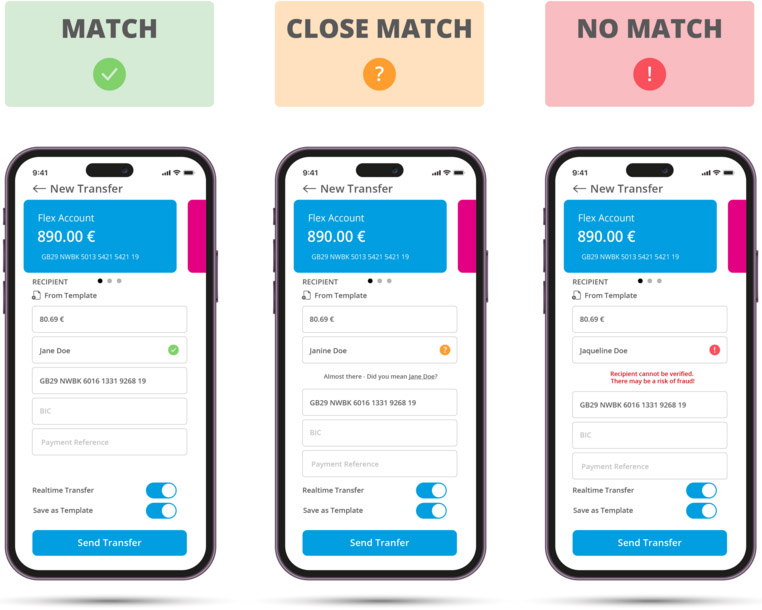
This is the newest and most underestimated reason. Since October 9, 2025, the eurozone has had a required recipient verification process — Verification of Payee (VoP), under EU Regulation 2024/886. Before sending, the bank checks whether the recipient name you entered matches the account holder’s name for that IBAN, and returns one of the following responses:
- Match — match, you can send it.
- Close match — close match, the bank will suggest the correct name.
- No match — the name does not match; there is a high risk of error or fraud.
- Check unavailable — the recipient’s bank is not yet part of the VoP scheme.
VoP is a verification before sending, and it does not “lose” money. But if you ignored a no match warning, the transfer may have been sent to the wrong place, and getting it back will be difficult. A common everyday case is when the recipient provides not their full legal name (as registered with the bank), but an abbreviation or nickname — and VoP consistently returns a mismatch. The solution is to always give the sender the full name or company name exactly as it appears at the bank.
Error in the IBAN or reject by the recipient bank
If the IBAN was entered incorrectly, two scenarios are possible. If the account does not exist, the recipient bank will reject the payment (reject) and return the funds, usually within 1–3 business days after receipt. If the account exists but belongs to someone else, the situation is worse: formally, the transfer “arrived,” just not to the right person. In that case, the recall procedure comes into effect, which is discussed below.
What to do if a SEPA transfer did not arrive: step by step
- Check the timeframe. For SCT — whether a full business day has passed, taking the cut-off time and weekends into account. For Instant — whether more than a couple of minutes have passed.
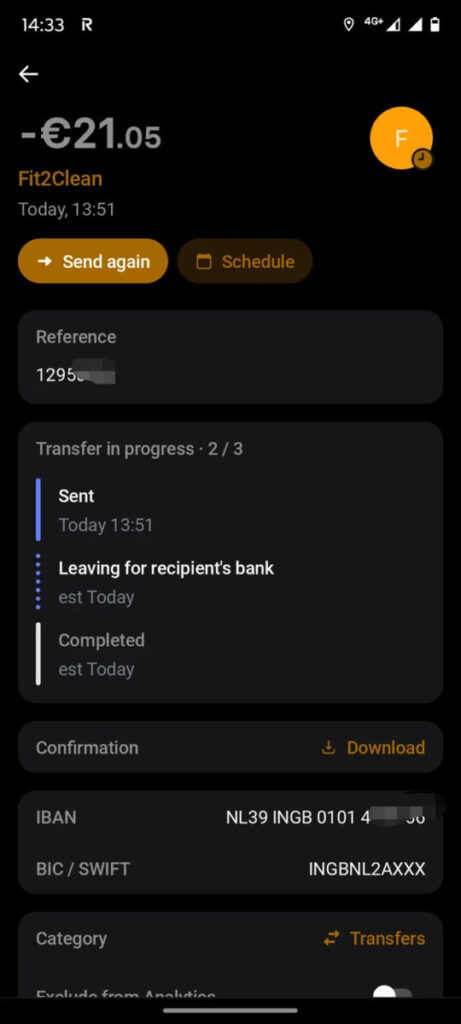
- Check the status in the bank. Find the transfer in your history. The statuses sent / completed and processing / pending mean different things.
- Check your email and push notifications. If there is an AML review, the bank may request documents — without a response, the transfer will remain on hold.
- Verify the details. Check the IBAN character by character and the recipient’s full name. Compare them with what VoP showed when sending.
- Confirm with the recipient. Sometimes the money is already in the account, but it has not yet appeared in their app.
- Contact the sending bank. If the timeframe has clearly expired. This is your starting point: it is the sending bank that initiates the trace (claim) and the return, not the recipient’s bank.
- Request a payment trace. The bank can send a non-receipt inquiry — it has a standard SCT inquiry procedure (within 13 months from the debit date).
Can a SEPA Transfer Be Canceled
Yes, but with caveats — and much depends on whether the money has already settled in the recipient’s account (completed settlement).
Before settlement. As long as the transfer has not entered interbank settlement, it can be canceled — the bank simply voids the payment order. The window is very short: for Instant, it is practically nonexistent; for a regular SCT, only until the payment is sent to clearing.
After settlement — the Recall procedure. Once the money has already been credited to the recipient, it cannot be returned unilaterally. A formal recall is initiated under EPC rules:
- The recall can be initiated only by the sending bank (upon your request), within 10 business days from the transfer execution date.
- In cases of fraud, the period is extended to 13 months.
- A refund is possible only with the recipient’s consent (or that of their bank) — the recipient’s bank cannot debit the funds without grounds and often waits for the client’s approval.
- The recipient’s bank has 15 business days to respond to the request.
- The recipient’s bank may charge a fee for processing the recall.
The main takeaway: the sooner you contact the bank, the higher your chances. Once the bona fide recipient has withdrawn the money, a refund depends on their goodwill rather than any automatic process. SEPA transfers do not have chargebacks like card payments do.
Sent it to the wrong IBAN? Don’t write threatening messages to a “stranger” and don’t wait. Immediately submit a recall request to your bank — time is measured in days.
Does SEPA Work in Ukraine
The direct answer: as of June 2026, Ukraine is not yet a participant in SEPA. Ukrainian banks are not yet connected to SEPA schemes directly, so euro transfers from a Ukrainian bank to the EU still go through SWIFT and correspondent banks — with the usual fees and processing times, rather than “as within Europe.”
What this means in practice right now:
- You can send/receive a standard SEPA transfer only through an account with a bank or payment service within the SEPA zone — for example, through European neobanks and EMIs (Wise, Revolut, and similar services) that have their own European IBAN. Many Ukrainians and sole proprietors use exactly this setup.
- Ukraine already has IBAN for domestic accounts, but that alone does not make a Ukrainian bank a SEPA participant.
Accession status. Ukraine is steadily moving toward membership. The National Bank has signed a memorandum with the European Payments Council, and in December 2025 the government approved a package of draft laws. The Verkhovna Rada is currently considering the main draft law No. 14327 and the alternative No. 14327-1: the relevant committee supported the revised version in April 2026, but the law has not yet been finally adopted — the account register and law enforcement access to it remain disputed. According to optimistic estimates, actual connection may be possible in 2027–2028. For comparison, neighboring Moldova joined SEPA on October 6, 2025.
When Ukraine joins SEPA, euro transfers across the EU will become faster and cheaper (the Ministry of Finance estimates savings of €70–100 million per year), and the same rules will apply to them — including D+1 timelines, VoP, and the recall procedure described above.

Frequently Asked Questions
How long can a SEPA transfer take at most? A standard SCT takes until the end of the next business day after the debit. Taking cut-off times and weekends into account, in the worst case this is 2–3 calendar days. SEPA Instant takes up to 10 seconds.
The transfer is stuck in processing status — is that normal? Yes, if little time has passed or the bank is carrying out a check. If the status does not change for more than one business day, contact the sending bank.
Can I get the money back if I sent it to someone else’s IBAN? You can initiate a recall procedure through your bank within 10 business days (in case of fraud — up to 13 months). However, the return will require the recipient’s consent, and there is no guarantee. Act as quickly as possible.
Why did the bank show “recipient name does not match”? This is the Verification of Payee check (required in the eurozone from October 2025). Most often, the reason is that the account holder’s name was entered incompletely or inaccurately. Ask the recipient for their name exactly as it appears at the bank.
Will SEPA work in Ukraine? Yes, this is planned. The legislation is in the process of being adopted, with 2027–2028 as the target timeframe. For now, Ukrainians use SEPA through European accounts and EMIs.
The material is for informational purposes only and does not constitute financial or legal advice. Rules and timeframes may vary by bank — please check with your payment institution. Sources: EPC scheme rulebooks (SCT and SCT Inst Rulebook), EU Regulation 2024/886 (Instant Payments / Verification of Payee), materials from the Ministry of Finance of Ukraine, and bill card No. 14327. The information is current as of June 2026.