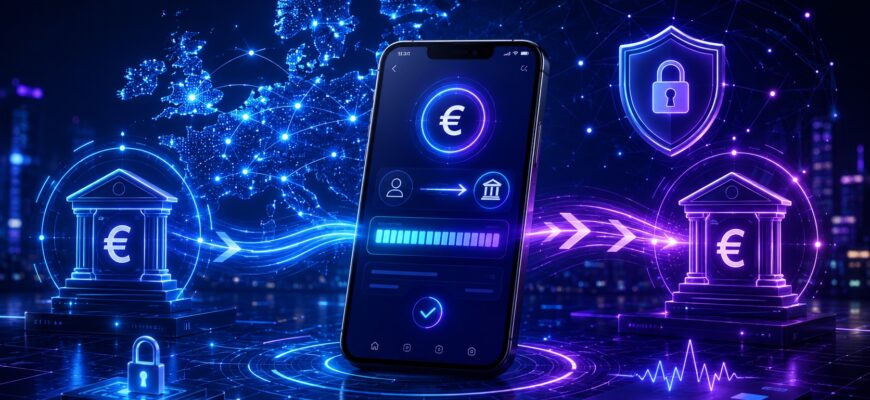
SEPA (Single Euro Payments Area) is a unified European euro transfer system covering 36 countries. SEPA Instant is its instant version: funds arrive within 10 seconds, 24/7/365. Since October 9, 2025, SEPA Instant has become required for all eurozone banks — they can no longer charge more for an instant transfer than for a regular one, and the €100,000 limit has been removed. Also, from October 2025, Verification of Payee (VoP) came into effect — a recipient name verification system before a transfer that helps protect against fraud.
Disclaimer: The material is for informational purposes only. Specific fees, limits, and processing times may vary between banks and depend on your pricing plan. Before making a large transfer, always check the latest information in your banking app.
- What’s New in SEPA in 2024–2025
- What Is SEPA: A Complete Definition
- A simple analogy
- Who created SEPA
- Key features of SEPA
- Which countries are part of SEPA
- 27 EU countries:
- 4 non-EU countries (EEA and associated members):
- 5 microstates and territories:
- Types of SEPA Transfers
- 1. SCT (SEPA Credit Transfer) — classic transfer
- 2. SCT Inst (SEPA Instant Credit Transfer) — instant transfer
- 3. SDD (SEPA Direct Debit) — direct debit
- SEPA vs SEPA Instant: key differences
- Practical example
- SEPA vs SWIFT: what to choose in 2026
- When is SWIFT needed even within Europe?
- How long does a SEPA transfer take?
- SCT (standard SEPA)
- SCT Inst (instant SEPA)
- Why does the translation sometimes take longer?
- SEPA Fees in 2026
- For individuals (within SEPA):
- For business (B2B):
- Incoming transfers
- SEPA transfer limits
- Technical SEPA limit in 2026:
- Limits of specific banks:
- Revolut:
- N26:
- Wise:
- Paysera:
- Verification of Payee (VoP)
- How it works
- Why this is needed
- Examples of use
- Important nuances:
- How to Make a SEPA Transfer: Step-by-Step Guide
- Step 1: Gather the recipient’s details
- Step 2: Open the app and select transfer
- Step 3: Enter the IBAN
- Step 4: Enter the name and amount
- Step 5: Review and confirm
- Step 6: Wait for confirmation
- Features of other banks:
- SEPA in Revolut, Wise, N26, and Paysera: Comparison
- Best use cases:
- SEPA for Ukrainian Sole Proprietors and Individuals
- What options do Ukrainians have in 2026:
- Scenario: A sole proprietor receives payment from the EU
- What sole proprietors need to know:
- Military Tax and Sole Proprietors
- What Are IBAN and BIC
- IBAN (International Bank Account Number)
- BIC (Bank Identifier Code) / SWIFT
- IBAN or BIC: Which Is More Important?
- Common mistakes
- 1. A one-digit error in the IBAN
- 2. Incorrect recipient name
- 3. Transfer after the cut-off time
- 4. Sending a non-EUR amount
- 5. Incorrect payment purpose
- 6. Exceeding the bank’s limit
- 7. Transfer to a sanctioned country
- What to do if the transfer has not arrived
- SEPA Instant did not arrive within 10 seconds?
- Has a regular SCT not arrived within 2–3 days?
- Did the transfer go to the wrong place?
- Security of SEPA Transfers
- What protects SEPA in 2026:
- How to protect yourself:
- Top scam schemes of 2026:
- Frequently Asked Questions (FAQ)
- What is SEPA in simple terms?
- How long does a SEPA transfer take in 2026?
- What is the difference between SEPA and SEPA Instant?
- Which countries are part of SEPA?
- What is Verification of Payee (VoP)?
- How much does a SEPA transfer cost in 2026?
- What is the SEPA Instant limit in 2026?
- What is an IBAN and how can you find it?
- Can a Ukrainian use SEPA?
- Which is the best bank for SEPA transfers?
- How is SEPA different from SWIFT?
- What should you do if a SEPA transfer has not arrived?
- Can a SEPA transfer be canceled?
- Are SEPA transfers safe?
- Can you send money to Russia or Belarus via SEPA transfer?
- Which is better for sending money to Europe — SEPA or Wise?
- Conclusion
What’s New in SEPA in 2024–2025
If the last time you read about SEPA was a couple of years ago, a lot has changed:
- October 9, 2025 — SEPA Instant became compulsory for all eurozone PSPs (Regulation 2024/886, deadline under Article 5 of the regulation)
- The €100,000 limit on SEPA Instant has been removed — you can now send any amount
- The price of SEPA Instant cannot be higher than for a regular SEPA transfer — no more extra charges for “instant”
- Verification of Payee (VoP) — required verification of the recipient’s name before the transfer
- Non-bank PSPs (Revolut, Wise, Paysera) gained access to TARGET — they are now full participants
- For non-euro EU countries, the deadline is October 9, 2027 (Poland, the Czech Republic, Sweden, etc.)
- The UK and Switzerland — there is no compulsory deadline (they are not part of the EU/EEA), but many banks have already joined voluntarily
Main point: if SEPA Instant used to be an “option” that could cost €0.50–1.00, it is now the new standard for European transfers. Any bank that does not support Instant in 2026 is a sign to switch to a competitor.
What Is SEPA: A Complete Definition
SEPA (from the English Single Euro Payments Area — the Single Euro Payments Area) is a unified European standard for bank transfers in euros. It allows euros to be sent between accounts in 36 countries just as easily as within a single country — with the same rules, timeframes, and (often) fees.
A simple analogy
Imagine you live in Lviv and want to transfer money to a friend in Odesa — it is simple, fast, and usually free. Before 2008, to transfer €100 from Germany to France, you had to go through a complicated international procedure: high fees, filling out SWIFT forms, and waiting 3–5 days. SEPA made such transfers within Europe just as simple as “sending money to a friend in the next city over.”
Who created SEPA
The system was created by the European Payments Council (EPC), a non-profit organization of European banks. The system was launched in 2008 and became required for all eurozone banks in 2014.
Key features of SEPA
| Feature | Value |
|---|---|
| Currency | Euro only (EUR) |
| Geography | 36 European countries |
| Account identifier | IBAN (International Bank Account Number) |
| Additional | Bank BIC/SWIFT code (often optional) |
| Speed | Standard — up to 1 business day, Instant — 10 seconds |
| Fee for individuals | Often €0 (depends on the bank) |
| Recipient protection | From 10/2025 — Verification of Payee (VoP) |
| Transfer limit | Up to €999,999,999 (effectively no limit) |
Which countries are part of SEPA
As of 2026, SEPA includes 36 countries:
27 EU countries:
Austria, Belgium, Bulgaria, Hungary, Germany, Greece, Denmark, Ireland, Spain, Italy, Cyprus, Latvia, Lithuania, Luxembourg, Malta, the Netherlands, Poland, Portugal, Romania, Slovakia, Slovenia, Finland, France, Croatia, the Czech Republic, Sweden, Estonia
4 non-EU countries (EEA and associated members):
Iceland, Liechtenstein, Norway, as well as Switzerland (participates in SEPA on the basis of bilateral agreements without being an EEA member)
5 microstates and territories:
Andorra, Vatican City, Monaco, San Marino, the United Kingdom (remained in SEPA after Brexit as a “third country”)
Important: Ukraine, Russia, Belarus, Moldova, Georgia, and Turkey are not part of SEPA. If you receive money from these countries into a European account, it will be an international SWIFT transfer with different fees and processing times. However, Ukrainians can use SEPA through European neobanks (Revolut, Wise, N26, Paysera, ZEN) opened in their name.
Types of SEPA Transfers
In 2026, there are three main SEPA schemes:
1. SCT (SEPA Credit Transfer) — classic transfer
The oldest and most widely used type of SEPA. A standard credit transfer between euro accounts.
- Speed: up to 1 business day (in practice, often a few hours)
- Operating hours: only on business days and during bank working hours
- Limit: up to €999,999,999
- Use: regular payments, salary, bill payments
2. SCT Inst (SEPA Instant Credit Transfer) — instant transfer
Launched in November 2017 by the European Payments Council. The main type of transfers in 2026.
- Speed: up to 10 seconds (in practice, usually 2–5 seconds)
- Operating hours: 24/7/365 — around the clock, including weekends and holidays
- Limit: as of October 2025 — removed (previously €100,000)
- Use cases: instant payments, paying for goods, transfers between freelance platforms
3. SDD (SEPA Direct Debit) — direct debit
Allows the recipient to withdraw money from your account based on a previously granted mandate. Used for recurring payments.
- Speed: 2–5 business days
- Types: Core (for individuals) and B2B (for legal entities)
- Use cases: utilities, subscriptions, insurance, memberships
- Protection: chargeback available within 8 weeks
Most users use SCT and SCT Inst. SDD is mainly relevant for businesses and recurring payments.
SEPA vs SEPA Instant: key differences
| Parameter | SCT (standard) | SCT Inst (instant) |
|---|---|---|
| Speed | Up to 1 business day | Up to 10 seconds |
| Available on weekends | ❌ No | ✅ Yes, 24/7 |
| Transfer limit | Up to €999,999,999 | From 10/2025 — no limit |
| Fee | Usually €0 for individuals | From 10/2025 — no higher than SCT |
| Availability in 2026 | All SEPA banks | Required for all eurozone banks |
| Verification of Payee | ✅ Required from 10/2025 | ✅ Required from 10/2025 |
| When to choose | Scheduled payments | Urgent, weekend, instant |
Practical example
Scenario: on Friday evening, you urgently need to pay €5000 for a service in Germany.
- SCT: the money will only be sent on Monday morning and will arrive by Tuesday. Time lost — 3 days.
- SCT Inst: the money will reach the recipient within 10 seconds, on Friday evening. The service is received immediately.
That is why in 2026, Instant is becoming the new standard, while regular SCT is an outdated option for non-time-sensitive transactions.
SEPA vs SWIFT: what to choose in 2026
This is the most common question. In short: within Europe — SEPA, for other countries — SWIFT.
| Parameter | SEPA | SWIFT |
|---|---|---|
| Geography | 36 European countries | Worldwide (200+ countries) |
| Currency | EUR only | Any currency |
| Speed | 10 seconds (Instant) — 1 day | 1–5 business days |
| Fee | Often €0 | $10–50+ per transfer |
| Hidden fees | No | Correspondent banks (OUR/BEN/SHA) |
| Bank details | IBAN + (BIC) | Account number + SWIFT/BIC + bank address |
| Transparency | Full | Difficult to track |
| When to use | EUR transfers in Europe | Non-EUR currencies, non-European countries |
When is SWIFT needed even within Europe?
- A transfer in USD, GBP, CHF — even between European accounts — goes via SWIFT
- A transfer to a non-SEPA country (for example, from Germany to Turkey)
- Corporate payments with special requirements (LC, collection)
How long does a SEPA transfer take?
SCT (standard SEPA)
- Within one country: often several hours, max — the next business day
- Between SEPA countries: usually 4-12 hours on a business day
- On weekends: processing only on Monday
- Cut-off time: each bank has its own (usually 14:00-17:00) — after this time, the transfer will be sent only the next day
SCT Inst (instant SEPA)
- Guaranteed: up to 10 seconds (regulator requirement)
- In practice in 2026: usually 2-5 seconds
- Operating hours: 24/7/365 — no weekends, holidays, or cut-off times
- Condition: both banks must support SCT Inst (from 10/2025 — all eurozone banks are required to do so)
Why does the translation sometimes take longer?
- Cut-off times — sent after 17:00? Wait until morning
- Weekends and holidays — Europe has many non-working days (Catholic Christmas, Easter, local holidays)
- Compliance checks — AML, sanctions screening (usually automatic)
- Suspicious activity — a large amount, a new recipient = manual review
- Switzerland — formally in SEPA, but sometimes slower (separate currency CHF)
SEPA Fees in 2026
For individuals (within SEPA):
| Bank / Service | SCT | SCT Inst |
|---|---|---|
| Revolut Standard | €0 | €0 |
| Revolut Premium/Metal/Ultra | €0 | €0 |
| N26 Standard | €0 | €0 (from 10/2025) |
| N26 You/Metal | €0 | €0 |
| Wise | €0 (from EUR balance) | €0 |
| Paysera | €0.30-0.50 | €0.40-0.80 |
| Bunq | €0 | €0 |
| ZEN | €0 | €0 |
| Monobank (EUR account) | €0 (incoming) | — |
The key rule for 2026: if your bank charges a higher fee for SEPA Instant than for a regular SCT, this is a violation of the Instant Payments Regulation. You can file a complaint with the national regulator.
For business (B2B):
- Revolut Business: from €0 to €0.20 per transfer (depends on the plan)
- N26 Business: €0 for the basic plan
- Wise Business: €0.31-0.39 per SEPA transfer
- Paysera Business: €0.30-0.80 per SEPA transfer
Business accounts usually have limits on free transfers (for example, the first 10/100/500 per month), after which a fee is charged for each one.
Incoming transfers
For most banks, incoming SEPA transfers are free, regardless of the amount. This applies to Revolut, N26, Wise, Bunq, and ZEN. Paysera may charge €0.30 for an incoming transfer.
SEPA transfer limits
Technical SEPA limit in 2026:
- SCT (standard): up to €999,999,999 (effectively no limit)
- SCT Inst (instant): discontinued as of October 2025 — previously €100,000
Limits of specific banks:
The actual limits are set by the banks themselves, depending on verification and the plan.
Revolut:
- SEPA (outbound): up to €100,000 per transaction
- UK outbound: up to £250,000 per payment
- Limits can be increased through KYC and document verification
N26:
- Incoming SEPA: up to €100,000 per transaction
- Outgoing SEPA (standard): up to €10,000 per day, can be increased in settings
- SEPA Instant: configurable personal limit in the app (as of 10/2025)
- MoneyBeam (P2P between N26 users): €1,000
Wise:
- SEPA from the EUR balance: no amount limit
- Card transactions: their own limits (depend on the plan)
Paysera:
- Basic SEPA: €15,000 per transaction for unverified users
- Verified account: up to €100,000 and above
Tip: before a large transfer (>€10,000), check the limits in your app and, if necessary, complete additional verification in advance — this can save you several hours.
Verification of Payee (VoP)
This is the main innovation of 2026. From October 9, 2025, all Eurozone banks must verify the recipient’s name before a transfer.
How it works
When you enter the recipient’s IBAN in a banking app, the system automatically sends a request to the receiving bank and compares the name you entered with the account holder’s name. The result is displayed using three signals:
- 🟢 Green: the name matches completely — you can send it
- 🟡 Yellow: the name matches partially — be careful, check the spelling
- 🔴 Red: the name does not match — a high risk of error or fraud
Why this is needed
VoP is protection against APP-fraud (Authorised Push Payment fraud) — a scam in which the victim is persuaded to send money to the fraudster themselves. According to EU statistics, before VoP these schemes were generating fraudsters billions of euros per year.
Examples of use
Case 1 — successful transfer:
- You enter the IBAN: DE89 3704 0044 0532 0130 00
- Name: Hans Müller
- VoP responds: 🟢 “Name matches”
- The transfer is completed in 10 seconds
Case 2 — fraud detected:
- A scammer sent an “invoice” with an IBAN
- Name by IBAN: John Smith
- You entered: Microsoft Ireland Operations
- VoP responds: 🔴 “Names do not match”
- You realize that this is fraud
Important nuances:
- 🌍 Does not work outside the eurozone — the UK, Switzerland, non-EU banks
- 🕐 Non-euro EU countries (Poland, Czechia, Sweden) — VoP will become required from October 9, 2027
- 🏢 For legal entities — VoP checks the company name
- ⚖️ A yellow signal does not block the transfer — it is a warning
Tip: even with a green VoP, do not let your guard down. Scammers can create accounts with the correct name. VoP is additional protection, not a cure-all.
How to Make a SEPA Transfer: Step-by-Step Guide
I’ll show you using Revolut as an example — the most popular fintech service for Russian- and Ukrainian-speaking audiences.
Step 1: Gather the recipient’s details
You will need:
- Recipient’s IBAN (for example, DE89 3704 0044 0532 0130 00)
- Recipient’s name — exactly as in the bank records
- BIC/SWIFT code (optional for SEPA) — for example, COBADEFFXXX
- Payment reference — description (for example, “Invoice #1234”)”
Step 2: Open the app and select transfer
- Open Revolut → tap “Send”
- Select “Bank transfer”
- Or find the recipient directly in the list of previous ones
Step 3: Enter the IBAN
- Enter the recipient’s IBAN with or without spaces — the system will accept either format
- Revolut will automatically determine:
- The bank’s country
- The transfer type (SEPA or SWIFT)
- Instant availability
- Select the type: SEPA Instant (if available) or regular SEPA
Step 4: Enter the name and amount
- Enter the recipient’s full name — exactly as it appears at the bank (including capitalization and special characters)
- Revolut will make a VoP request and display the result (🟢/🟡/🔴)
- Enter the amount in EUR
- Add the payment reference
Step 5: Review and confirm
- Check all the details on the final screen
- Tap “Send”
- Confirm with Face ID / Touch ID / PIN
Step 6: Wait for confirmation
- SEPA Instant: a notification will arrive within a few seconds
- Standard SCT: the money has been sent and will reach the recipient within the business day
Features of other banks:
- N26: similarly, in the “Send Money” section → “Bank Transfer”. From October 2025, you can set a personal limit for SEPA Instant
- Wise: via the “Recipients” section → create a recipient → select “Send money”
- Paysera: via “Make a payment” → select the “SEPA” or “SEPA Instant” type
Tip: if you are making a transfer to a new recipient for the first time, send a small amount first (for example, €1) to verify the details. This is standard practice for large transfers.
SEPA in Revolut, Wise, N26, and Paysera: Comparison
| Parameter | Revolut | N26 | Wise | Paysera |
|---|---|---|---|---|
| Country IBAN | LT (Lithuania) | DE (Germany) | BE (Belgium) | LT (Lithuania) |
| SEPA SCT | ✅ Free | ✅ Free | ✅ Free | €0.30-0.50 |
| SEPA Instant | ✅ Free | ✅ Free (from 10/2025) | ✅ Free | €0.40-0.80 |
| Licence | Bank licence (LT) | Bank licence (DE) | EMI (not a bank) | EMI |
| Deposit protection | Up to €100,000 (BoL) | Up to €100,000 (BaFin) | Safeguarded, without BaFin | Up to €100,000 (BoL) |
| Available to Ukrainians | ⚠️ With restrictions | ✅ Yes (for EU residents) | ✅ Yes | ✅ Yes (including sole proprietors) |
| SEPA transfer limit | €100,000 | €10,000/day | No limit | €15-100,000 |
| Multi-currency | 36+ currencies | EUR (US$ for premium) | 40+ currencies | 25+ currencies |
| Business account | ✅ Revolut Business | ✅ N26 Business | ✅ Wise Business | ✅ Paysera Business |
Best use cases:
- Revolut — an all-rounder, best for multi-currency transactions and travel
- N26 — the only one of the four that is a fully fledged bank with a German license, best for living in the EU
- Wise — best for frequent international transfers and real mid-market exchange rates
- Paysera — best for Ukrainian sole proprietors and freelancers (supports Lithuanian IBAN + understands CIS-specific needs)
Learn more about choosing a bank in our article “Revolut, Wise, N26, Monzo: Which Bank to Choose in 2026” and our review of Paysera for Ukrainians.
SEPA for Ukrainian Sole Proprietors and Individuals
This is the most important section for our audience. Ukraine is not directly part of SEPA, but Ukrainians (especially sole proprietors) actively use SEPA through European neobanks.
What options do Ukrainians have in 2026:
- Paysera is the most popular choice for sole proprietors. A Lithuanian EMI that supports Ukrainian entrepreneurs.
- Wise is excellent for freelancing and receiving salaries from the EU/US
- N26 is only for those who live in the EU (requires an EU address and residency)
- Revolut Business can be opened for a Ukrainian sole proprietor, but there are limitations
- Monobank EUR is a Ukrainian bank with support for incoming SEPA transfers to a euro account
Scenario: A sole proprietor receives payment from the EU
Suppose you are a programmer registered as a sole proprietor under Group 3, and a client from Germany wants to pay you €5000.
Option A — via Paysera:
- The client sends a SEPA Instant transfer to your Paysera IBAN
- The money arrives within 10 seconds
- You convert it to hryvnia at the Paysera exchange rate or withdraw it to a Ukrainian account
- Fee: €0.30-0.50 for SEPA + conversion fee
Option B — via Wise:
- The client sends a SEPA transfer to your Wise EUR balance
- The money arrives within minutes
- You convert it to UAH at the real exchange rate (mid-market rate)
- You withdraw to a Ukrainian card via Wise → SEPA → Privat/Mono/etc.
Option B — via Ukrainian Monobank EUR:
- Open a euro account with Monobank
- The client sends a SEPA transfer — it will arrive within 1–2 business days
- Monobank fee: free incoming transfer up to a certain amount
- The money goes straight to a Ukrainian bank — convenient for sole proprietor reporting
What sole proprietors need to know:
- Taxes: all transfers from abroad are subject to taxation (5% single tax + USC)
- NBU currency control: incoming payments from €400 may require the payment purpose to be specified
- Payment purpose: always specify “Payment for services according to invoice #…” — without this, the bank may delay the transfer
- Limit for sole proprietors on Group 3: in 2026 — UAH 9,336,000 (~€220,000) per year
- SBU filter: banks automatically check senders against sanctions lists — funds from Russia/Belarus will be blocked
Military Tax and Sole Proprietors
From December 1, 2024, a 1% military tax has been introduced for sole proprietors (for Group 3), while for individual entrepreneurs in Groups 1–2 it is a fixed payment. Take this into account in your calculations.
Tip for sole proprietors: keep income records in hryvnias using a Monobank/Privat statement — this is more convenient for tax accounting. The EUR→UAH conversion must be recorded with the date and exchange rate.
What Are IBAN and BIC
IBAN (International Bank Account Number)
IBAN is an international bank account number format created specifically for SEPA and international transfers. It makes it possible to clearly identify the recipient’s account in any country.
IBAN structure:
DE89 3704 0044 0532 0130 00
│  │ │                  │
│  │ └── BBAN (Basic Bank Account Number)
│  └──── Check digits
└─────── Country code (ISO 3166-1)
Examples of IBAN lengths:
| Country | Code | Length | Example |
|---|---|---|---|
| Germany | DE | 22 | DE89 3704 0044 0532 0130 00 |
| France | FR | 27 | FR14 2004 1010 0505 0001 3M02 606 |
| Italy | IT | 27 | IT60 X054 2811 1010 0000 0123 456 |
| Lithuania | LT | 20 | LT12 1000 0111 0100 1000 |
| Poland | PL | 28 | PL61 1090 1014 0000 0712 1981 2874 |
| United Kingdom | GB | 22 | GB29 NWBK 6016 1331 9268 19 |
BIC (Bank Identifier Code) / SWIFT
BIC (also known as a SWIFT code) is 8 or 11 characters that identify a specific bank.
Example: COBADEFFXXX
- COBA — bank code (Commerzbank)
- DE — country (Germany)
- FF — location (Frankfurt)
- XXX — branch (optional, for the main office)
IBAN or BIC: Which Is More Important?
- IBAN is required for all SEPA transfers
- BIC is optional for SEPA within the EU/EEA (since 2014, the “IBAN-only” rule)
- BIC is required for SWIFT transfers and non-SEPA transactions
Most recipient banks in 2026 accept transfers by IBAN only, especially for Instant. But when filling out invoices, it is better to include both for compatibility.
Common mistakes
1. A one-digit error in the IBAN
What happens: the transfer may go to the wrong place or be returned. Modern systems check IBAN control digits, but mistakes still happen.
How to avoid it: copy the IBAN, do not enter it manually. Use verification via iban.com.
2. Incorrect recipient name
What happens: VoP will show a 🔴 red signal. The transfer will not go through or will go through with risk.
How to avoid it: ask the recipient for the exact spelling of the name as it appears at the bank (including patronymic for some countries).
3. Transfer after the cut-off time
What happens: a regular SCT will only be sent the next day.
How to avoid it: use SEPA Instant (there are no cut-off times) or plan transfers in advance.
4. Sending a non-EUR amount
What happens: the bank will automatically convert it, causing you to lose money on the exchange rate and fees.
How to avoid it: before a SEPA transfer, move funds to a EUR balance via Wise/Revolut with a minimal fee.
5. Incorrect payment purpose
What happens: the recipient bank (especially in Ukraine) may request additional documents or return the payment.
How to avoid it: for sole proprietors, always specify “Payment for services according to invoice #XXX dated YYYY-MM-DD”. For a gift/loan repayment — “Gift” or “Loan repayment”.
6. Exceeding the bank’s limit
What happens: the transfer will not go through or will get stuck in manual review.
How to avoid it: check the limits in the app before making a large transfer. If necessary, split it into several transactions.
7. Transfer to a sanctioned country
What happens: the transfer will be blocked; account freezing and an investigation are possible.
How to avoid it: do not send SEPA transfers to accounts in Russia, Belarus, Iran, North Korea, and other sanctioned jurisdictions.
What to do if the transfer has not arrived
SEPA Instant did not arrive within 10 seconds?
Since October 2025, this is a regulatory violation. What to do:
- Wait 1 minute — there can sometimes be delays in compliance checks
- Check the status in the sender’s app
- Contact the recipient’s bank — they may have a processing issue
- File a complaint with the national regulator (BaFin for Germany, NBP for Poland, FCMC for Latvia, etc.)
Has a regular SCT not arrived within 2–3 days?
- Request a statement from the sender — it will contain the TRN (transaction reference number)
- Provide the TRN to the recipient bank — they will initiate a trace
- If the transfer was returned — the money will be sent back to the sender within 1–3 days
- If it is delayed — the banks can initiate a payment investigation (a paid inquiry, €15–30)
Did the transfer go to the wrong place?
This is the most painful situation. Steps:
- Notify the bank immediately — every minute counts
- Submit a recall request — the sending bank will ask the receiving bank to return the money
- Be prepared for the recipient to refuse — if the money has already been withdrawn, getting it back is difficult
- In case of fraud — contact the police + the bank
- Remember VoP — if VoP showed 🔴, the bank may share responsibility
Important: unlike SDD (direct debit), a regular SEPA transfer does not have an automatic chargeback. If the money has been sent, it can only be returned with the recipient’s consent.
Security of SEPA Transfers
What protects SEPA in 2026:
✅ Verification of Payee (VoP) — recipient name verification
✅ Sanctions screening — automatic screening against sanctions lists
✅ AML monitoring — monitoring of suspicious activity
✅ 2FA in banking apps — required for all transfers
✅ SCA (Strong Customer Authentication) — biometrics + PIN
✅ Limits on large amounts — require additional verification
How to protect yourself:
- Never give anyone your banking password or SMS codes — not even the bank’s “security team”
- Always verify the recipient’s IBAN — especially for invoices from new counterparties
- Do not make SEPA transfers to unknown accounts — this is exactly how scammers collect money
- Enable push notifications for all transactions
- Use a separate account for large transactions
- Enable 2FA through an app, not SMS (SMS can be intercepted)
- Do not ignore 🔴 VoP — this is a serious signal
Top scam schemes of 2026:
- CEO Fraud — a fake email from “management” asking you to urgently send a SEPA transfer
- Invoice Fraud — replacing the IBAN in genuine invoices (the hacker compromises the email account)
- Pig Butchering — a prolonged “relationship” and persuasion to invest
- Fake Bank Calls — calls from the “security department” asking you to confirm a transfer
- Romance Scam — a scammer “falls in love” and asks for a SEPA transfer for a “ticket to visit you”
Read more about security in our article “How KYC and Biometrics Work”.
Frequently Asked Questions (FAQ)
What is SEPA in simple terms?
SEPA (Single Euro Payments Area) is a unified European euro payment system covering 36 countries. It allows you to send euros between accounts in these countries as easily as within a single country — under the same rules, with low fees (often €0 for individuals), and fast processing times (up to 10 seconds via SEPA Instant).
How long does a SEPA transfer take in 2026?
SEPA Instant takes up to 10 seconds (in practice usually 2–5 seconds) and works 24/7/365. Standard SEPA SCT takes up to 1 business day, but only during the bank’s working hours. Since October 9, 2025, SEPA Instant has become required for all eurozone banks, so most transfers now arrive instantly.
What is the difference between SEPA and SEPA Instant?
The main difference is speed and availability. SEPA Instant takes up to 10 seconds around the clock (24/7/365), including weekends and holidays. Standard SEPA SCT takes up to 1 business day and works only during bank business hours. Since October 2025, the price of SEPA Instant cannot be higher than standard SEPA — this is a requirement of the Instant Payments Regulation.
Which countries are part of SEPA?
SEPA includes 36 countries: all 27 EU countries, the EEA countries (Iceland, Liechtenstein, Norway), Switzerland, the United Kingdom (after Brexit), as well as the microstates of Andorra, Vatican City, Monaco, and San Marino. Ukraine, Russia, and Belarus are not part of SEPA.
What is Verification of Payee (VoP)?
Verification of Payee (VoP) is a recipient name verification system that has been required since October 9, 2025, before a SEPA transfer. When you enter an IBAN, the bank automatically checks the account holder’s name against what you entered and shows the result: green (match), yellow (partial match), or red (no match). This protects against fraud and mistakes.
How much does a SEPA transfer cost in 2026?
For individuals at most banks (Revolut, N26, Wise, Bunq, ZEN), both types of SEPA cost €0. Paysera charges €0.30–0.80 depending on the plan. For businesses, fees can range from €0 to €0.50 per transfer. Important: since October 2025, a bank is not allowed to charge more for SEPA Instant than for standard SEPA.
What is the SEPA Instant limit in 2026?
Since October 2025, the technical limit for SEPA Instant has been removed — it used to be €100,000. Now you can send any amount. However, your bank may set its own limit: Revolut — €100,000 per transaction, N26 — €10,000 per day (can be increased), Paysera — up to €100,000 after verification.
What is an IBAN and how can you find it?
IBAN (International Bank Account Number) is the international bank account number format required for all SEPA transfers. The length of an IBAN depends on the country: 22 characters for Germany, 27 for France, 20 for Lithuania. You can find your IBAN in your banking app (usually in the “Account details” or “Bank details” section).
Can a Ukrainian use SEPA?
Yes. Ukraine is not directly part of SEPA, but Ukrainians can use SEPA through European neobanks: Paysera (the most popular for sole proprietors), Wise, and Revolut Business. Ukrainian Monobank also accepts incoming SEPA transfers to a euro account. The main thing is to comply with NBU currency regulations and pay taxes.
Which is the best bank for SEPA transfers?
It depends on your needs: Revolut is the best all-round option and great for travel, N26 is ideal for living in the EU (German banking license), Wise is best for frequent international transfers at the real exchange rate, and Paysera is well suited for Ukrainian sole proprietors and entrepreneurs. All four support SEPA Instant from October 2025.
How is SEPA different from SWIFT?
SEPA works only in EUR and only across 36 European countries, but it is faster (up to 10 seconds via Instant) and almost always free. SWIFT works in any currency and any country worldwide, but it is slower (1–5 days), more expensive ($10–50+), and comes with non-transparent correspondent bank fees. Within Europe for EUR, use SEPA; for other currencies or countries, use SWIFT.
What should you do if a SEPA transfer has not arrived?
If a SEPA Instant transfer has not arrived within 1 minute, this is a breach of the regulator’s requirement — contact the sending or receiving bank. If a standard SCT has not arrived within 2–3 business days, request the TRN (transaction reference number) from the sender and provide it to the receiving bank for tracing. As a last resort, the banks can initiate a payment investigation.
Can a SEPA transfer be canceled?
No, once sent, a SEPA transfer cannot be canceled — especially SEPA Instant, which is credited within 10 seconds. You can only submit a recall request through your bank, which will ask the receiving bank to return the money, but the recipient may refuse. That is why you should always check the payment details before sending, especially if there is a VoP warning.
Are SEPA transfers safe?
Yes, SEPA transfers are a safe, regulated way to move money in Europe. In 2026, protection has become stronger thanks to VoP (recipient verification), required 2FA/biometrics, and automatic AML monitoring. The main risks are fraud involving IBAN substitution in invoices and social engineering. Never share your passwords or SMS codes with anyone.
Can you send money to Russia or Belarus via SEPA transfer?
No. Russia and Belarus are not part of SEPA, and EU sanctions also block most transfers to these countries. Attempting to send a SEPA transfer to an account in Russia or Belarus will lead to a block and an investigation. Transfers to these countries use alternative systems, often through third-country jurisdictions.
Which is better for sending money to Europe — SEPA or Wise?
Wise works through SEPA, so it is not an alternative but a way to use SEPA. Wise is a fintech service that lets you hold a multi-currency balance and convert currencies at the real exchange rate. If you have a EUR balance in Wise, sending via SEPA will be free and fast. If you need conversion (USD→EUR→SEPA), Wise is often more cost-effective than traditional banks thanks to its fair exchange rate.
Conclusion
In 2026, SEPA has become the gold standard for European transfers. Since October 9, 2025, instant transfers in 10 seconds are the new normal, not a premium option. Verification of Payee protects against fraud, the removal of the €100,000 limit opens SEPA Instant to large transactions, and the end of extra charges for Instant has made the system truly mainstream.
Key takeaways for users:
✅ Always choose SEPA Instant if it is available — this is the new standard
✅ Do not pay extra for Instant — this violates the regulatory requirement
✅ Trust VoP, but verify everything — especially when dealing with new counterparties
✅ For Ukrainian sole proprietors — Paysera, Wise, or Monobank EUR are three workable options
✅ Do not send a SEPA transfer without confirming the payment details — canceling a transfer is almost impossible
✅ Use app-based 2FA, not SMS
If you are not yet using fintech services with SEPA Instant support, now is the best time to start. In 2026, standard SEPA transfers taking 1–2 days look like a relic of the past.